
Who Is the U.S. Talking To?The Questions Behind the Iran Peace Talks
ARTICLE ORIGINALLY APPERAED IN AUTHOR'S SUBSTACK ACCOUNT. IRAN USA PEACE
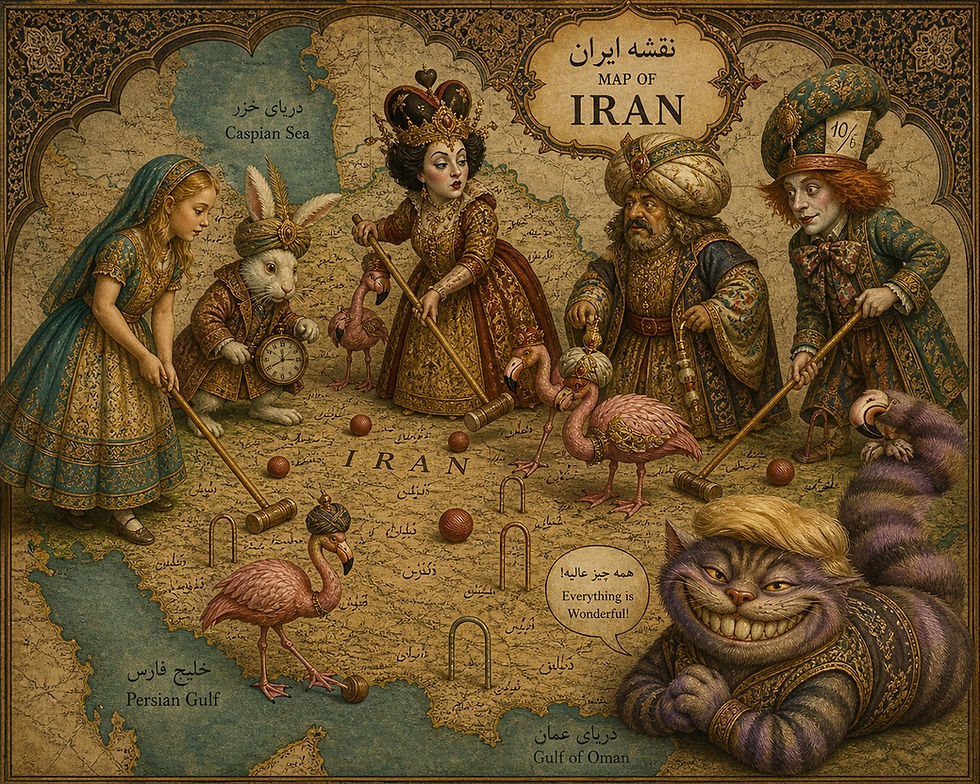
As negotiations continue between the United States and Iran, one of the most important questions remains largely unanswered: Who exactly is Washington negotiating with?
Officially, the talks are presented as standard diplomacy between governments. Yet the reality inside Iran’s power structure is likely far more complicated. Reports indicate proposals and counterproposals are moving through regional intermediaries, with Pakistan, Oman, Qatar, Egypt, and Turkey all connected in various ways to the negotiation process. (reuters.com)
But “Iran” is not a single unified actor.
There is the formal state bureaucracy and the foreign ministry. There are clerical institutions and commercial elites trying to preserve economic stability. And then there is the Islamic Revolutionary Guard Corps (IRGC), whose influence stretches across Iran’s military, intelligence, economic, and political systems.
That distinction matters because it may determine whether these negotiations represent a genuine attempt at stabilization, a temporary operational pause, or a struggle between competing factions inside Iran itself.
The Western media often frames diplomacy as if there is one coherent Iranian actor sitting across the table from Washington. In practice, there may be several overlapping power centers competing simultaneously. This may explain why the Trump administration’s public messaging has often appeared internally contradictory. At various times Washington has threatened renewed military action, hinted at political transition inside Iran, expressed support for Iranian civilians, and simultaneously pursued negotiations through official Iranian channels.
The contradiction may not actually be contradiction at all. It may reflect an attempt to separate “Iran the nation” from “Iran the security regime.”
The central problem is that the IRGC is not merely a military organization. Over decades it has evolved into something far larger: part military force, part intelligence service, part economic conglomerate, and part political enforcement structure. In many ways it operates as one of the dominant governing institutions inside the country.
This creates a dilemma for negotiators. If Washington negotiates through official Iranian institutions, it may still effectively be negotiating with structures heavily influenced by the IRGC. Yet if the United States refuses to engage with the existing state apparatus entirely, there may be no functioning authority capable of enforcing a ceasefire, implementing maritime agreements, or maintaining control over nuclear infrastructure.
That may explain why the talks remain so opaque. The ambiguity may not be accidental.
The negotiations are also taking place under the shadow of the Strait of Hormuz crisis, where media narratives increasingly portray Iran as “controlling” the Strait. In reality, Iran retains the ability to threaten and disrupt shipping traffic, particularly in routes nearest its coastline, but that is different from uncontested military control of the waterway itself.
Still, the perception of control carries political value. Iranian media benefits domestically and regionally from projecting an image of strength against the United States and its allies. Yet excessive triumphalism may carry risks of its own.
Unlike Washington, Israel does not necessarily operate under the same political or economic constraints. The United States must balance congressional oversight, alliance management, global energy stability, maritime insurance concerns, and the risk of broader escalation. Israel’s strategic calculus is often narrower and more immediate.
If Israeli leadership concludes that negotiations are merely buying time for IRGC recovery, missile regeneration, or nuclear reconstitution, it is entirely possible that Israel could decide to act independently regardless of Washington’s broader diplomatic goals. In that sense, Iranian declarations of victory may inadvertently increase the risk of unilateral Israeli escalation.
One of the more overlooked possibilities is that the Trump administration may not actually be pursuing outright regime collapse. A shattered Iranian state could produce exactly the type of instability Washington wishes to avoid: militia fragmentation, refugee crises, unsecured nuclear material, and long-term regional chaos.
Instead, the United States may be attempting something far more difficult: weakening or fracturing the coercive security apparatus while preserving enough state continuity to prevent total collapse.
That possibility would explain the strange mixture of military pressure, sanctions, indirect diplomacy, maritime operations, and repeated references to a future Iran beyond the current crisis.
It would also explain why it has become so difficult to determine who the United States is actually talking to.
Because the answer may be that Washington is speaking to several different groups at the same time — some attempting to preserve the Iranian state, others attempting to preserve the regime, and perhaps some already thinking about what comes after both.
The real question may not be whether peace talks are occurring. The real question is whether anyone inside Iran still possesses enough authority to guarantee that any agreement reached today will still matter tomorrow.

Comments