
Through the Iranian Looking Glass: Is Iran America’s Friend and Enemy at the Same Time?
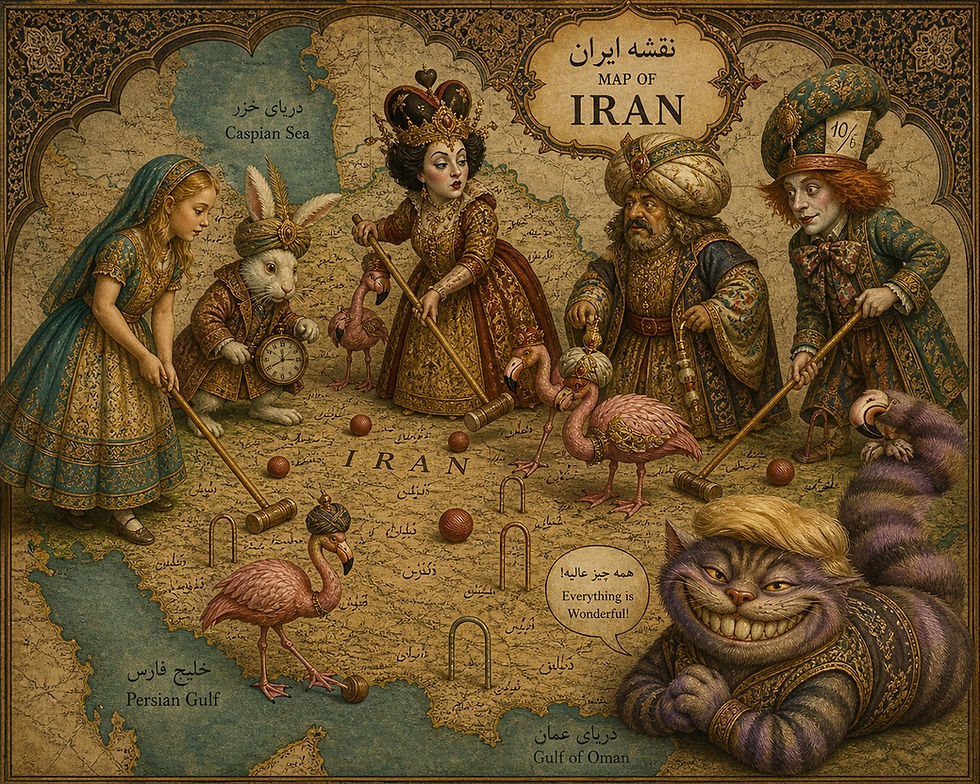
“Contrariwise, if it was so, it might be; and if it were so, it would be; but as it isn't, it ain't. That's logic.” Tweedle Dum and Dee, Alice in Wonderland, L. Carroll.
For nearly half a century, American policy toward Iran has been built around a simple assumption: Iran is a strategic adversary to be contained, sanctioned, deterred, and, when necessary, confronted militarily. From the 1979 revolution onward, Tehran’s leadership has defined much of its foreign policy in opposition to Washington, while institutions such as the Islamic Revolutionary Guard Corps have grown into powerful military, political, and economic actors with influence well beyond Iran’s borders. On its face, the relationship is straightforward—two rivals locked in a long struggle for regional advantage.
But geopolitics is rarely that simple.
A closer look at the developing confrontation in the Strait of Hormuz suggests that Washington’s strategy may be more layered than either its critics or supporters fully appreciate. Publicly, the United States has applied pressure—tightening sanctions, contesting maritime access, challenging illicit shipping networks, and establishing escorted transit operations intended to reopen commercial movement through one of the world’s most vital energy chokepoints. Yet there is another possibility quietly emerging beneath the surface: that America may be applying pressure selectively—not to permanently cripple Iran as a nation, but to separate destabilizing power centers from the parts of the Iranian state that could eventually be drawn back into a more stable regional order.
If that sounds contradictory, consider the economics of the moment.
Iran’s greatest national asset remains its oil wealth. Long-term damage to fields, infrastructure collapse, or forced abandonment of productive wells would create consequences lasting decades—not only for Iran, but for world energy markets and regional stability. It would create refugee pressure, invite black-market networks, deepen outside influence from powers such as China and Russia, and turn Iran from a pressured state into a broken one. Broken states rarely become peaceful states. More often, they become incubators for prolonged instability.
That opens the door to a strategic hypothesis: what if Washington’s pressure campaign is designed not to destroy Iran’s economic future, but to preserve it under different political conditions?
Under that interpretation, controlled movement of stored Iranian crude, limited allowances that prevent catastrophic field damage, or quiet financial mechanisms that preserve national productive capacity would not be concessions—they would be strategic tools. They would communicate a very specific message: America’s quarrel is not necessarily with Iran’s existence as a functioning state, but with the coercive networks, regional militancy, and destabilizing behaviors that have defined much of its posture.
Which brings us to an even larger question: who exactly is Washington negotiating with?
Official statements from both sides often speak in broad terms—“Iran,” “the regime,” “the government,” “Washington,” “the United States.” But states are not monoliths. Inside Iran exist overlapping centers of power: clerical authority, political leadership, commercial interests, technocratic ministries, military institutions, intelligence services, and patronage networks tied to the Revolutionary Guard. Some of those actors may be committed to ideological confrontation. Others may simply be trying to preserve state continuity, economic viability, and their own place in whatever comes next.
It is possible that Washington understands this and is watching actions—not speeches—to determine who truly governs.
Shipping behavior. Proxy restraint or escalation. Port operations. Financial compliance. Quiet diplomatic contacts through third parties. Responses to economic pressure. All of these become signals. In that sense, the United States may not be negotiating with “Iran” as popularly understood, nor directly with the most militant factions inside it, but instead probing for pragmatic actors capable of making decisions rooted in survival rather than ideology.
If so, Iran becomes a strategic paradox.
It remains an adversary in military and political terms—challenging freedom of navigation, threatening regional partners, and resisting American influence. Yet parts of the Iranian state may simultaneously represent a possible future negotiating partner, a preserved economic asset, and even—under altered conditions—a stabilizing actor in Gulf energy security.
Through that looking glass, Iran is both enemy and potential partner at once.
Not friend in the traditional sense. Not ally. Perhaps not even trustworthy. But possibly something more complicated: a state Washington may seek to pressure, divide, reshape, and eventually reintegrate—while breaking the coercive structures that made confrontation inevitable in the first place.
The true contest may not be whether America defeats Iran.
It may be whether America can determine which Iran survives.


Comments