
The Mystery of the Vanishing CoalWhat Balochistan’s Coal Trade May Tell Us About the Economics of Insurgency
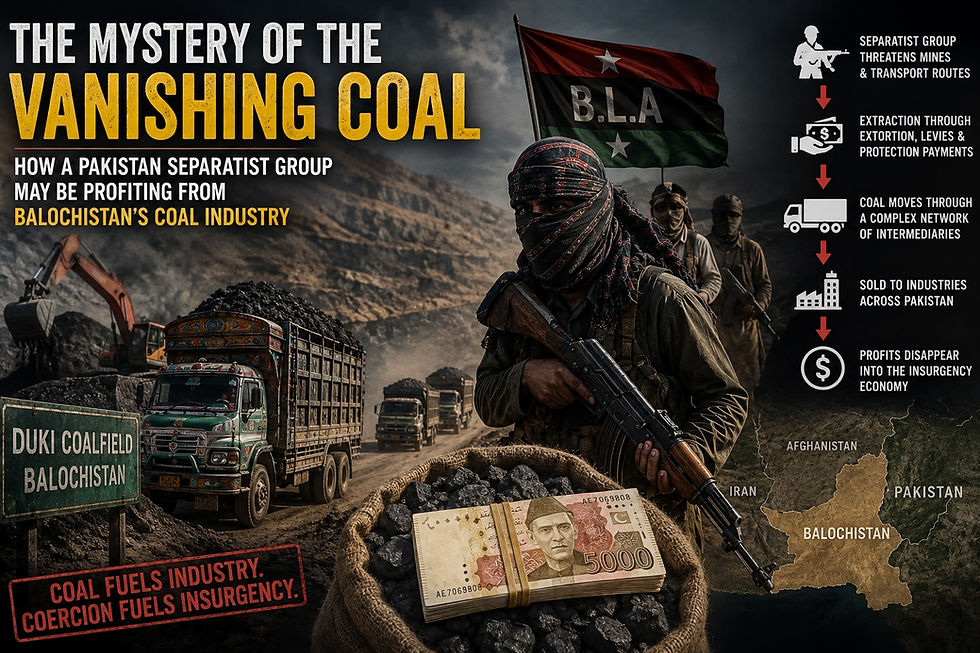
IS IT INSURGENCY OR ORGANIZED CRIME?
Pakistan has a mineral problem, but perhaps not quite the one it appears to have.
Balochistan contains some of Pakistan’s most important undeveloped mineral resources, including major copper and gold deposits, along with substantial reserves of coal and natural gas. Islamabad increasingly sees those resources as part of Pakistan’s economic future and is actively seeking greater foreign investment in their development.
Standing in the way is a resurgent Baloch separatist insurgency.
A recent analysis by the Armed Conflict Location & Event Data Project (ACLED) of violence surrounding Balochistan’s extractive industries paints an increasingly troubling picture. ACLED recorded more than 130 attacks directly associated with extractive operations during the preceding three years. Yet the geography of those attacks is particularly revealing. Most did not occur inside mines themselves. More than two-thirds of attacks connected with extraction occurred during transportation, and 89 percent of those associated with mineral mining took place along roads.[1]
Militants have attacked trucks, established temporary roadblocks and checkpoints, and in some instances demanded money for passage. ACLED reports that gunfire has frequently been directed at vehicles, sometimes disabling trucks that were subsequently burned. Fewer than 17 percent of documented roadside attacks involved bombs or landmines, leading ACLED to characterize much of the activity as intended to generate instability rather than simply maximize casualties.[2]
Attribution requires care. Not every attack against Balochistan’s coal industry can be attributed to the Baloch Liberation Army (BLA), and the BLA specifically denied responsibility for the October 2024 massacre of coal miners in Duki.[8]This article therefore distinguishes documented Baloch separatist or militant activity from hypotheses specifically concerning the BLA.
The violence nevertheless raises an economic question deserving considerably more attention:
Where does the money come from?
Coal provides an especially useful place to start.
Unlike narcotics, gemstones, currency or other compact commodities commonly associated with illicit financing, coal is extraordinarily difficult to hide. It moves by the tonne. Producing it requires mines, workers and machinery. Moving it requires trucks, drivers, fuel and roads. Selling significant quantities requires brokers, industrial purchasers, storage facilities and ultimately customers capable of consuming it.
Coal does not disappear into someone’s jacket pocket.
If Balochistan’s coal economy provides income to armed separatists—whether through extortion, protection payments, transportation levies, sympathetic businesses, commercial intermediaries or mechanisms not yet publicly identified—then somewhere between the mine and the furnace there should be a physical and financial trail.
That does not mean the BLA necessarily owns coal mines or operates fleets of trucks. Nor does it mean legitimate Pakistani companies purchasing Balochistan coal knowingly finance militants. Indeed, the opposite possibility may be more interesting: an insurgent organization may not need to control the commodity at all.
It may only need influence over the environment through which the commodity moves.
Nothing that follows should be read as an allegation that particular Pakistani companies, officials, coal purchasers, transporters or industrial consumers are participating in illicit activity. This analysis combines documented conditions in Balochistan with mechanisms observed in other conflict zones, organized-crime environments and commodity markets to develop testable hypotheses about how an armed organization might extract value from otherwise legitimate commerce.
Coal provides an unusually good commodity with which to test those hypotheses because whatever else may vanish along the way—the identity of an intermediary, the purpose of a payment, the origin of a surcharge or the beneficiary of a transaction—millions of tonnes of coal cannot simply disappear.
Somebody mines it, somebody moves it, somebody buys it, and eventually somebody burns it.
The investigation should begin by following the coal.
Follow the Coal
Balochistan’s coal industry is sufficiently large to leave a substantial physical trail.
Government of Balochistan production statistics list approximately 542,000 tonnes from Duki, 439,000 tonnes from Harnai, 136,000 tonnes from Chamalang and approximately 487,000 tonnes from the Quetta area, with the displayed provincial figures totaling roughly 1.66 million tonnes.[3]
Much of that coal moves by road.
In June 2023, representatives of the Balochistan Goods Transport Association and Coal Suppliers Association reported that armed men had stopped and damaged 42 trucks carrying coal from the Harnai and Duki coalfields toward Punjab and other parts of Pakistan.[4] In November 2024, another attack involved coal trucks traveling from Chamalang toward Punjab.[5] The following month, police were guarding trucks carrying Duki coal toward Punjab when their convoy was attacked.[6]
The coal, in other words, does not disappear into an unidentified foreign market. Documented movements show production from Balochistan entering Pakistan’s broader domestic commercial system.
That system involves mines, coal traders, trucking companies, weigh stations, warehouses, purchasing departments and industrial consumers. Each participant potentially creates records. Mines record production. Trucks carry manifests. Buyers issue purchase orders. Loads are weighed. Coal may be sampled and graded. Payments are made. Industrial consumers record fuel purchases and consumption.
That gives investigators two trails to follow.
The first is physical:
Mine → coal trader → transporter → industrial purchaser → stockpile → furnace.
The second is financial and generally runs in the opposite direction:
Purchaser → supplier → transporter/intermediaries → mine operator.
Under ordinary circumstances, those trails should broadly correspond.
The difficulty is that numerous legitimate intermediaries can stand between producer and consumer. A trader may purchase from several mines and aggregate production. A transporter may subcontract individual trucks. A broker may stand between the mine and industrial consumer. Coal from different sources and of different qualities may be blended.
None of this is inherently suspicious.
It does mean that an investigation into insurgent financing should not begin and end with mine ownership.
A large industrial plant purchasing Balochistan coal may have no direct relationship with the mine that produced it. The plant may purchase from a legitimate supplier aggregating coal from multiple operators. That supplier may separately contract transportation, while individual truck owners operate through brokers. Several commercial relationships may separate the furnace from the coalfield.
The final buyer can therefore be entirely legitimate while knowing remarkably little about every transaction occurring upstream.
If an armed organization extracts money from a mine operator, transporter or local intermediary, the ultimate industrial consumer does not necessarily need to know anything about it.
The coal remains legitimate coal.
The factory receives fuel.
Somewhere upstream, however, another payment may have occurred.
Who Actually Buys It?
The downstream purchasers matter not because they should automatically be suspected of wrongdoing, but because they provide investigators with the opposite end of the transaction.
Pakistan’s coal-trading sector supplies power generation, cement manufacturing and other industrial consumers.[9]Starting with those consumers, an investigator can work backward.
Who supplied the coal? Where did the supplier obtain it? Who transported it? What did transportation cost? Which mine or coalfield produced it? What grade was purchased? What grade was delivered? How much was paid? How many intermediaries stood between producer and consumer?
There is another important question:
Was the apparent buyer actually the consumer?
Commodity traders routinely purchase and resell material. A company appearing on paper as the purchaser of a large coal shipment may therefore be another intermediary rather than the furnace in which the coal is ultimately burned.
The distinction between the paper buyer and the ultimate consumer could prove important.
Coal Has a Fingerprint
Coal also provides investigators with another advantage: not all coal is the same.
Its commercial value depends upon characteristics including calorific value, ash, sulfur and moisture. Buyers do not simply purchase tonnes of something called coal. They purchase fuel expected to satisfy particular specifications.
That creates another trail.
A purchasing contract specifies a quality. The supplier identifies an origin. A laboratory may certify the delivered material. A weighbridge records the quantity. The industrial consumer eventually records fuel consumption.
Those records will not match perfectly. Coal is naturally variable, sampling is imperfect, and blending different grades is a legitimate industrial practice.
But over sufficiently large quantities, patterns can emerge.
The investigation therefore should not merely ask where the coal traveled.
It should ask whether its paper value remained reasonably consistent with its physical value.
The Protection-Racket Hypothesis
Perhaps the BLA does not need to control the coal.
Perhaps it needs only to convince the people who control the coal that doing business without accommodating local coercive power carries a price.
This is the protection-racket hypothesis.
Available evidence does not establish that the BLA operates a comprehensive protection system over Balochistan’s coal industry. ACLED documents militants establishing temporary checkpoints, interfering with commercial transportation and sometimes demanding payment for passage. It also documents extensive violence surrounding extractive industries.[2]
Those facts do not establish an organized BLA taxation system.
They provide sufficient reason to ask whether one could be developing.
The distinction matters because a protection economy requires considerably less military capability than territorial control. An insurgent organization attempting to seize and hold a major mine must overcome the forces protecting it. An organization attempting to dominate large stretches of territory requires manpower, logistics and the ability to withstand government counterattack.
A protection racket requires something different.
It requires credibility.
The organization must demonstrate sufficient intelligence, access and armed capability to impose costs upon businesses that refuse to accommodate it. Once demonstrated often enough, the threat itself begins doing much of the work.
This principle is familiar from organized crime. A protection racket does not succeed because the organization destroys every business that refuses to pay. If it did, eventually there would be no businesses left from which to collect money.
Occasional coercion establishes the credibility of the threat. Commerce then continues.
The objective is not to kill the goose.
It is to collect the golden eggs.
Violence as a Price Signal
An attack has two potential effects.
The first is physical: one truck is disabled or destroyed.
The second is informational: hundreds of other drivers, mine operators, brokers and transportation companies learn that another truck could be attacked.
The second effect may ultimately be more economically consequential.
Once businesses begin changing behavior because of what might happen, an armed organization no longer needs to attack every shipment. Risk itself becomes part of the transaction.
The relevant measure of insurgent power may therefore not simply be how many fighters an organization can field or how much territory it can physically control.
Another measure is how much commercial uncertainty those fighters can generate.
The Most Successful Tax May Be the Least Visible
If some form of protection economy exists, investigators should not necessarily expect a crippling tribute.
Such a demand would be economically self-defeating. Mines would close, transporters would abandon routes, purchasers would find alternative supplies and investors would go elsewhere.
A sustainable coercive system would instead have an incentive to extract an amount businesses could tolerate.
In a high-volume commodity business, even a relatively small recurring payment could become meaningful to an armed organization without making the underlying industry uneconomic.
This article does not claim that the BLA charges such a levy. The point is that investigators searching only for spectacular payments could miss a more sustainable model.
The financially important transaction may be precisely the one small enough to disappear into ordinary operating expenses.
A transporter charges more for operating on a dangerous route. A contractor adds another expense. A broker incorporates another margin. A mine operator treats an informal payment as necessary to avoid disruption.
By the time the coal reaches an industrial consumer hundreds of miles away, whatever happened upstream may simply appear as the delivered cost of coal.
At that point, an extraordinary payment has begun becoming ordinary overhead.
When the Coal Doesn’t Match the Invoice
There is another complication.
Even if the BLA is extracting money from Balochistan’s coal economy, there is no reason to assume it would be the only participant interested in exploiting opacity within the system.
Coal markets present opportunities for something much older than insurgency:
Corruption.
Commodity markets elsewhere demonstrate that the mechanism is not fanciful.
Reporting by the Financial Times based upon documents obtained by the Organized Crime and Corruption Reporting Project alleged in 2024 that lower-calorific-value Indonesian coal purchased by an Adani company had subsequently been sold to an Indian state-owned utility as substantially higher-grade fuel. Adani strongly denied wrongdoing and maintained that the shipments had passed multiple independent quality checks.[10]
In another case, Indian police reported uncovering an alleged coal-adulteration operation in Rajasthan involving the diversion of higher-value imported coal and substitution with lower-grade material, with truck drivers and traders allegedly participating.[11]
Neither case tells us anything about whether similar activity occurs in Balochistan.
They establish something narrower but important:
Coal quality, transportation, blending and documentation can be exploited financially.
Coal is particularly susceptible to this type of manipulation because its value depends upon more than weight. Different grades command different prices, and industrial purchasers legitimately blend coals to achieve a desired combination of price and performance.
Blending itself is entirely legitimate.
But whenever price depends upon characteristics that must be sampled, measured and certified, the possibility exists for the paper description of a commodity to diverge from what physically arrives.
A Hypothetical Procurement Scheme
Consider a purely hypothetical government-owned industrial facility or power plant authorized to purchase a specified quantity and grade of coal.
The government pays for that specification.
Now suppose someone responsible for procurement discovers that substantially cheaper, lower-grade coal can be obtained through an intermediary. Some higher-grade coal is delivered, cheaper material is blended with it, and the plant continues operating.
Trucks arrive. Weighbridge records show tonnage. The stockpile grows. The boiler continues burning fuel.
Nothing has physically vanished.
But if the entire delivery is invoiced as the more expensive specification, a difference has emerged between the actual value of the coal and its invoiced value.
That difference creates the investigative question:
Who captured it?
It might be an ordinary corruption scheme involving suppliers and purchasing officials. It might involve a broker, transporter or laboratory employee. Or, in a conflict economy, an armed organization possessing influence over producers, transporters or intermediaries could theoretically become another participant.
There is no evidence presented here that the BLA participates in such a scheme.
The important point is that the mechanism exists independently of the insurgency. An insurgent organization would not need to invent it. It would merely need to discover that its access, relationships or coercive power had something commercially valuable to offer participants already willing to manipulate the system.
Corruption Does Not Require Shared Ideology
A corrupt purchasing official does not have to support Baloch separatism. A BLA intermediary does not have to approve of corruption inside a Pakistani enterprise. A coal broker does not have to care about either one’s political objectives.
The relationships can be entirely transactional.
A militant controls access. A businessman controls coal. A transporter controls movement. A laboratory employee controls a quality certificate. A procurement official controls a purchase order.
No participant needs to control the entire chain.
Each controls a gate, and each gate can potentially acquire a price.
This is why investigators should resist assuming that every irregularity discovered in the coal economy must originate with the BLA. Ordinary commercial corruption may exist entirely independently of separatism. An armed organization entering such an environment might simply discover opportunities already present.
Follow the Laboratory
The testing process may therefore be nearly as important as the mine.
Who samples the coal? Where is it sampled? Who selects the sample? Which laboratory performs the analysis? Who pays for it? Does the purchaser conduct independent testing? What happens when the buyer’s results differ from the supplier’s? Who has authority to accept an off-specification shipment?
These sound like mundane procurement questions.
They are precisely the sort of mundane questions upon which commodity fraud can depend.
Investigators can also compare the quantity and stated quality of coal purchased with the fuel ultimately consumed and the electricity or industrial output produced. No single discrepancy proves anything. Coal varies, stockpiles mix different shipments, boilers operate at different efficiencies and sampling is imperfect.
Patterns, however, can justify further investigation.
Perhaps Nothing Is Wrong
Every apparent anomaly discussed here could have an innocent explanation.
A trader earning a large margin may simply have negotiated well. Transportation through Balochistan is dangerous and expensive. Coal quality varies. Storage costs money. Industrial buyers legitimately blend coal. Laboratories legitimately obtain different samples.
The purpose is not to manufacture evidence for a predetermined theory.
The sequence should always be:
Establish the transaction. Identify the anomaly. Test the ordinary explanations. Investigate what remains.
Only then should insurgent financing, corruption or organized crime enter the explanation.
The mystery may not be that coal disappears.
What can disappear far more easily is value.
An inflated transportation charge, manipulated quality certificate, unnecessary intermediary, unexplained discount, protection payment, procurement kickback or unusual broker’s margin may each be small individually.
Repeated across enormous commodity volumes, they become something else entirely.
Perhaps nothing is vanishing except accountability.
Don’t Kill the Goose
If the protection-racket hypothesis has merit, restraint becomes part of the business model.
The objective would not be maximum extraction from any single transaction but maximum sustainable extraction over time. A crippling levy destroys the revenue source. A modest and predictable one can become another cost of operating in a difficult environment.
Mine operators may resent militants yet prefer predictable accommodation to unpredictable disruption. Transporters may oppose separatism yet pay whatever is necessary to keep trucks moving. Contractors may simply incorporate local realities into their prices. Final purchasers may know nothing about arrangements occurring several layers down the contracting chain.
Nobody needs to like the arrangement.
They need only decide that living with it costs less than challenging it.
If that occurs for long enough, an insurgent organization begins acquiring characteristics of a shadow authority. It does not require a formal tax office or legal jurisdiction. It needs enough coercive authority that commercial actors behave as though an informal tax exists.
The Price of Refusal
A protection system still requires enforcement. Someone eventually must demonstrate what happens when accommodation fails.
This makes the pattern of violence itself an investigative variable.
Researchers should examine not only how many attacks occur, but who is attacked and who is not.
Are some transportation companies repeatedly targeted while competitors operating along comparable routes move relatively freely? Do attacks follow disputes or changes in commercial relationships? Do particular contractors consistently experience fewer disruptions? Or are targets better explained by their relationship with the Pakistani state, indicating predominantly ideological selection?
None of these patterns would prove protection payments.
But they would produce better questions than simply counting attacks.
An organization pursuing economic coercion may also require surprisingly little conventional military strength. It needs mobility, local intelligence, knowledge of commercial routines and enough armed capability to demonstrate periodically that it can reach businesses or transportation routes.
Once the reputation exists, anticipated violence begins supplementing actual violence.
The organization does not need to be everywhere.
Its reputation travels farther than its fighters.
And that is where coal begins becoming less interesting than what comes next.
From Coal to Critical Minerals
If the protection-racket hypothesis is correct, time may matter almost as much to the BLA as money.
Balochistan’s extractive economy today is not the economy Pakistan hopes to have a decade from now.
Reko Diq illustrates the scale of the transformation Islamabad hopes to achieve. Barrick describes it as one of the world’s largest undeveloped copper-gold projects. At peak construction, the company expects the project to employ more than 7,500 workers, followed by approximately 3,500 direct long-term employees once operating.[13]
A development of that scale creates far more than a mine.
It requires roads, power, communications, maintenance facilities, heavy equipment, fuel, contractors, worker transportation, storage and logistics.
It also requires security.
The security problem is no longer prospective. In 2026, Barrick slowed development activity and extended its review of Reko Diq while citing escalating security risks in Pakistan and the wider region.[12]
Balochistan’s insecurity is therefore already influencing the timetable and risk calculations surrounding the mineral economy Pakistan is counting upon for its future.
That presents the BLA with a potential strategic problem.
A lightly armed insurgent group can exploit an isolated and poorly secured road. Challenging a mature industrial corridor supported by surveillance, hardened facilities, coordinated security forces and improved communications is considerably more difficult.
In purely military terms, large-scale development could move the balance increasingly against the insurgency.
That creates an incentive to establish influence before the transformation is complete.
But that does not necessarily mean conducting larger attacks.
The more sustainable objective could be to establish an economic position while the environment remains favorable.
Get Into the Cost Structure Early
A road can be hardened.
A mine can be fortified.
A convoy can be protected.
An entrenched commercial relationship can be much harder to remove.
This is where the organized-crime analogy becomes useful. Successful protection organizations historically have often sought not to own entire industries but to insert themselves into enough points in an industry’s cost structure that operating without accommodation becomes more difficult than operating with it.
Something similar could theoretically occur around Balochistan’s extractive economy.
A multinational mining company would have powerful legal and reputational reasons never to negotiate with the BLA.
But multinational companies employ contractors. Contractors employ subcontractors. Subcontractors hire transportation companies. Transportation companies hire local drivers. Local businesses provide fuel, food, equipment, labor, maintenance and other services.
Every connection between a heavily defended mine and the surrounding economy creates an interface.
An armed organization does not necessarily need to penetrate the fortress if it can influence some of those interfaces.
The Mine Is Not the Supply Chain
This distinction becomes especially important with a project such as Reko Diq.
A multibillion-dollar mining operation can receive substantial perimeter security. Fuel tankers, employees, replacement parts, construction materials, local contractors and eventual mineral production cannot spend their entire journeys inside that perimeter.
The mine may ultimately become the most secure component of a much larger distributed system.
Defending a point is easier than defending a network.
If informal commercial relationships have already developed during the coal era, the BLA may not need to create those relationships from scratch when the mineral economy expands.
Coal as the Training Ground
Coal therefore may be more important than its immediate monetary value suggests.
Large numbers of truck movements create repeated interactions among miners, brokers, transporters, local communities, security forces and purchasers.
An organization operating within that environment can accumulate commercial intelligence. It can learn which companies use which routes, who owns the trucks, which contractors depend upon particular corridors, how quickly security forces respond, which businesses resist pressure and which intermediaries can resolve local problems.
Most importantly, it can learn how much disruption businesses tolerate before changing behavior.
If some form of protection economy exists around coal, coal may therefore function as a training ground for something considerably larger.
The commodity changes.
The system does not.
Replace coal with copper concentrate, gold or another valuable mineral. The companies become larger and the security stronger, but there are still contractors, workers, roads, suppliers, warehouses, transporters and local intermediaries.
The identity of the ultimate purchaser may be secondary.
China could buy the mineral. India could buy it. An American or European company could purchase it. A global commodity trader could buy and resell it.
From the perspective of an organization extracting rents from the commercial environment, what matters is not necessarily who ultimately owns the mineral.
It is whether the mineral must move through an economic system the organization can influence.
A Much Larger Tax Base
This is where the implications become serious.
Coal is a relatively low-value bulk commodity. Copper, gold and other strategic minerals represent much greater concentrations of value.
Even a very small effective extraction from the future mineral economy could potentially become meaningful to an armed organization.
That creates another paradox.
The BLA politically opposes outside exploitation of Balochistan’s resources. Yet if it succeeds in developing a protection economy around extraction, it could acquire a financial interest in continued development.
Political ideology and organizational finance do not always point in the same direction.
The strategic question is therefore no longer simply whether Pakistan can protect future mines.
It is whether Pakistan can prevent an informal taxation system from becoming part of those mines’ operating environment before they are fully developed.
By the time enormous volumes of valuable minerals begin moving through Balochistan, the most consequential battle may already have occurred.
Not over who owns the mines.
But over who gets paid when the minerals move.
Is Pakistan Fighting the Wrong War?
Pakistan’s security response to violence in Balochistan is understandable.
When militants attack soldiers, destroy vehicles, threaten mines and interfere with highways, governments send security forces. Pakistan has increased paramilitary deployments, protected construction sites and provided security around major mining projects.
Some of this is unavoidable.
The BLA remains an armed separatist organization capable of lethal violence. Pakistan cannot investigate its way out of an ambush or send forensic accountants to confront gunmen at a checkpoint.
Military and paramilitary force will remain necessary.
But that does not mean military force is the correct instrument for every dimension of the problem.
If the hypotheses explored here have merit, Pakistan may be confronting an organization whose visible military activity obscures an increasingly important economic dimension.
That raises an uncomfortable question:
What if Pakistan is fighting the gunmen while insufficiently investigating the business model that keeps the gunmen in business?
An Expensive Way to Protect a Truck
There is a fundamental asymmetry at work in Balochistan. A relatively small militant unit can attack a truck at comparatively little cost, while preventing that same attack can require a substantial and continuing commitment from the Pakistani state.
To protect commercial traffic, Pakistan must deploy personnel across a wide geographic area, establish and maintain checkpoints, escort vulnerable convoys, protect mining facilities and patrol important transportation routes. Those forces must also be supported with bases, vehicles, communications, intelligence and logistics. Because the government cannot know precisely where or when the next attack will occur, it must maintain security across a much larger area than the militants actually need to threaten.
The attacker chooses the time and place of an operation, while the defender attempts to protect everything considered important. A relatively small number of militants can therefore force Pakistan to commit security resources vastly disproportionate to what the militants themselves expend conducting attacks.
ACLED already points toward this limitation. Pakistan has increased security deployments, yet additional personnel alone cannot correct weaknesses in intelligence gathering, operational coordination, governance and local support.[1]
More soldiers can protect another location or escort another convoy.
They cannot necessarily dismantle financial and commercial relationships sustaining an insurgency.
There is also an opportunity cost. Military and paramilitary capacity devoted to routine commercial protection is unavailable for ports, energy facilities, strategic transportation corridors, military installations, borders and other critical national infrastructure.
The objective should therefore not simply be to place enough soldiers along every road to prevent every attack. Pakistan should also determine whether the economic system behind those attacks can be disrupted sufficiently that threatening commercial traffic becomes less profitable and less useful.
What Kind of Organization Is Pakistan Fighting?
Calling the BLA merely an organized-crime organization would be an overstatement.
It possesses a political program centered upon Baloch nationalism and separatism and conducts violence against the Pakistani state.[7]
Organizations, however, do not always fit neatly into one category.
An insurgency can develop criminal methods. A political movement can operate protection rackets. A militant organization can tax commerce. A separatist organization can interact transactionally with smugglers, corrupt officials or legitimate businesses.
The useful question is therefore not whether the BLA is an insurgency or an organized-crime organization.
It is whether parts of its economic behavior increasingly resemble organized crime.
If they do, Pakistan needs another set of weapons alongside its soldiers.
Send in the Investigators
If meaningful BLA revenue flows through protection payments, transportation levies, compromised businesses, intermediaries or corrupt procurement, an infantry battalion is poorly designed to attack those systems.
The relevant battlefield instead includes corporate ownership records, mine licenses, bank accounts, tax filings, trucking companies, coal brokers, procurement contracts, laboratory certifications, property records, customs declarations, unexplained wealth and beneficial ownership.
The objective is not merely to identify who carries a rifle.
It is to identify who collects the money, who moves it, who disguises it and who provides the commercial interfaces through which illicit value can enter legitimate commerce.
That requires financial investigators, forensic accountants, tax authorities, anti-corruption investigators, intelligence services and prosecutors.
There is an obvious difficulty.
A genuine financial investigation must follow evidence wherever it leads.
If insurgent financing overlaps with ordinary corruption, investigators may eventually encounter businessmen, government employees, police, politically connected intermediaries or other actors who are not separatists at all.
Perhaps they will find none.
But an investigation cannot assume in advance that the boundary between insurgent and legitimate economies is clean.
An army operation targets an enemy outside the state.
A financial investigation may discover participants inside it.
That can make the latter politically much more uncomfortable.
Diagnose the Enemy Correctly
The central policy question is not whether Pakistan should use soldiers or investigators.
It needs both.
The question is whether it has the proportions right.
If the BLA is primarily developing toward a conventional territorial insurgency, Pakistan requires a strong counterinsurgency response.
If it is increasingly financing itself through protection, informal taxation and commercial relationships, Pakistan requires a much stronger financial and organized-crime response.
If it is doing both, treating either dimension in isolation will fail.
Coal provides an opportunity to determine which model better describes reality before Balochistan’s critical-mineral economy expands dramatically.
Sometimes the most dangerous mistake in counterinsurgency is not underestimating the enemy’s strength.
It is misunderstanding what kind of enemy one is fighting.
A Challenge to the Pakistan Beat: Follow the Coal
The argument presented here remains a hypothesis.
There is substantial evidence that Baloch separatists attack extractive industries, interfere with transportation and exploit the vulnerability of Balochistan’s limited transportation infrastructure. There is also ample reason to believe that Pakistan’s expanding mineral ambitions will bring substantially more investment and commercial activity into areas affected by insecurity.
What remains unclear is precisely how the BLA monetizes that economic environment and how much of its relationship with extractive industries has evolved beyond disruption.
Coal offers an unusually good opportunity to find out.
The investigation should begin without assuming that anything improper is occurring.
How much coal is produced annually in Duki, Harnai, Chamalang, Mach and other producing areas? Which companies and individuals hold the mining licenses? How much production is officially reported, and how closely does that correspond with the coal actually leaving the region?
From there, follow the physical commodity.
Which companies purchase coal at or near the mine? Which aggregate production from multiple mines? Who owns the trucks? Which routes do they use? What transportation charges are customary, and how have those charges changed as security deteriorated?
Then identify the consumers.
Which cement companies, industrial plants, power generators and other large users purchase Balochistan coal?
And distinguish the paper buyer from the actual consumer.
Identify the Middlemen
The intermediaries may prove more interesting than either the mine or the final furnace.
Researchers should identify companies appearing repeatedly between Balochistan’s coalfields and major industrial consumers. Their ownership, directors, related companies and commercial histories deserve examination, particularly where an intermediary appears to handle volumes disproportionate to its visible operations.
The same applies to transportation companies.
Do some operators experience markedly different security outcomes from competitors using similar routes? Are differences explained by better security, schedules and procedures—or is there something else worth examining?
Again, difference does not equal wrongdoing.
It identifies a question.
Follow the Money in Both Directions
The financial trail should then be compared with the physical one.
What does coal cost at the mine?
What does the trader pay?
What does transportation add?
What does the industrial consumer ultimately pay?
Where do significant unexplained differences emerge?
Storage, financing, security, transportation, quality and commercial risk all create legitimate costs. The objective is to identify discrepancies requiring explanation rather than manufacture evidence for a predetermined conclusion.
The same discipline applies to protection payments.
Investigators should establish whether mine operators, transporters or brokers actually make recurring payments to militants rather than assuming that occasional checkpoint extortion represents a comprehensive taxation system.
If such payments exist, their size and regularity matter.
A crippling levy suggests predation.
A small, predictable and recurring payment could suggest something more sophisticated: an attempt to convert coercive power into sustainable commercial revenue.
Follow the Coal’s Quality
Investigators should also compare what industrial consumers contract to purchase with what suppliers deliver, what laboratories certify and what industrial users ultimately consume.
Differences should initially be presumed explainable. Coal varies naturally and legitimate blending is common.
Persistent discrepancies deserve closer examination.
The relevant records may be surprisingly mundane: weighbridge tickets, laboratory certificates, purchase orders, truck manifests, stockpile measurements and fuel-consumption records.
Coal has weight.
Coal has energy.
Both can be measured.
Look Beyond the BLA
Perhaps the greatest mistake would be to assume that every irregularity discovered must involve separatists.
If corruption exists within the coal economy, beneficiaries could include businessmen, brokers, transporters or officials with no ideological connection to the BLA whatsoever.
That possibility may actually be central to the investigation.
An insurgent organization entering an already opaque or corrupt commercial environment does not need to construct an illicit financial architecture from the beginning. It may simply discover where its coercive power has value within an economy that already exists.
The relevant question becomes not merely who supports the BLA politically, but who benefits financially from the same commercial arrangements.
Then Look Toward the Minerals
Finally, compare whatever is discovered in coal with the commercial networks emerging around Balochistan’s major mineral projects.
Do the same trucking companies appear? Do the same brokers appear? Do the same local contractors appear? Do the same intermediaries appear?
Are companies already operating within the coal economy positioning themselves to service copper, gold and other mineral projects?
If the answer is no, the coal economy may tell us relatively little about the coming mineral boom.
If the answer is yes, Pakistan and foreign investors should understand exactly what commercial relationships they are inheriting.
The Challenge
This article cannot answer those questions from outside Balochistan.
Journalists covering Pakistan, local reporters, researchers, financial investigators and mining specialists have access to information capable of testing the hypothesis much more effectively.
The challenge to them is simple:
Follow the coal.
Determine who mines it, who purchases it, who transports it, who grades it, who resells it and who ultimately burns it. Follow the money moving in the opposite direction and identify the intermediaries appearing repeatedly between producer and consumer.
Look for ordinary explanations first.
Then investigate what remains unexplained.
Perhaps the result will reveal nothing more than a difficult commodity market operating in an exceptionally dangerous region.
Perhaps it will demonstrate that BLA financing from coal is considerably less sophisticated than hypothesized here.
Either finding would be valuable.
But another possibility deserves investigation.
The BLA may not need to own mines, control large territories or direct coal toward a particular foreign buyer. It may need only enough coercive influence over local commerce to extract relatively small amounts of value repeatedly while allowing the underlying industry to continue functioning.
If that is occurring, Pakistan’s problem is no longer exclusively an insurgency problem.
It is also a financial, commercial and organized-crime problem.
That distinction matters because Pakistan is preparing for an enormous expansion of Balochistan’s mineral economy.
The coal moving today may be worth relatively little compared with the copper, gold and other strategic minerals expected to move tomorrow. If an informal system for taxing commerce is already being learned, tested and normalized, the greatest danger may not be that the BLA eventually develops enough military strength to seize those resources.
It may never need to.
The more consequential possibility is that by the time those resources begin moving at scale, the price of accommodating the BLA has already become another cost of doing business in Balochistan.
The coal itself probably has not vanished.
The more important question is where the money goes before the coal reaches the furnace—and who is positioning themselves to collect when the cargo becomes considerably more valuable.
Endnotes
Pearl Pandya, “Escalating Baloch Militancy Threatens Pakistan’s Drive to Develop Its Mineral and Energy Sector,” Armed Conflict Location & Event Data Project (ACLED), August 2026.
Ibid. ACLED documents the concentration of extractive-sector attacks along roads, the use of gunfire against vehicles, temporary checkpoints and demands for payment for passage.
Government of Balochistan, Directorate of Mines & Minerals, provincial coal-production statistics. The displayed figures list approximately 542,464 tonnes for Duki, 439,493 tonnes for Harnai, 136,466 tonnes for Chamalang and 486,982 tonnes for Quetta, with approximately 1.66 million tonnes total in the displayed provincial figures.
Dawn, “Coal Supply at Risk as Security Concerns Mount,” June 8, 2023. Representatives of the Balochistan Goods Transport Association and Coal Suppliers Association reported that 42 trucks carrying coal from Duki and Harnai toward Punjab and other parts of Pakistan had been stopped and damaged.
Dawn, report on coal trucks traveling from the Chamalang area toward Punjab being attacked, November 2024.
Dawn, report on police guarding coal trucks traveling from Duki toward Punjab surviving an attack, December 2024.
Reuters, August 26, 2024, background on the BLA, Baloch separatism, resource grievances and attacks on Pakistani state and Chinese interests.
Reuters, October 13, 2024. The BLA denied involvement in the October 2024 Duki coal-mine massacre, for which no organization had claimed responsibility at the time.
PACRA, Coal Mining & Trading, July 2026, overview of Pakistan’s coal mining and trading sector, including Balochistan coalfields and industrial coal consumption.
Financial Times and Organized Crime and Corruption Reporting Project reporting, May 2024, concerning allegations that lower-calorific-value Indonesian coal was subsequently sold to an Indian state-owned utility as substantially higher-grade coal. Adani denied wrongdoing and said the shipments passed multiple independent quality checks.
Times of India, 2025, reporting a Rajasthan police investigation into an alleged coal-adulteration operation involving diversion of higher-value imported coal and substitution with lower-grade material.
Barrick Mining Corporation, Reko Diq project updates, March–April 2026. Barrick cited escalating security risks while extending its review and slowing project-development activity.
Barrick Mining Corporation, Reko Diq project materials. Barrick describes Reko Diq as one of the world’s largest undeveloped copper-gold projects and projects more than 7,500 workers at peak construction and approximately 3,500 long-term direct employees once operational.


Comments