
The Nuclear Republic: Trump’s Push for a More Energy-Secure America
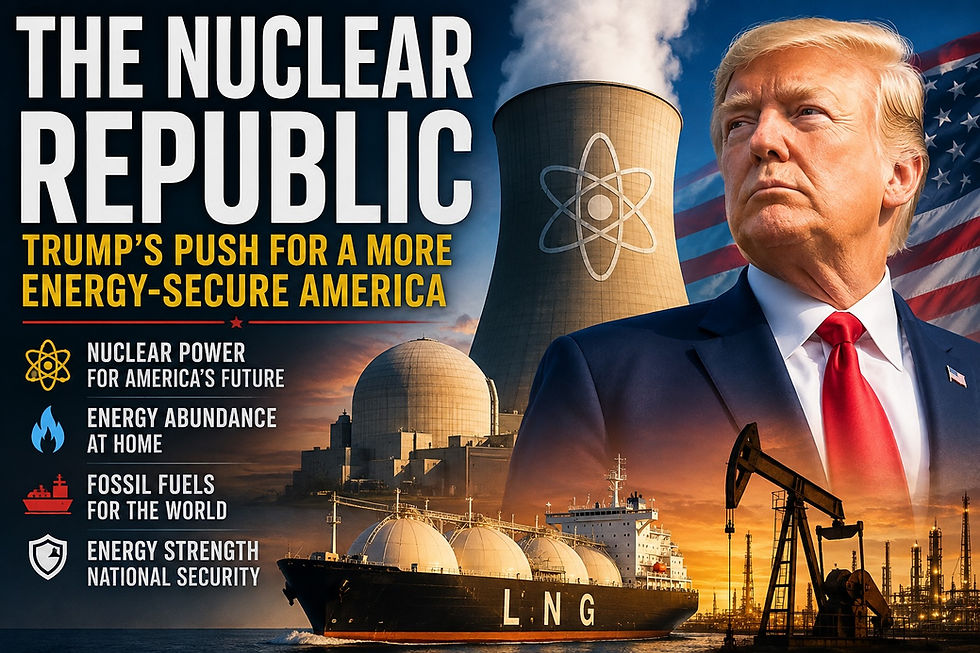
The Nuclear Republic: Trump’s Push for a More Energy-Secure America
For decades, American energy policy has largely been discussed as a question of supply: how much oil should be drilled, how much natural gas should be produced, how rapidly renewables should be deployed, and whether nuclear power should be preserved.
The Trump administration appears to be moving toward a considerably larger proposition.
Its emerging energy strategy could eventually produce an America in which nuclear power assumes a much greater share of the burden of supplying reliable domestic electricity, while the country's enormous oil and natural-gas resources increasingly serve both domestic industry and export markets.
The administration has not formally described its policy in precisely those terms. Nevertheless, its nuclear, fossil-fuel, regulatory and export policies increasingly point in the same direction.
The objective may not simply be American energy independence.
It may be American energy abundance.
The Return of Nuclear Power
The scale of the administration's nuclear ambition is easily overlooked.
President Donald Trump's May 2025 nuclear executive orders established a national objective of increasing American nuclear generating capacity from roughly 100 gigawatts today to 400 gigawatts by 2050.
The administration also called for 5 gigawatts of additional generation through uprating existing reactors and for 10 new large nuclear reactors with complete designs to be under construction by 2030.
This is not merely a program to preserve America's existing nuclear fleet. It represents an attempt to rebuild an American nuclear industry.
The administration has attacked the problem from several directions simultaneously.
Existing reactors can be uprated. Closed reactors can be restarted. Large conventional reactors can once again be constructed. Small modular reactors can serve industrial and grid applications. Microreactors can eventually supply military installations, remote facilities and specialized customers.
Most importantly, Washington is attempting to shorten the enormous period between designing a reactor and actually deploying one.
The Department of Energy's Reactor Pilot Program was created to accelerate testing of advanced reactor designs. The initial objective was to have three advanced reactors achieve criticality by July 4, 2026.
The government beat its own target.
Four advanced reactor designs achieved criticality by early July.
These should not be confused with four commercial nuclear power stations entering service. They were zero-power or experimental criticality demonstrations rather than grid-connected generating plants.
But their significance lies elsewhere.
The United States demonstrated that the reactor-development cycle itself could potentially be accelerated.
The Department of Energy says the first Antares demonstration provides a technical basis for subsequent reactors capable of producing electricity beginning in 2027 and beyond.
That may ultimately prove more important than the number of demonstration reactors themselves.
Getting Electricity Onto the Grid
The administration does not intend to wait for an entirely new generation of reactors before increasing nuclear generation.
Its Utility Power Reactor Incremental Scaling Effort, or UPRISE, aims to add 2.5 gigawatts of nuclear capacity by 2027 and 5 gigawatts by 2029.
That latter figure represents approximately five large conventional reactors' worth of generating capacity.
Some of the quickest additional electricity can come from facilities America has already built.
The federal government is supporting the restart of the approximately 800-megawatt Palisades plant in Michigan and the approximately 835-megawatt Crane Clean Energy Center in Pennsylvania, formerly Three Mile Island Unit 1. The Department of Energy has indicated that additional restart announcements are expected.
Meanwhile, Washington is putting substantial financial power behind the next generation of large reactors.
In June 2026, the Department of Energy announced a conditional commitment for $17.5 billion in nuclear supply-chain financing intended to support five projects and accelerate deployment of 10 large commercial reactors.
The significance of that program extends beyond the reactors themselves.
A country cannot suddenly decide to construct dozens of nuclear plants if it no longer possesses the industrial infrastructure required to manufacture them.
Reactors require specialized forgings, pumps, valves, pressure vessels, control systems, turbines, electrical equipment, enriched uranium, fabricated nuclear fuel and an experienced workforce.
The administration is therefore attempting to rebuild not simply nuclear generating capacity, but the industrial ecosystem behind it.
Nuclear for the Heavy Lifting
This is where nuclear power fits into the larger American energy picture.
Electricity demand is again becoming a major strategic concern.
Artificial intelligence, data centers, advanced manufacturing, semiconductor fabrication, electrification and potentially reshored heavy industry all require enormous quantities of dependable electricity.
Solar and wind generation will remain components of the American electricity system. Natural gas will almost certainly remain crucial as well.
But nuclear power possesses an attribute particularly valuable to an industrial economy: it can provide enormous amounts of electricity continuously from a relatively small physical footprint.
A 1-gigawatt nuclear reactor does not produce electricity only when the sun shines or the wind blows. It is designed to operate continuously for long periods between refueling outages.
That makes nuclear particularly well suited to what might be called the heavy lifting of the electrical system — large quantities of dependable baseload generation supporting industry, cities, military facilities, data centers and critical infrastructure.
Trump's nuclear program therefore makes considerably more sense when viewed alongside his fossil-fuel policies rather than in competition with them.
America Is Already an Energy Exporter
There is an important point that changes the entire discussion.
The United States does not need to become a net energy exporter.
It already is one.
According to the U.S. Energy Information Administration, American total energy exports reached a record 31 quadrillion British thermal units in 2025, while imports totaled approximately 21 quadrillion BTUs. Net energy exports consequently reached another record.
Natural gas illustrates the transformation even more clearly.
The United States is already the world's largest exporter of liquefied natural gas. American LNG exports averaged approximately 15 billion cubic feet per day in 2025, and the EIA expects them to exceed 18 billion cubic feet per day in 2027.
That gives Washington something previous generations of American policymakers rarely possessed:
energy as an instrument of geopolitical power.
American LNG can supply European states seeking alternatives to Russian gas. It can serve rapidly growing Asian economies. American petroleum products already flow extensively into international markets.
The energy question therefore becomes larger than whether America can supply itself.
The question becomes how much surplus energy America can economically produce — and what strategic advantages that surplus creates.
Nuclear Changes the Equation
Consider the long-term implications if the administration even approaches its 400-gigawatt nuclear target.
Every additional unit of electricity produced by nuclear power reduces the amount of another fuel required to produce that electricity.
That does not mean natural gas disappears from the American electrical system. Far from it. Gas turbines provide flexibility that nuclear plants generally do not, and America's gas resources are enormous.
But a substantially larger nuclear fleet could change the allocation of American energy resources.
Natural gas that otherwise might have been burned to produce domestic baseload electricity could potentially be available for LNG exports, petrochemical manufacturing, industrial processes or other higher-value uses.
Oil is somewhat different because relatively little American electricity is generated from petroleum. Increasing nuclear generation would therefore not directly free enormous quantities of crude oil for export.
But together the policies create a diversified national energy system:
Nuclear power supplies an increasing portion of dependable domestic electricity.
Natural gas provides grid flexibility, industrial energy and a growing export commodity.
Oil continues supplying transportation, industry, petrochemicals and international markets.
Renewables contribute additional domestic electricity where economically and operationally appropriate.
The result would not be a nuclear America replacing a fossil-fuel America.
It would be an energy-abundant America using different energy sources for the jobs to which they are best suited.
Energy Exports as Foreign Policy
There is another strategic dimension.
For most of the postwar era, American foreign policy was constrained by the country's dependence upon global energy markets.
Energy security influenced American relationships with the Middle East, shaped naval strategy, affected trade policy and exposed the economy to disruptions thousands of miles from American territory.
An energy-surplus United States occupies a fundamentally different strategic position.
Instead of competing for scarce imported energy, the United States can become a supplier.
That matters enormously.
A cargo of American LNG delivered to Europe represents more than a commercial transaction. It gives European governments another alternative to Russian energy.
American energy delivered to Asian allies reduces their vulnerability to potentially hostile suppliers.
Oil and gas exports improve the American trade balance while simultaneously extending American economic influence.
Under such a system, America's fossil-fuel reserves become not merely domestic resources but strategic export assets.
Nuclear power can help make that possible by carrying an increasing portion of America's internal electricity requirement.
The Industrial Challenge
There is, however, an enormous difference between announcing 400 gigawatts of nuclear capacity and building it.
The United States currently operates roughly 100 gigawatts.
Reaching 400 gigawatts would therefore require approximately 300 gigawatts of additional nuclear capacity, before accounting for reactors that eventually retire.
Expressed crudely, that is equivalent to roughly 300 additional one-gigawatt reactors.
The actual future fleet would undoubtedly consist of a mixture of large reactors, small modular reactors, advanced reactors, uprated existing plants and possibly microreactors serving specialized applications.
But the industrial requirement remains enormous.
America will need uranium.
It will need conversion and enrichment capacity.
It will need nuclear fuel fabrication.
It will need specialized steel and forgings.
It will need pumps, valves and control systems.
It will need engineers, welders, electricians, nuclear operators and construction workers.
And it will need a regulatory system capable of approving reactors at something approaching the speed at which industry can build them.
The nuclear program is therefore as much an industrial policy as an energy policy.
From Energy Independence to Energy Abundance
For half a century, American politicians spoke about "energy independence."
That concept may now be becoming obsolete.
The more ambitious objective is energy abundance: producing enough reliable energy to supply American households and industry, support the extraordinary electrical requirements of artificial intelligence and advanced manufacturing, and still maintain enormous export capacity.
Trump's nuclear initiative should be understood within that larger framework.
The administration is not abandoning oil and gas in favor of nuclear power. It is simultaneously encouraging fossil-fuel production, LNG exports, nuclear construction and expansion of the infrastructure required to support them.
If successful, the resulting system could eventually produce a division of labor within American energy.
Nuclear power would increasingly perform the heavy lifting of dependable domestic electricity generation.
Natural gas would remain a crucial balancing and industrial fuel while supporting an expanding LNG export industry.
Oil and petroleum products would continue serving transportation, industry and world markets.
Other generating technologies would supplement the system where they are competitive and useful.
Such a transformation will take decades, and the administration's extraordinarily ambitious nuclear targets may prove difficult to achieve.
But the direction is becoming unmistakable.
The United States is no longer merely debating how to secure enough energy for itself.
It is beginning to ask a much larger question:
What happens when America has enough energy to power itself — and a great deal of the world besides?


Comments