
PACIFICAPacific Intelligence, Commerce & Strategic Assessment

Weekly Intelligence Report — Issue No. 2
Reporting Period: August 3–9, 2026Week Ending: Sunday, August 9, 2026
Regional Assessment: CONSTRUCTIVELY COMPETITIVE — WITH RISING ECONOMIC PRESSURE
EXECUTIVE ASSESSMENT
The Pacific strategic environment did not undergo a dramatic transformation during the week ending August 9. That is itself important.
The larger trend identified in PACIFICA Issue No. 1 continues: strategic competition is increasingly being expressed through infrastructure, industrial capacity, mineral supply chains, maritime access, workforce development, and commercial relationships rather than through military activity alone.
The region remains competitive, but the competition is becoming more tangible.
Critical-mineral policy is moving beyond identifying deposits toward the more difficult question of how minerals are financed, extracted, processed, transported, priced, and integrated into dependable supply chains. New reference prices announced for several critical minerals are particularly significant because transparent pricing can make projects easier to evaluate and finance. This potentially benefits Pacific and Indo-Pacific producers that have resources but have struggled to convert geological potential into bankable projects.
At the same time, the Philippines delivered an important economic warning. Reported second-quarter GDP growth slowed sharply to 2.3 percent, with investment declining and public construction weakness contributing to the slowdown. This matters beyond the Philippines. PACIFICA treats infrastructure capacity as a component of strategic capacity. Governments cannot indefinitely separate maritime security ambitions from the roads, ports, power systems, public finances, and industrial base needed to support them.
Australia continues to deepen its role as an economic bridge between developed Indo-Pacific economies and Pacific Island states. Discussions surrounding the Pacific Australia Labour Mobility scheme this week highlighted something frequently overlooked in traditional strategic analysis: people are infrastructure too. Workforce availability, vocational training, migration arrangements, and skills transfer increasingly determine whether large infrastructure and industrial projects can actually be built.
China remains the principal external competitive pressure throughout much of the region. But Beijing's challenge is increasingly encountering a response that is not exclusively military. Australia, Japan, the United States, India and regional governments are gradually constructing overlapping networks involving minerals, ports, infrastructure, finance, logistics, training and technology.
This produces PACIFICA's central assessment for Issue No. 2:
The Pacific is beginning to develop competing economic ecosystems. The strategic question is increasingly not simply who controls territory, but who can finance, build, operate, supply and maintain the systems upon which Pacific economies depend.
That transition creates risk.
It also creates considerable commercial opportunity.
STRATEGIC INDICATORS DASHBOARD
Indicator | Current Assessment | Weekly Trend |
Regional Military Stability | Stable with localized pressure | ► |
Chinese Maritime Pressure | Elevated | ► |
Commercial Shipping | Stable | ► |
Critical Minerals Competition | Increasing | ▲ |
Infrastructure Development | Accelerating | ▲ |
Foreign Investment Activity | Growing | ▲ |
U.S.–Japan–Australia Coordination | Strong | ▲ |
Pacific Island Strategic Value | Increasing | ▲ |
Industrial Supply-Chain Competition | Increasing | ▲ |
Workforce & Skills Competition | Growing | ▲ |
Continuity Assessment
Issue No. 1 characterized the region as Constructively Competitive.
That assessment remains appropriate.
There is insufficient evidence this week to elevate the region toward a crisis-oriented assessment. Military competition continues, particularly around China, Taiwan and the Philippines, but economic competition is producing at least as much long-term strategic movement.
PACIFICA therefore reinforces rather than revises the original Continuous Strategic Assessment.
TOP FIVE REGIONAL DEVELOPMENTS
1. Critical Minerals Are Moving From Geology Toward Markets
The most important long-term development may not involve a mine at all.
New reference prices introduced for gallium, germanium, tungsten, antimony, neodymium and praseodymium are intended to improve price discovery in markets where opaque pricing and Chinese market dominance have complicated investment decisions.
This is strategically important.
A mineral deposit has limited strategic value if investors cannot reliably determine what its future production might be worth.
Greater pricing transparency can help convert critical minerals from a geopolitical concept into a financeable commodity market.
The implications extend across Australia, Indonesia, Papua New Guinea and other potential Indo-Pacific producers.
The next phase of critical-mineral competition therefore appears increasingly likely to revolve around:
mine → processing → electricity → transport → port → shipping → customer
rather than simply ownership of the deposit.
That distinction will become increasingly important throughout PACIFICA's coverage.
2. Philippine Economic Growth Sends an Infrastructure Warning
The Philippines reported second-quarter economic growth of approximately 2.3 percent, compared with 2.8 percent during the first quarter and 5.4 percent during the comparable period a year earlier. Reported investment fell 9.2 percent, with weakness in public construction identified as an important contributor.
This deserves strategic attention.
The Philippines occupies one of the most important geographic positions in the Indo-Pacific. It sits adjacent to major South China Sea disputes and near maritime approaches connecting the South China Sea with the western Pacific.
But geography alone does not create national power.
Ports require roads.
Military facilities require electricity.
Shipyards require skilled workers.
Logistics systems require warehouses.
Industrial expansion requires reliable capital.
The country's strategic importance may therefore generate increasing demand for precisely the infrastructure capabilities currently experiencing economic pressure.
PACIFICA Assessment: The Philippine infrastructure slowdown represents both a vulnerability and a potential future investment requirement.
3. Pacific Labor Is Becoming a Strategic Resource
Australia's Pacific Australia Labour Mobility program received attention at the Developing Northern Australia Conference on August 7, including discussion of workforce shortages, regional economic integration and business opportunities connecting Australia with Pacific Island states and Timor-Leste.
The significance extends beyond immigration policy.
The Pacific faces a recurring contradiction.
Large infrastructure ambitions require skilled workers, while many smaller Pacific economies possess limited pools of specialized construction, engineering and technical labor.
Labor-mobility programs can create income and training opportunities, but they can also remove workers from the very economies attempting to build new infrastructure.
That creates an emerging requirement for:
vocational education, construction training, heavy-equipment certification, electrical trades, maritime skills, industrial maintenance and engineering education.
PACIFICA therefore upgrades Workforce Training from an interesting supporting sector to a persistent strategic indicator.
4. Japan's Infrastructure Requirements Continue Expanding
Japan continues implementing large infrastructure-resilience and defense-related construction programs.
Penta-Ocean Construction's current medium-term planning, for example, identifies national resilience projects, aging ports and highways, climate adaptation, defense construction, logistics facilities and supply-chain resilience among significant demand drivers through 2028.
This illustrates a larger regional trend.
Japan is not merely increasing defense spending.
It is reinforcing the physical infrastructure beneath national power.
Ports, hardened facilities, logistics centers, industrial buildings and transportation networks increasingly occupy the intersection between civilian economic development and strategic resilience.
This distinction matters because many of the companies capable of performing this work are commercial engineering, construction, equipment and logistics firms rather than traditional defense contractors.
PACIFICA will continue tracking this category closely.
5. Pacific Geography Continues Appreciating
Competition involving Taiwan, the Philippines, Japan and the broader Pacific maritime environment continues reinforcing the strategic value of locations that previously attracted relatively limited outside attention.
The same principle applies farther south.
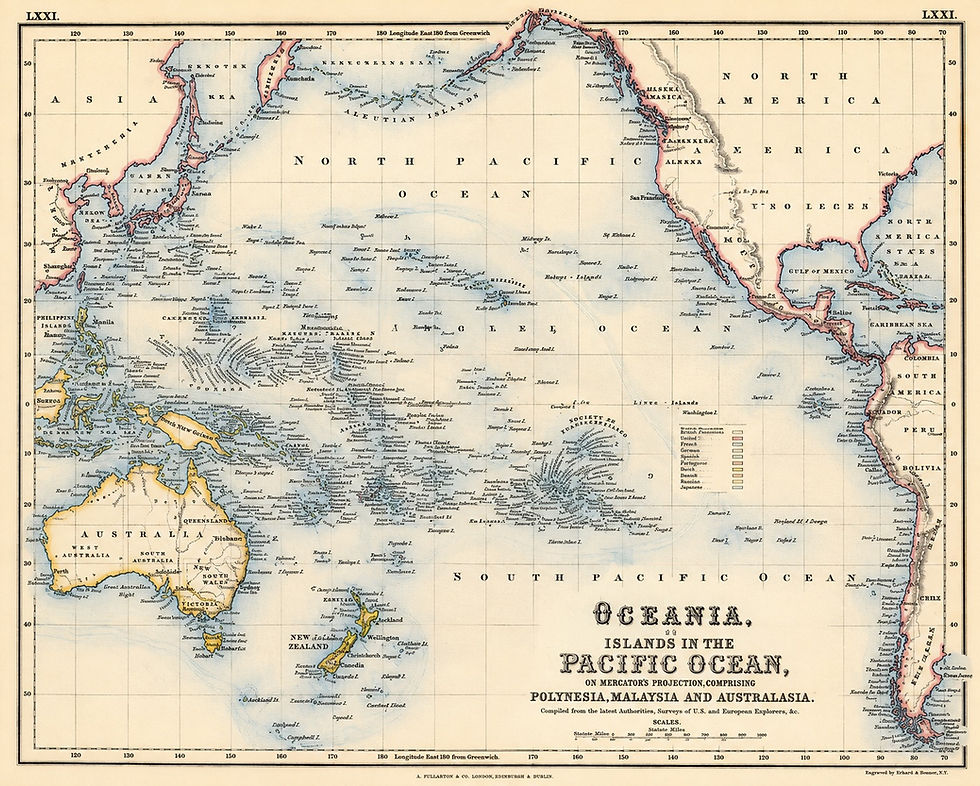
Ports in Fiji, infrastructure in Papua New Guinea, communications in Micronesia, logistics facilities in Australia and transportation networks throughout Pacific Island states increasingly belong to the same strategic system.
The region should therefore not be understood simply as scattered islands separated by large amounts of water.
It is better understood as a network of potential:
ports, airfields, cables, warehouses, fuel facilities, mines, processing facilities, power systems and maritime routes.
That network is becoming increasingly valuable.
FEATURED COUNTRY INTELLIGENCE
PHILIPPINES
Current Assessment: STRATEGICALLY IMPORTANT / ECONOMICALLY CONSTRAINED
The Philippines presents one of the clearest examples of the relationship between economics and security.
Chinese maritime pressure ensures continued attention toward Philippine defense requirements. But the country's latest economic data introduce another variable.
Second-quarter growth slowed substantially, while investment declined.
Manufacturing nevertheless recorded growth, as did several service sectors.
The resulting picture is mixed rather than uniformly negative.
Philippine Strategic Wish List
PACIFICA assesses likely continuing demand for:
Port modernization
Electrical generation and grid resilience
Shipbuilding and repair
Coastal infrastructure
Warehousing and logistics
Heavy construction equipment
Flood-control and water infrastructure
Industrial facilities
Maritime surveillance
Workforce training
The most important analytical question may therefore be whether slower domestic growth eventually collides with increasing strategic infrastructure requirements.
If that occurs, Manila will have greater incentive to seek outside financing and foreign investment.
That would increase competition among American, Japanese, Australian, Korean and Chinese capital.
Continuous Strategic Assessment
Reinforced.
The Philippines remains one of the Pacific's most strategically important infrastructure markets, although fiscal and governance constraints may determine how quickly potential becomes actual construction.
AUSTRALIA
Current Assessment: REGIONAL INDUSTRIAL ANCHOR
Australia's importance continues to expand beyond its traditional role as a military ally.
It possesses something increasingly scarce in the strategic Pacific:
space, minerals, capital, infrastructure, technical capability and political stability in the same country.
Australia consequently sits at the intersection of several PACIFICA trends.
Critical minerals can be extracted there.
Processing can potentially be expanded there.
Pacific labor can connect with Australian industry.
Ports connect Australian production to Asian and global markets.
Australian companies possess engineering experience applicable throughout the Pacific.
Australia is therefore increasingly functioning as the region's industrial rear area.
That description may ultimately prove more important than simply calling Australia an American ally.
Commercial Outlook
Strongest sectors remain:
mining services, mineral processing, industrial power, port engineering, heavy equipment, maritime logistics and workforce development.
The development of more resilient mineral markets strengthens this position.
Continuous Strategic Assessment
Strengthened.
Australia's strategic value is increasing because economic security and military security are becoming harder to separate.
FIJI
Current Assessment: SMALL STATE / LARGE NETWORK VALUE
Fiji illustrates one of PACIFICA's central principles:
National size does not necessarily determine strategic importance.
Location does.
Fiji occupies an advantageous position connecting the South Pacific's maritime and aviation networks. Earlier Quad initiatives involving port infrastructure reinforce the growing recognition that Pacific infrastructure is strategic infrastructure.
The commercial implications are broader than construction of an individual port.
Ports generate secondary requirements:
roads, electricity, storage, communications, cranes, dredging, maintenance, security, customs systems, ship services and workforce development.
A single infrastructure project can therefore generate an economic ecosystem substantially larger than the original contract.
Continuous Strategic Assessment
Strengthened modestly.
Fiji should increasingly be viewed as a regional logistics platform rather than solely an island tourism economy.
CRITICAL MINERALS & STRATEGIC INDUSTRIES
Critical minerals remain PACIFICA's strongest emerging commercial theme.
But this week's analysis reinforces an important methodological distinction.
The opportunity is not necessarily the mineral itself.
The more useful question is:
What physical capabilities must exist if critical-mineral competition continues?
The answer is substantial.
Mining requires heavy machinery.
Heavy machinery requires maintenance.
Processing requires enormous quantities of electricity.
Electricity requires generation and transmission.
Processing plants require industrial engineering.
Mines require roads.
Exports require ports.
Ports require dredging.
Cargo requires ships.
Projects require financing.
Workers require housing and training.
Projects also require environmental permitting, water management and remediation.
This produces a much larger economic footprint than the mine alone.
Sector Outlook
Sector | Outlook |
Critical Mineral Extraction | Strong |
Mineral Processing | Strong |
Port Engineering | Strong |
Heavy Equipment | Strong |
Industrial Power Systems | Strong |
Environmental Consulting | Moderate to Strong |
Workforce Training | Growing |
Maritime Logistics | Strong |
Industrial Construction | Strong |
Project Finance | Growing |
Indonesia demonstrates both the opportunity and the warning.
Rapid expansion of nickel processing at the Morowali industrial complex has created enormous industrial capacity, but research has also identified measurable deterioration in nearby coastal water clarity associated with industrial expansion.
That creates another potential market.
Environmental management should not automatically be treated as an obstacle to mineral development.
It is itself an industry.
Water treatment, emissions controls, waste management, coastal monitoring and remediation could become increasingly important components of the Pacific mineral economy.
MARITIME SECURITY
The maritime environment remains stable but pressured.
There was no regional event this week sufficient to justify a PACIFICA Special Supplement.
That should not be interpreted as strategic inactivity.
Chinese maritime activity continues to create pressure around contested waters, particularly involving Taiwan and the Philippines.
The important development is the increasingly blurred boundary between military and nonmilitary maritime power.
Coast guards, commercial shipping, ports, maritime surveillance, fishing fleets and logistics infrastructure all influence the operating environment.
This creates what PACIFICA will continue treating as a maritime economic-security continuum.
A port capable of handling commercial bulk cargo today can have strategic logistics value tomorrow.
A shipyard servicing commercial vessels can support government vessels.
A civilian communications network can improve maritime awareness.
The dividing line between commercial infrastructure and strategic infrastructure is therefore becoming increasingly difficult to draw.
INVESTMENT OUTLOOK
PACIFICA does not provide stock recommendations.
Its purpose is different.
The objective is to identify strategic trends and then determine what economic capabilities would have to expand if those trends continue.
This week's strongest signals remain concentrated in five areas.
Infrastructure
Port expansion, roads, industrial facilities, electrical systems and logistics infrastructure remain fundamental requirements throughout the region.
Critical-Mineral Processing
The geopolitical demand exists.
The processing bottleneck remains.
That makes processing capacity potentially more strategically important than some additional mineral discoveries.
Heavy Engineering
Large Pacific projects require capabilities many small states cannot supply domestically.
International engineering companies therefore occupy an unusually strong position.
Power Generation
Mining, processing, ports, data infrastructure and industrialization all increase electricity demand.
Power may become the hidden bottleneck behind several otherwise attractive Pacific development strategies.
Workforce Development
The infrastructure pipeline cannot expand indefinitely without engineers, electricians, welders, equipment operators, maritime workers and technicians.
Training should therefore be considered an investable capability rather than merely a social program.
REGIONAL WATCH
Papua New Guinea
Continue monitoring mining, LNG, port infrastructure and the political environment surrounding major resource projects.
PNG remains one of the Pacific's largest unrealized combinations of natural resources and infrastructure requirements.
Assessment: Opportunity remains high; execution risk remains substantial.
Solomon Islands
Competition over external relationships remains important, but PACIFICA will continue resisting the temptation to interpret every Solomon Islands development exclusively through China.
Education, infrastructure, telecommunications, fisheries and transportation remain equally important indicators.
Assessment: Strategically contested; commercially underdeveloped.
Micronesia
Infrastructure, communications, aviation and maritime services remain the principal areas to monitor.
Small population does not eliminate strategic importance.
In some cases it increases the significance of individual projects.
Assessment: High strategic value relative to economic size.
Indonesia
Nickel processing remains strategically important, but environmental consequences and infrastructure requirements deserve increasing attention.
Assessment: Industrial strength increasing; environmental and power constraints require monitoring.
Japan
Infrastructure resilience, defense construction, industrial capacity and supply-chain security increasingly reinforce one another.
Assessment: Strong and strengthening.
STRATEGIC OPPORTUNITIES
PACIFICA identifies four particularly important opportunity clusters this week.
Industrial Power
Electricity may become one of the largest secondary beneficiaries of regional industrialization. Mines, processing facilities, ports and manufacturing plants cannot operate reliably without substantial generating capacity.
Port Ecosystems
Port investment should not be measured solely by the cost of a dock. Each major port can generate secondary investment in storage, roads, fuel, maintenance, customs, security, telecommunications and maritime services.
Environmental Engineering
More mineral extraction will create more environmental requirements. Firms capable of making resource projects politically and environmentally sustainable may become increasingly valuable.
Workforce Infrastructure
The region needs people capable of operating what governments and investors intend to build.
This may eventually become one of the largest constraints on Pacific development.
REGIONAL RISKS
The principal risks remain manageable but significant.
Chinese maritime pressure could produce an unexpected confrontation.
Weak government finances could delay infrastructure projects.
Critical-mineral prices could undermine marginal projects.
Environmental opposition could slow mining and processing development.
Labor shortages could raise construction costs.
Extreme weather could damage infrastructure and interrupt transportation.
And geopolitical enthusiasm could produce projects whose strategic rationale is stronger than their commercial economics.
That final category deserves particular attention.
Strategically desirable does not automatically mean commercially viable.
PACIFICA will continue distinguishing between the two.
WHAT TO WATCH NEXT WEEK
The week beginning August 10 should be monitored for several signals:
Critical-mineral pricing: whether improved price transparency begins influencing financing, offtake agreements or project announcements.
Philippine infrastructure policy: indications that Manila intends to counter slowing investment or public-construction weakness.
Australia-Pacific workforce initiatives: evidence that labor mobility is being linked more directly with vocational training and industrial development.
Chinese maritime activity: any increase in operational pressure around Taiwan, the Philippines or adjacent Pacific approaches.
Pacific infrastructure financing: new port, aviation, communications, power or transportation commitments.
Japanese industrial investment: additional evidence that resilience and defense spending are generating broader commercial construction requirements.
Indonesia: environmental or regulatory responses to the continuing expansion of mineral-processing capacity.
Papua New Guinea: movement involving major mining, energy or infrastructure projects.
FINAL STRATEGIC ASSESSMENT
The Pacific remains Constructively Competitive.
But the nature of that competition is becoming clearer.
The contest is not simply China versus the United States.
Nor is it simply a military competition.
It is becoming a contest between economic systems capable of delivering physical results.
Who can build the port?
Who can finance the mine?
Who can process the mineral?
Who supplies the excavator?
Who generates the electricity?
Who trains the electrician?
Who insures the project?
Who operates the ship?
Who maintains the infrastructure ten years later?
Those questions may ultimately prove as strategically important as counting warships.
The strongest countries and partnerships in the emerging Pacific system will therefore not necessarily be those capable of making the largest announcements. They will be those capable of turning capital, resources, technology and people into durable infrastructure.
For investors, companies and policymakers, this creates a useful way of reading the region.
Do not look only at today's crisis.
Look at what must be built if today's trend continues.
That is where much of tomorrow's Pacific economy is already beginning to appear.
PACIFICA — Issue No. 2Week Ending August 9, 2026
PACIFICA is a continuous strategic-assessment product examining the intersection of geopolitics, commerce, infrastructure, industry, investment and security across the Pacific.

Comments