
STATE OF THE STRAIT. ISSUE #5 WEEK ENDING AUGUST 4, 2026
STATE OF THE STRAIT
Weekly Strategic Intelligence Newsletter
Issue No. 5
Markets Price Peace. Shipping Does Not.
Reporting Period: July 29 – August 4, 2026Information Cutoff: Tuesday, August 4, 2026 – 0800 EDT
Published by the Blue Web Institute
Executive Summary
The fifth week of the Strait of Hormuz crisis revealed a growing divergence between financial expectations and operational reality. Diplomatic initiatives expanded, military operations slowed, and oil markets surrendered much of their wartime risk premium. Yet commercial shipping, marine insurers, and energy companies continued behaving as though the Strait remained an active conflict zone.
This divergence is now the defining strategic characteristic of the campaign.
The United States temporarily suspended additional strikes while pursuing diplomatic engagement through Oman and regional partners. President Donald Trump publicly linked restraint in military operations to renewed discussions regarding both Iran's nuclear program and the restoration of commercial navigation through the Strait of Hormuz. Tehran, however, publicly denied that direct negotiations with Washington were underway while confirming discussions with Oman concerning a temporary shipping arrangement.
The political narrative increasingly favors stabilization.
The commercial narrative does not.
Throughout the reporting period, commercial traffic through the Strait remained only a fraction of historical norms. Public Automatic Identification System (AIS) data continued showing sparse vessel movements, while numerous commercial operators either reduced or disabled public transmissions. Limited increases in tanker traffic were offset by continued reports of inspections, selective routing, military oversight, and persistent uncertainty regarding safe passage.
Perhaps the week's single most significant development occurred outside the financial markets.
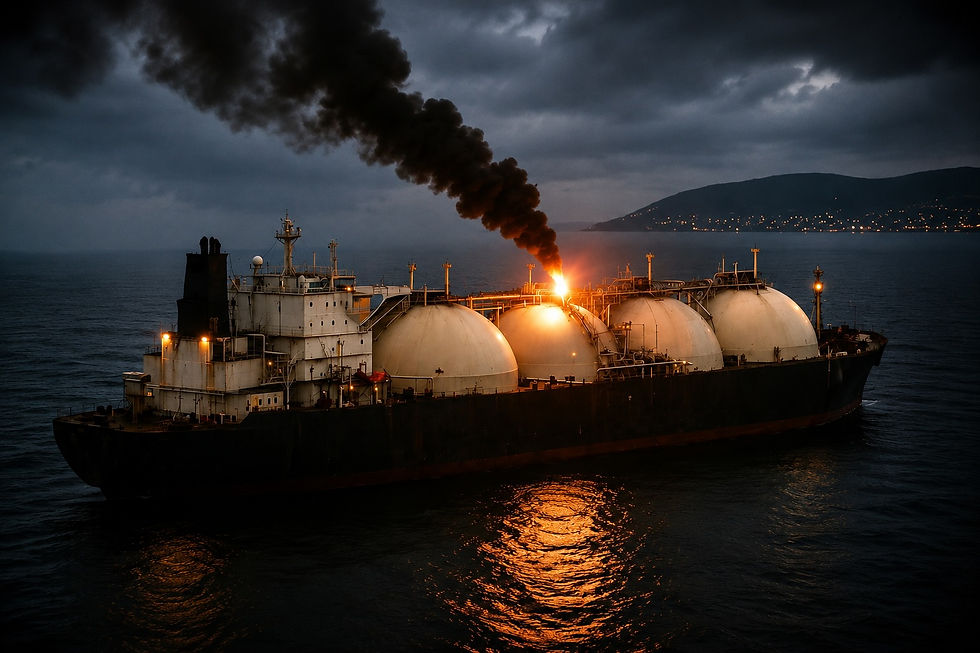
The missile strike against the LNG carrier GasLog Shanghai demonstrated that even vessels successfully transiting the Strait remain vulnerable to attack. The incident fundamentally altered assumptions that a limited reopening of Hormuz necessarily represented restored maritime security. While oil markets focused on diplomatic optimism, insurers, charterers, and LNG operators were forced to reassess the physical risks associated with Gulf navigation.
Meanwhile, the Department of the Treasury significantly expanded the financial dimension of the campaign by sanctioning Iranian maritime insurance entities supporting Tehran's effort to establish its own transit approval system. Insurance has now become an active instrument of strategic competition rather than merely a commercial service supporting maritime trade.
The reporting period therefore marks another transition in the evolution of the conflict.
Issue No. 1 concluded that commercial confidence determines whether the Strait is operationally open.
Issue No. 2 demonstrated that maritime security itself had become an economic service.
Issue No. 3 showed governments adapting through permanent infrastructure rather than waiting for military victory.
Issue No. 4 observed that military operations paused while commercial restrictions remained.
Issue No. 5 identifies an even more important development.
Markets have begun pricing diplomacy.
Commercial shipping continues pricing operational risk.
That divergence increasingly explains the behavior of every major participant in the Gulf—from governments and insurers to tanker operators, LNG exporters, and energy traders.
The campaign is no longer defined solely by military operations.
It is increasingly defined by competing perceptions of confidence.
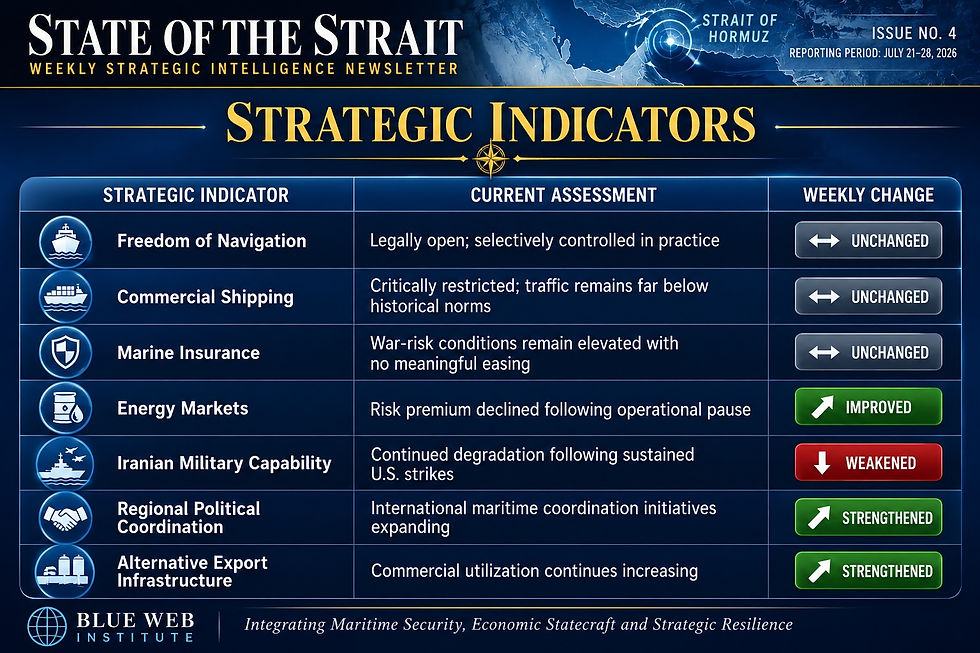
Strategic Indicators
Strategic Indicator | Current Assessment | Weekly Change |
Freedom of Navigation | Legally open; selectively administered in practice | Unchanged |
Commercial Shipping | Severely restricted; selective passage continues | Unchanged |
Marine Insurance | Elevated war-risk conditions remain; insurance increasingly weaponized | Deteriorated |
Energy Markets | Diplomatic optimism reducing immediate risk premium | Improved |
Iranian Military Capability | Conventional maritime capabilities remain significantly degraded | Unchanged |
Regional Political Coordination | Oman assumes increasingly important diplomatic role | Strengthened |
Alternative Export Infrastructure | Continued operational utilization and commercial expansion | Strengthened |
LNG Security | Emerging as a strategic vulnerability following the GasLog Shanghaiattack | Deteriorated |
Strategic Overview
Five weeks into the crisis, the Strait of Hormuz has entered what may become its most analytically challenging phase.
The opening weeks of the conflict were comparatively straightforward.
Military strikes produced commercial disruption.
Oil prices rose.
Shipping declined.
Insurance premiums increased.
The relationships between cause and effect remained relatively easy to identify.
Today's strategic environment is considerably more complex.
Military operations have slowed.
Oil prices have fallen.
Diplomatic initiatives have expanded.
Yet commercial shipping remains severely constrained.
This contradiction is not evidence that markets are wrong or that commercial shipping is irrational.
Instead, it illustrates that different participants evaluate risk according to different time horizons.
Financial markets are forward-looking.
Oil traders continuously incorporate expectations regarding future diplomatic developments into present pricing.
Commercial shipping operates differently.
A Very Large Crude Carrier valued at more than $100 million cannot base voyage decisions upon optimistic headlines alone. Shipowners, insurers, charterers, lenders, and cargo owners require sustained evidence that commercial passage has become operationally dependable.
Confidence develops more slowly than optimism.
The attack against GasLog Shanghai illustrates this distinction perfectly.
From a purely financial perspective, oil prices suggested that immediate escalation risks had diminished.
From the perspective of an LNG operator, however, the successful attack on a loaded gas carrier demonstrated precisely the opposite.
The incident confirmed that selective commercial passage does not necessarily equate to commercial security.
Consequently, the campaign has entered a new strategic phase.
The central question is no longer whether the Strait is physically open.
Nor is it whether military operations are intensifying.
The more important question has become:
When do commercial institutions decide that the Strait has become safe enough to resume normal operations?
That answer increasingly depends upon factors extending well beyond military power.
Insurance markets.
Financial regulation.
Commercial confidence.
Infrastructure resilience.
Diplomatic credibility.
Legal certainty.
These interconnected systems collectively determine whether global commerce views the Strait of Hormuz as a functioning international waterway or merely a navigable battlefield.
This observation reinforces the central proposition of the Blue Web Doctrine.
Maritime strategy in the twenty-first century cannot be understood exclusively through naval operations.
It must also be understood through the commercial institutions that ultimately determine whether ships choose to sail.
Campaign Continuity Assessment
The campaign has now progressed through five identifiable stages:
Issue | Primary Strategic Development |
Issue No. 1 | Commercial confidence becomes the decisive measure of freedom of navigation. |
Issue No. 2 | Maritime security evolves into an integrated economic service combining naval protection, insurance, sanctions, and finance. |
Issue No. 3 | Regional governments begin adapting through permanent infrastructure and export diversification. |
Issue No. 4 | Military operations pause while commercial restrictions persist, revealing a separation between kinetic activity and maritime behavior. |
Issue No. 5 | Financial markets increasingly price diplomacy while commercial shipping continues pricing operational risk, creating the largest divergence observed since the conflict began. |
Taken together, these developments suggest that the Strait of Hormuz is no longer simply the focal point of a regional military confrontation.
It has become a laboratory demonstrating how modern maritime commerce responds to sustained geopolitical competition.
The implications extend well beyond the Gulf.
They will likely influence future thinking regarding maritime insurance, economic statecraft, strategic logistics, and the protection of global energy supply chains for years to come.
STATE OF THE STRAIT
Weekly Strategic Intelligence Newsletter
Issue No. 5
Section 2 — Military Situation, CENTCOM Operations, Economic Warfare, and the New Insurance War
Military Situation
The reporting period marked a transition from an operational pause to a renewed cycle of selective military pressure. Although the United States temporarily suspended additional strikes while diplomatic efforts gained momentum through Oman, that pause proved conditional rather than permanent. By the middle of the reporting period, CENTCOM resumed precision operations against Iranian military infrastructure following renewed attacks on commercial shipping and reported Iranian missile and drone activity directed at U.S. and coalition interests.
The resumption of strikes demonstrates an important characteristic of the current campaign.
Military operations are increasingly functioning as a flexible instrument supporting diplomatic and economic objectives rather than representing an independent military effort.
Unlike the opening weeks of the conflict, when sustained air operations dominated the operational picture, current military activity appears increasingly calibrated to preserve strategic leverage while avoiding uncontrolled escalation.
The result is a campaign that alternates between military pressure and diplomatic engagement without fundamentally abandoning either.
This approach has important implications for commercial markets.
Repeated transitions between negotiations and renewed strikes reinforce uncertainty among insurers, charterers, and shipowners. Commercial operators increasingly face an environment in which political progress can be reversed within hours by renewed military action.
That uncertainty—not simply the probability of attack—continues depressing commercial confidence throughout the Gulf.
CENTCOM Operations
CENTCOM's operational emphasis continues reflecting a systematic effort to degrade Iran's maritime military architecture rather than pursue generalized destruction.
Since the beginning of the campaign, coalition operations have targeted:
Coastal anti-ship missile batteries.
Maritime surveillance systems.
Drone launch facilities.
Command-and-control nodes.
Logistics centers supporting the Islamic Revolutionary Guard Corps (IRGC).
Naval facilities supporting asymmetric operations.
Selected transportation infrastructure facilitating military movement.
The cumulative effect has substantially weakened Iran's conventional maritime capability.
Importantly, however, recent events demonstrate that degraded capability does not equate to eliminated capability.
The attack against the LNG carrier GasLog Shanghai illustrates that Iran—or Iranian-aligned forces—retain sufficient capability to threaten individual commercial vessels despite sustained degradation of conventional military infrastructure.
This distinction should shape future assessments.
The campaign is no longer primarily concerned with eliminating every possible threat.
Instead, it increasingly seeks to reduce Iranian capability below the threshold necessary to sustain systematic disruption of international commerce.
Whether that objective has been achieved remains uncertain.
Commercial behavior suggests that markets believe additional risk remains.
The Return of Kinetic Pressure
Issue No. 4 concluded that the campaign had entered an operational pause.
Developments during the current reporting period require that assessment to be modified.
Military pressure has resumed, although in a more selective form.
Rather than returning immediately to prolonged nightly strike sequences, coalition operations now appear increasingly responsive to Iranian actions. Missile launches, attacks against commercial shipping, drone activity, or attempts to interfere with coalition forces have generated measured military responses rather than continuous offensive campaigns.
This evolution reflects an increasingly mature strategy.
Military force is being employed to preserve commercial conditions rather than simply punish hostile behavior.
From the perspective of maritime strategy, that represents an important conceptual shift.
The objective is no longer battlefield dominance alone.
The objective is maintaining an environment in which international commerce can eventually resume with acceptable levels of confidence.
Competing Systems of Maritime Control
One of the most important strategic developments this week has received comparatively limited public attention.
The Strait of Hormuz is no longer governed solely by international maritime law.
Instead, commercial shipping increasingly operates under overlapping systems of authority.
A vessel transiting the Gulf may simultaneously answer to:
International maritime law.
Coalition naval forces.
Iranian military directives.
Marine insurers.
OFAC sanctions regulations.
Flag-state requirements.
Charter-party obligations.
Port-state inspections.
Each institution exercises some degree of influence over whether a voyage ultimately proceeds.
Consequently, freedom of navigation has evolved into something considerably more complicated than simple physical access.
Navigation has become administratively contested.
This observation represents one of the most important analytical developments since the newsletter began.
Modern maritime competition increasingly occurs through governance rather than naval confrontation alone.
Treasury and OFAC Developments
The Department of the Treasury significantly expanded the economic dimension of the campaign during the reporting period.
OFAC designated additional Iranian maritime insurance organizations and commercial entities associated with Tehran's effort to establish a parallel insurance and transit approval system for vessels operating through the Strait of Hormuz.
Among the most significant actions were sanctions directed against the Persian Gulf Marine Insurance Company and HormuzSafe Marine Services Authority, together with additional measures targeting vessels and organizations participating in Iranian petroleum transportation and sanctions-evasion networks.
These designations are strategically important for several reasons.
First, they demonstrate that Washington increasingly views insurance as an operational component of Iranian maritime influence rather than merely a commercial service.
Second, they attempt to prevent Tehran from legitimizing a competing maritime governance structure financed through compulsory insurance, transit fees, or associated financial mechanisms.
Third, they reinforce the broader coalition objective of preserving internationally recognized commercial navigation rather than allowing Iran to establish de facto regulatory authority over the Strait.
This represents one of the most innovative aspects of the campaign.
Financial regulation has become an instrument of maritime strategy.
The New Insurance War
Perhaps no development better illustrates the evolution of modern maritime conflict than the growing importance of insurance.
Earlier editions of State of the Strait described marine insurance as an economic consequence of military operations.
Current developments suggest a more significant conclusion.
Insurance has itself become part of the battlefield.
Competing systems now seek to determine:
Who provides insurance.
Which voyages receive coverage.
Which underwriters remain internationally recognized.
Which payments comply with sanctions.
Which commercial routes remain financially viable.
The result is a contest not only over military control of the Strait but also over the financial architecture supporting maritime commerce.
This development strongly reinforces one of the central propositions advanced in the Blue Web Doctrine.
Future maritime conflicts are unlikely to be decided solely through fleets.
They will increasingly be decided through the interaction of:
naval power,
insurance markets,
banking systems,
sanctions,
commercial finance,
and international legal frameworks.
The Gulf now provides the clearest real-world example yet observed of this emerging form of strategic competition.
Section Assessment
The reporting period demonstrates that military operations, economic pressure, and commercial governance have become increasingly inseparable.
Air operations continue supporting economic objectives.
Treasury actions directly influence maritime operations.
Insurance markets affect strategic decision-making.
Commercial confidence remains the ultimate measure of success.
The campaign therefore continues evolving away from a conventional military conflict and toward a broader contest over the institutions governing international maritime commerce.
That evolution may ultimately prove to be the most enduring legacy of the 2026 Strait of Hormuz crisis.
STATE OF THE STRAIT
Weekly Strategic Intelligence Newsletter
Issue No. 5
Section 3 — Energy Markets, Commercial Shipping, AIS Activity, the GasLog Shanghai Case Study, Marine Insurance, and the New Normal
Energy Markets
Financial markets spent much of the reporting period repricing what traders increasingly viewed as a reduced probability of immediate regional escalation. Following President Trump's announcement that additional military strikes would be suspended while diplomatic efforts continued, Brent crude fell from the low $90s into the low $80s before stabilizing. West Texas Intermediate followed a similar trajectory.
At first glance, the market reaction appeared logical.
Lower probability of immediate conflict should reduce the geopolitical risk premium embedded in oil prices.
However, the behavior of commercial shipping suggests that traders and shipowners are evaluating different variables.
Commodity futures increasingly reflect expectations.
Commercial shipping reflects operational experience.
This distinction has become the defining economic characteristic of the Strait of Hormuz during the current reporting period.
Oil markets now appear increasingly willing to assume that diplomacy will ultimately reduce risk.
Commercial operators continue demanding physical evidence before committing vessels valued at hundreds of millions of dollars.
That difference explains why energy prices have moderated while shipping volumes remain historically depressed.
The Divergence Between Financial and Physical Markets
One of the most important analytical developments this week is the growing separation between financial markets and physical energy markets.
Paper markets respond rapidly to changing political expectations.
Physical markets operate under considerably different constraints.
Every cargo still requires:
A willing shipowner.
An acceptable charter agreement.
Adequate insurance.
Crew acceptance.
Financial clearance.
Regulatory compliance.
Confidence that the voyage will not become a political or military incident.
Consequently, the effective delivered cost of energy increasingly depends upon logistics rather than production.
The Gulf currently illustrates this phenomenon with unusual clarity.
Although benchmark oil prices have declined, the commercial system responsible for transporting that oil continues functioning under crisis conditions.
The result is a widening divergence between market optimism and commercial caution.
Commercial Shipping
Commercial shipping remains the clearest indicator that the Strait has not returned to normal.
During the reporting period, daily commodity traffic remained well below historical averages despite improving diplomatic conditions.
Individual tankers successfully completed voyages.
Several LNG carriers resumed limited movement.
Yet these individual successes should not be confused with systemic recovery.
Normal commercial behavior has not returned.
Instead, shipping continues operating through carefully selected voyages approved according to evolving commercial, financial, military, and insurance criteria.
The Strait therefore remains open in law.
Selective in practice.
This distinction has now persisted for several consecutive reporting periods.
As a result, it should increasingly be viewed as the new operational baseline rather than a temporary anomaly.
AIS Activity and Tanker Movements
Automatic Identification System (AIS) reporting continues providing valuable insight while becoming progressively less complete.
Throughout the reporting period several vessels:
reduced public transmissions,
temporarily disappeared from publicly available tracking,
reappeared after clearing higher-risk waters,
or modified routing patterns while approaching the Strait.
These developments reinforce an increasingly important methodological point.
Public AIS no longer measures total commercial activity.
It measures observable commercial activity.
Commercial intelligence therefore requires integrating AIS data with:
port movements,
commercial reporting,
satellite imagery,
tanker fixture information,
and insurer assessments.
No single source now adequately describes Gulf traffic.
Nevertheless, observable patterns remain consistent.
Commercial traffic continues moving selectively.
Operators continue exercising extraordinary caution.
Commercial confidence remains substantially below historical norms.
Case Study: GasLog Shanghai
No single event better illustrates the current strategic environment than the attack against the LNG carrier GasLog Shanghai.
The vessel departed the Strait during a period when financial markets increasingly anticipated de-escalation.
From the perspective of investors, diplomatic optimism suggested that risk had begun declining.
From the perspective of the ship's crew, owners, insurers, and charterers, the attack demonstrated something entirely different.
Selective passage is not equivalent to secure passage.
This distinction deserves careful consideration.
Several important questions emerge.
Why attack an LNG carrier?
Unlike crude oil tankers, LNG cargoes occupy a uniquely important position within the global energy system. Many countries rely upon uninterrupted LNG deliveries for electrical generation rather than merely transportation fuels. Disruption therefore extends beyond petroleum markets into electricity production and industrial supply chains.
Second, was the vessel deliberately targeted?
Public reporting has not conclusively answered this question.
One possibility is deliberate targeting intended to discourage renewed LNG traffic.
Another is degraded Iranian command-and-control, with isolated missile batteries operating under incomplete situational awareness.
A third possibility remains simple misidentification.
At present, available reporting does not definitively support any single explanation.
What can be stated with confidence is that the commercial consequences remain the same regardless of intent.
Insurance markets respond to observed risk.
They do not require certainty regarding motivation.
Consequently, the attack substantially weakens confidence that limited commercial reopening represents genuine normalization.
From the perspective of Blue Web analysis, GasLog Shanghai may ultimately become one of the defining commercial events of the entire campaign.
It demonstrated that military restraint alone does not automatically restore commercial confidence.
Marine Insurance
Marine insurers continue behaving more cautiously than financial markets.
Despite declining oil prices, there is little evidence that war-risk conditions have materially eased.
Instead, underwriters continue evaluating:
missile threats,
drone activity,
sanctions compliance,
competing inspection regimes,
political uncertainty,
voyage routing,
LNG exposure,
and the growing interaction between insurance and government policy.
Insurance therefore continues functioning as an independent strategic indicator rather than merely following battlefield developments.
This week's Treasury sanctions targeting Iranian maritime insurance organizations reinforce that conclusion.
Insurance is now actively contested.
The market itself has become part of the conflict.
The New Normal
Perhaps the most important conclusion of Issue No. 5 is that the Strait appears to be developing a new commercial equilibrium.
For months analysts have debated when conditions might return to normal.
Increasingly, that may be the wrong question.
Instead, the region appears to be establishing a different operating model.
Characteristics of this emerging environment include:
permanently elevated insurance costs,
selective commercial routing,
increased dependence upon alternative export infrastructure,
recurring diplomatic negotiations,
intermittent military operations,
persistent sanctions,
greater commercial due diligence,
and slower recovery of shipping confidence.
Rather than waiting for complete normalization, commercial actors increasingly appear to be adapting to sustained instability.
This has important strategic implications.
Infrastructure investments previously viewed as temporary become permanent.
Insurance pricing evolves into a long-term commercial cost.
Routing decisions become structural rather than temporary.
Investment decisions begin incorporating persistent geopolitical risk rather than assuming rapid normalization.
This process represents more than crisis management.
It represents strategic adaptation.
From the perspective of the Blue Web Doctrine, this may ultimately become the defining legacy of the Strait of Hormuz crisis.
The international maritime system is not waiting for peace.
It is learning how to operate without it.
Section Assessment
The third section of this week's reporting demonstrates that the campaign has entered a period where economic behavior has become a more reliable indicator than military activity.
Oil prices have declined.
Shipping has not recovered.
Insurance remains cautious.
Infrastructure investment continues accelerating.
Commercial operators are adapting rather than waiting.
Taken together, these developments suggest that the Gulf is transitioning from an acute military crisis toward a prolonged period of managed commercial competition.
The market has begun pricing peace.
The maritime industry continues pricing risk.
That distinction remains the single most important conclusion of this reporting period.
STATE OF THE STRAIT
Weekly Strategic Intelligence Newsletter
Issue No. 5
Section 4 — Political Developments, Regional Diplomacy, Media Perspective, and Blue Web Strategic Assessment
Political Developments
If the first month of the Strait of Hormuz crisis was dominated by military operations, the fifth week has become increasingly defined by diplomacy. Yet unlike previous regional crises, diplomacy has not displaced military power. Instead, negotiations, sanctions, commercial pressure, and selective military operations are now proceeding simultaneously.
This convergence reflects a broader transformation in modern strategic competition.
Rather than waiting for combat operations to conclude before negotiations begin, governments are increasingly attempting to negotiate while military, economic, and commercial pressure continues.
The result is an environment in which diplomacy becomes another instrument of competition rather than an alternative to it.
During the reporting period, the United States publicly linked restraint in additional military operations to progress toward reopening commercial navigation through the Strait. Tehran publicly rejected suggestions of direct negotiations with Washington while simultaneously acknowledging discussions with Oman concerning temporary maritime arrangements.
These apparently contradictory statements should not be viewed as unusual.
They reflect different political audiences.
Washington seeks to demonstrate that military restraint is producing diplomatic opportunity.
Tehran seeks to avoid any domestic perception that military pressure forced direct concessions.
Both narratives can exist simultaneously.
The commercial market, however, remains unconvinced by either.
Oman's Emerging Strategic Role
Among all regional governments, Oman has quietly assumed perhaps the most strategically important position.
Historically, Muscat has maintained productive relationships with Iran, the Gulf Cooperation Council, the United States, and major international trading nations. That unique diplomatic position now allows Oman to facilitate discussions that would be politically difficult through other channels.
More importantly, Oman appears increasingly interested in restoring commercial predictability rather than merely reducing military tensions.
That distinction deserves attention.
Traditional diplomacy often seeks ceasefires.
Commercial diplomacy seeks confidence.
Reports during the week suggested discussions concerning temporary shipping arrangements, designated commercial corridors, and mechanisms intended to reassure insurers and shipowners that limited navigation could resume under mutually understood conditions.
Whether these proposals ultimately succeed remains uncertain.
What matters strategically is that commercial navigation itself has become an explicit diplomatic objective.
That represents a significant evolution.
In previous Gulf crises, shipping generally recovered after military tensions subsided.
Today, governments are negotiating the restoration of commercial confidence itself.
The Future of Freedom of Navigation
One of the most important questions emerging from this week's reporting concerns the future meaning of freedom of navigation.
International law traditionally assumes that commercial vessels enjoy unrestricted transit through international waterways.
The current crisis suggests a more complicated reality.
Commercial vessels increasingly operate under conditions influenced by:
Coalition naval presence.
Iranian military capabilities.
International sanctions.
Marine insurance requirements.
Financial compliance systems.
Government advisories.
Commercial risk assessments.
Consequently, the legal right to transit no longer guarantees commercially practical transit.
Instead, navigation increasingly depends upon a complex interaction of military security, financial regulation, insurance availability, and political confidence.
This observation does not suggest that international law has become irrelevant.
Rather, it suggests that commercial navigation increasingly depends upon institutions operating alongside international law.
Future maritime strategy must therefore address both.
Media Perspective
Coverage during the reporting period illustrates another important divergence.
Financial media largely emphasized falling oil prices, suspended military strikes, and renewed diplomatic activity.
Specialized maritime reporting emphasized the opposite.
Shipping publications continued focusing upon:
sparse commercial traffic,
elevated insurance costs,
selective tanker movements,
LNG vulnerability,
sanctions,
and uncertainty regarding commercial operations.
Neither perspective is incorrect.
Each measures a different system.
Financial journalism increasingly evaluates expectations.
Maritime journalism increasingly evaluates operational conditions.
The difference explains why two accurate news reports may produce entirely different impressions regarding the state of the crisis.
One observes markets.
The other observes commerce.
The purpose of State of the Strait is to integrate both perspectives into a single strategic assessment.
Blue Web Strategic Assessment
Issue No. 5 provides perhaps the strongest validation yet of the central proposition advanced in the Blue Web Doctrine.
Modern maritime power cannot be understood solely through fleets and missiles.
The decisive variables increasingly involve:
commercial confidence,
insurance,
finance,
infrastructure,
sanctions,
logistics,
legal institutions,
and diplomatic credibility.
The reporting period demonstrates this relationship with unusual clarity.
Military operations declined.
Oil prices declined.
Commercial confidence did not recover.
The explanation lies outside traditional military analysis.
Insurance markets continued evaluating physical risk.
Shipowners continued protecting capital assets.
Charterers continued exercising caution.
Energy companies continued expanding alternative export systems.
Commercial institutions responded to observed operating conditions rather than political expectations.
This distinction has profound implications for future maritime strategy.
A navy may reopen a sea lane.
Only commerce determines whether the sea lane has truly reopened.
The Emerging Maritime Order
A broader question now deserves consideration.
What if current conditions represent not a temporary disruption but the beginning of a new maritime order?
Several developments suggest this possibility.
Regional governments are investing billions of dollars in permanent export alternatives.
Insurance markets are redesigning risk models around recurring geopolitical disruption.
Commercial operators are modifying routing strategies.
Governments increasingly employ sanctions, finance, insurance, and commercial regulation as instruments of maritime competition.
These are not temporary adjustments.
They represent structural adaptation.
If this trend continues, historians may eventually conclude that the 2026 Strait of Hormuz crisis permanently changed the way maritime commerce evaluates strategic risk.
Future shipping decisions may no longer assume that geopolitical stability is the default condition.
Instead, instability itself may become incorporated into normal commercial planning.
Implications Beyond the Gulf
Although this newsletter focuses on the Strait of Hormuz, the implications extend far beyond the Middle East.
Every major maritime chokepoint shares similar characteristics:
the Bab el-Mandeb,
the Suez Canal,
the Strait of Malacca,
the Taiwan Strait,
and the South China Sea.
Each combines commercial importance with geopolitical vulnerability.
The Gulf therefore provides an early case study for understanding how global commerce may respond to sustained strategic competition elsewhere.
The lessons emerging from Hormuz will likely influence:
maritime insurance,
naval doctrine,
energy security,
infrastructure investment,
international finance,
and commercial logistics for decades.
This is precisely why the Blue Web framework places equal emphasis on economics and maritime strategy.
The future contest for maritime influence will not be decided solely at sea.
It will also be decided in boardrooms, insurance markets, commodity exchanges, infrastructure ministries, and financial institutions.
Section Assessment
The political developments of the reporting period reinforce a central conclusion that has gradually emerged across the first five issues of State of the Strait.
The campaign has evolved beyond military confrontation.
It has become a contest over the governance of maritime commerce itself.
Military operations remain important.
Diplomacy continues expanding.
Commercial institutions increasingly determine outcomes.
Taken together, these developments suggest that the Strait of Hormuz is becoming a proving ground for a new model of maritime competition—one in which commercial confidence, economic statecraft, and institutional resilience are every bit as important as naval power.
That may ultimately prove to be the most enduring lesson of the conflict.
STATE OF THE STRAIT
Weekly Strategic Intelligence Newsletter
Issue No. 5
Section 5 — What to Watch, Conclusion, Methodology, Endnotes, and Blue Web Institute Publications
What to Watch Next Week
Although diplomatic activity increased during the reporting period, the strategic environment remains exceptionally fluid. The following indicators will provide the clearest evidence regarding whether the Gulf is moving toward genuine commercial normalization or simply entering another temporary operational pause.
1. Commercial Shipping Recovery
The single most important indicator remains daily commercial traffic through the Strait of Hormuz.
Particular attention should be paid to:
Total commodity vessel transits
Very Large Crude Carrier (VLCC) movements
LNG carrier departures
Product tanker activity
Empty ballast returns
Anchorage patterns near Fujairah and Oman
The key question is no longer whether individual vessels can transit.
It is whether systematic commercial confidence is returning.
2. LNG Traffic
Following the attack against GasLog Shanghai, LNG shipping has become a strategic indicator in its own right.
Watch for:
QatarEnergy departures
LNG charter rates
Diversions
Additional attacks
Underwriter guidance
Government escort arrangements
Future LNG movements may provide earlier indications of improving confidence than crude oil traffic alone.
3. Marine Insurance
Insurance continues providing perhaps the most reliable commercial indicator.
Readers should monitor:
War-risk premiums
Voyage approvals
Reinsurance participation
Hull & Machinery coverage
P&I Club guidance
Additional sanctions affecting insurers
A measurable reduction in insurance restrictions would represent one of the strongest indicators that commercial normalization has genuinely begun.
4. Treasury and OFAC
Economic warfare remains one of the campaign's principal instruments.
Watch for:
Additional sanctions
New General Licenses
Shipping advisories
Maritime financial enforcement
Insurance-related designations
Secondary sanctions affecting energy markets
The July 29 sanctions against Iranian maritime insurance may prove only the beginning of a broader financial campaign.
5. CENTCOM Operations
Military operations remain capable of rapidly changing the commercial environment.
Key indicators include:
Resumption of sustained strike operations
Maritime interception activity
Boarding operations
Escort missions
Freedom of Navigation Operations
IRGC naval activity
Drone and missile launches
6. Omani Diplomacy
Perhaps the week's most important political variable involves Oman.
Readers should monitor:
Shipping corridor negotiations
Temporary maritime agreements
International participation
Gulf Cooperation Council reactions
Iranian public statements
Commercial implementation measures
Should Oman successfully facilitate an internationally accepted commercial corridor, the Strait could enter an entirely new operational phase.
Conclusion
The fifth issue of State of the Strait demonstrates that the conflict has entered its most strategically sophisticated stage.
Military operations continue.
Diplomatic negotiations continue.
Sanctions continue.
Commercial adaptation continues.
None of these developments has replaced the others.
Instead, they now operate simultaneously.
This evolution reinforces one of the central conclusions developed throughout this newsletter series.
Modern maritime competition is no longer determined exclusively through naval operations.
It is increasingly shaped by the interaction of:
commercial confidence,
insurance,
finance,
logistics,
diplomacy,
sanctions,
infrastructure,
and military power.
Throughout the past five weeks, State of the Strait has documented the gradual transformation of the Gulf from an active battlefield into an increasingly complex commercial system adapting to sustained geopolitical competition.
That transformation appears likely to continue.
Markets may periodically recover.
Military operations may periodically pause.
Commercial institutions, however, continue adapting for the long term.
Regional governments are investing in redundancy rather than assuming stability.
Energy producers are redesigning export systems rather than waiting for peace.
Marine insurers are treating geopolitical disruption as a recurring commercial risk rather than an exceptional event.
Collectively, these developments suggest that the international maritime system has entered a period of structural adaptation whose effects will likely extend well beyond the present conflict.
The Strait of Hormuz remains one of the world's most important maritime chokepoints.
Increasingly, however, it is also becoming one of the world's most important laboratories for understanding how commerce responds to sustained geopolitical competition.
The lessons emerging from the Gulf today are unlikely to remain confined to the Gulf tomorrow.
Methodology
State of the Strait employs the analytical framework developed in the Blue Web Doctrine, integrating military operations, commercial shipping, insurance, finance, logistics, energy markets, infrastructure, and diplomacy into a unified assessment of maritime strategic conditions.
Rather than functioning as a news summary, the newsletter seeks to identify:
Tactical developments
Operational trends
Strategic adaptation
Systemic transformation
Every assessment is based upon publicly available information reviewed through the reporting cutoff and evaluated for its likely long-term impact on maritime commerce rather than short-term media attention.
The methodology emphasizes continuity.
Each issue builds upon previous reporting to identify evolving strategic patterns rather than isolated weekly events.
Selected Endnotes
U.S. Central Command (CENTCOM), official operational releases, July–August 2026.
U.S. Department of the Treasury, Office of Foreign Assets Control (OFAC), Iran-related sanctions and maritime enforcement releases.
Reuters, daily reporting on Strait of Hormuz shipping, energy markets, and Gulf diplomacy, July 29–August 4, 2026.
Lloyd's List, Gulf war-risk insurance and commercial shipping assessments.
Kpler, commodity vessel and tanker movement analytics.
Joint Maritime Information Center (JMIC), regional maritime security reporting.
Energy Information Administration (EIA), petroleum market statistics.
International Energy Agency (IEA), global energy market assessments.
International Maritime Organization (IMO), maritime safety guidance.
International Chamber of Shipping (ICS), commercial shipping advisories.
Additional Research from the Blue Web Institute
The State of the Strait newsletter provides weekly strategic assessments of the evolving security, commercial, and economic environment surrounding one of the world's most important maritime chokepoints. Readers seeking a deeper understanding of the concepts behind these assessments are invited to explore the following publications.
Blue Web Doctrine: Maritime Strategy for the Twenty-First Century
Blue Web Doctrine presents a new framework for understanding maritime power in the twenty-first century by integrating naval operations with global commerce, finance, insurance, logistics, infrastructure, and economic statecraft.
The book explores:
Maritime Economic Statecraft
Commercial Confidence as a Strategic Objective
War Insurance and Maritime Assurance
Alternative Export Infrastructure
Integrated Maritime Security
The Future of Naval and Economic Power
Available in Kindle and Paperback on Amazon.
Recent Research from the Blue Web Institute
Current and forthcoming publications include:
Economic Oxygen: Why Iran Signed the MOU—And What It Preserved
Stepping Stones to Security: The Strategic Value of Abu Musa and the Tunb Islands
Will the Kingdom Lead? Saudi Leadership and the Defense of the Red Sea
Who Pays When a Tanker Is Hit? The Financial Architecture of Maritime Conflict (forthcoming)
The New Insurance War: Maritime Finance as an Instrument of Strategy (research in progress)
PACIFICA — Weekly strategic intelligence covering the Indo-Pacific region
State of the Strait — Weekly strategic intelligence covering the Strait of Hormuz
About the Blue Web Institute
The Blue Web Institute is an independent research initiative dedicated to the study of maritime strategy, international security, global commerce, and economic resilience.
Its work bridges the gap between traditional military analysis and the commercial systems that underpin global trade. Through books, strategic papers, intelligence newsletters, and public commentary, the Institute examines how maritime power is increasingly shaped by economics as much as by fleets.
Better Understanding. Better Decisions.
About the Author
Francis J. Bell is an independent researcher specializing in maritime strategy, international security, and economic statecraft. He is the author of Blue Web Doctrine: Maritime Strategy for the Twenty-First Century, publisher of the State of the Strait and PACIFICA intelligence newsletters, and founder of the Blue Web Institute.

Comments