
STATE OF THE STRAIT ISSUE 4, July 28, 2026
STATE OF THE STRAIT
Weekly Strategic Intelligence Newsletter
Issue No. 4
Reporting Period Ending Tuesday, July 28, 2026
Blue Web Institute
Executive Summary
The fourth week of the Strait of Hormuz crisis marked a significant transition in the character of the conflict. While U.S. air operations against Iranian military targets paused following thirteen consecutive nights of strikes, maritime commerce failed to recover. The divergence between military activity and commercial behavior became the defining strategic development of the reporting period.
Financial markets responded positively to indications that the most intense phase of kinetic operations had ended. Brent crude retreated from its brief excursion above $100 per barrel to the mid-$80s, while West Texas Intermediate declined toward $80. Equity markets stabilized, and investors increasingly priced the possibility of diplomatic engagement rather than continued escalation.
Commercial shipping, however, demonstrated no comparable confidence. Vessel traffic through the Strait remained well below historical norms, with only a handful of commercial transits recorded on most days. Public Automatic Identification System (AIS) data became increasingly incomplete as vessels reduced or disabled transmissions while navigating the Gulf. The result was a maritime environment that remained legally open but commercially constrained.
The United States simultaneously shifted emphasis from continuous strike operations toward active enforcement of its maritime blockade. Boarding operations, vessel inspections, and selective interdictions demonstrated that the blockade had evolved into a functioning maritime-control regime rather than a purely declaratory economic measure. Iranian authorities likewise continued asserting authority over commercial navigation, producing a situation in which competing systems of maritime control increasingly influenced commercial decision-making.
Perhaps the most important strategic development occurred outside the Strait itself. Energy exporters accelerated the use of alternative transportation networks—including Mediterranean loading facilities, overland pipelines, and regional bypass infrastructure—while the Bab el-Mandeb remained vulnerable to Houthi attacks. Rather than restoring previous commercial patterns, regional governments and energy companies continued adapting to a prolonged period of elevated maritime risk.
Taken together, these developments suggest that the crisis has entered a new phase. The central question is no longer whether the Strait of Hormuz is technically open. Instead, it is whether commercial shipping, insurers, charterers, and energy markets have sufficient confidence to resume normal operations. At present, the evidence indicates they do not.
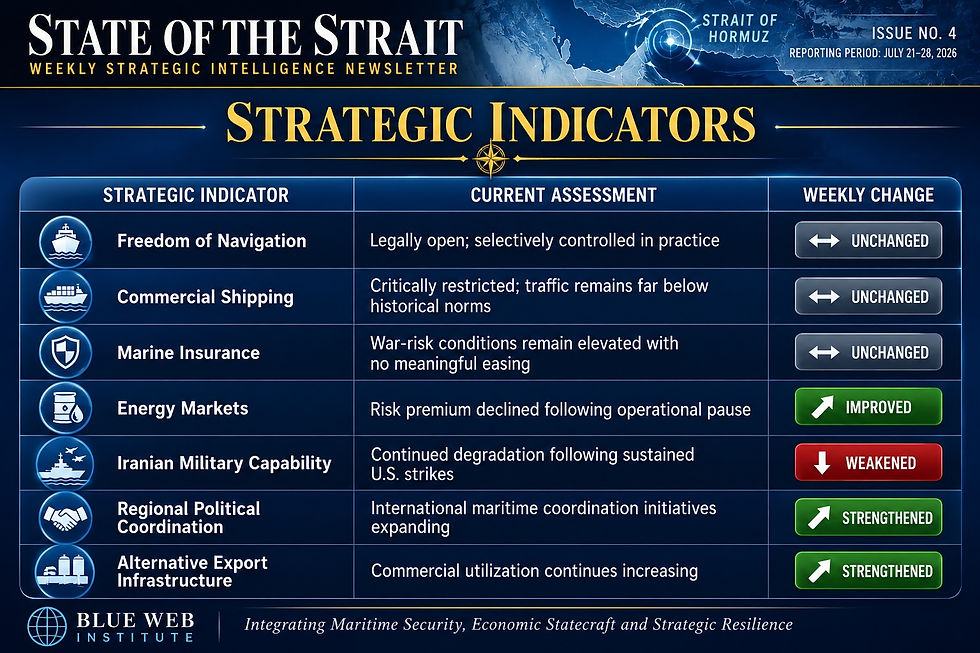
Strategic Indicators
Strategic Indicator | Current Assessment | Weekly Change |
Freedom of Navigation | Legally open; selectively controlled in practice | Unchanged |
Commercial Shipping | Critically restricted; traffic remains far below historical norms | Unchanged |
Marine Insurance | War-risk conditions remain elevated with no meaningful easing | Unchanged |
Energy Markets | Risk premium declined following operational pause | Improved |
Iranian Military Capability | Continued degradation following sustained U.S. strikes | Weakened |
Regional Political Coordination | International maritime coordination initiatives expanding | Strengthened |
Alternative Export Infrastructure | Commercial utilization continues increasing | Strengthened |
Strategic Overview
Issue No. 1 of State of the Strait argued that freedom of navigation is ultimately determined not by naval presence alone but by commercial confidence. Issue No. 2 demonstrated that maritime security itself had become an economic service purchased through insurance, sovereign guarantees, and credible military protection. Issue No. 3 concluded that regional governments had begun adapting structurally through alternative infrastructure rather than waiting for the Strait to normalize.
This week's developments reinforce each of those conclusions while adding a fourth.
Military de-escalation and commercial normalization are no longer moving together.
The suspension of U.S. strike operations produced an immediate response in financial markets, but almost none within commercial shipping. Vessel movements remained exceptionally limited despite the reduction in kinetic activity. Energy companies continued utilizing bypass routes where available, insurers maintained elevated risk assessments, and shipowners remained reluctant to expose high-value assets to continuing uncertainty.
The result is a growing separation between financial expectations and operational reality.
Markets increasingly price diplomacy.
Shipping continues pricing risk.
From a Blue Web perspective, this distinction is critical. Modern maritime conflicts are not decided solely through the destruction of military forces. They are decided through confidence. Once insurers, financiers, charterers, and shipowners alter long-established commercial behavior, restoring military stability alone may prove insufficient to restore normal trade.
Equally significant is the evolution of maritime governance itself. During the past week both the United States and Iran demonstrated active involvement in regulating commercial passage through the Gulf. Boarding operations, inspections, selective enforcement, and competing assertions of authority indicate that commercial navigation is increasingly shaped by administrative control rather than unrestricted passage.
The Strait therefore remains legally open while operating under conditions more closely resembling managed access than traditional freedom of navigation.
This distinction is likely to remain one of the defining strategic characteristics of the conflict moving forward.
STATE OF THE STRAIT
Issue No. 4
Section 2 — Military Situation, Blockade Enforcement, and Economic Warfare
Military Situation
The reporting period marked the first significant operational transition since the opening weeks of the conflict. After thirteen consecutive nights of precision strikes against Iranian military infrastructure, U.S. offensive air operations entered a temporary pause. The strikes had systematically targeted coastal anti-ship missile batteries, drone launch facilities, air-defense systems, command-and-control nodes, logistics centers, naval facilities, and selected transportation infrastructure supporting the Islamic Revolutionary Guard Corps (IRGC).
By the end of the reporting period, no official indication suggested that the strategic objectives of the campaign had changed. Rather, the operational pause appears intended to consolidate previous gains while reducing escalation risks and allowing diplomatic initiatives to proceed.
This distinction is important.
A pause in offensive operations does not necessarily represent a reduction in military pressure.
Instead, the United States appears to be shifting emphasis toward preserving its operational gains while maintaining overwhelming maritime superiority throughout the Gulf region.
From a military perspective, the cumulative effect of thirteen consecutive nights of strikes has substantially degraded Iran's ability to contest coalition naval operations through conventional means. Coastal surveillance networks have been disrupted, missile launch capability reduced, and naval infrastructure damaged across multiple locations. Although Iran retains significant asymmetric capabilities—including mines, fast attack craft, drones, and proxy forces—its conventional maritime posture has become progressively weaker.
Blockade Enforcement
The most important military development during the reporting period was not an airstrike.
It was the continued demonstration that the maritime blockade has evolved into an active enforcement operation.
Unlike the early phase of the conflict, when the blockade existed primarily as a declared economic policy, coalition naval forces are now exercising selective control over commercial shipping. Boarding operations, cargo verification, inspections, and vessel redirection have demonstrated that maritime enforcement has become an operational reality.
This distinction fundamentally changes the character of the conflict.
Traditional blockades seek to prevent commerce.
The present system seeks to regulate commerce.
Compliant vessels continue to move under carefully monitored conditions while suspected sanctions violators face inspection, diversion, or denial of passage. This produces a maritime environment that remains technically open but operationally controlled.
Such an approach offers several strategic advantages.
First, it preserves freedom of navigation for legitimate international commerce, reducing diplomatic friction with Gulf partners and major energy consumers.
Second, it concentrates economic pressure on Iranian petroleum exports and sanctions-evasion networks rather than indiscriminately restricting global shipping.
Third, it allows military pressure to continue even during periods when offensive strike operations have temporarily paused.
The resulting strategy reflects a broader shift from battlefield attrition toward sustained maritime governance.
Competing Maritime Control Systems
The reporting period also highlighted a growing competition over who exercises practical authority within the Strait.
Iranian officials continued asserting that commercial vessels should follow Iranian-designated navigation procedures and publicly claimed responsibility for regulating certain commercial movements. Although many of these claims cannot be independently verified, their strategic purpose is evident: Tehran seeks to demonstrate that commercial access to the Gulf ultimately depends upon Iranian acquiescence.
The United States is advancing an opposing model.
Rather than recognizing Iranian authority, coalition naval forces are exercising their own inspection regime while maintaining that international navigation remains protected under international law.
Consequently, commercial shipping increasingly operates between two competing systems of maritime administration.
Neither side has physically closed the Strait.
Instead, each is attempting to establish itself as the credible guarantor—or regulator—of maritime commerce.
This represents a significant evolution from the traditional concept of freedom of navigation. Instead of unrestricted passage, commercial operators increasingly face a managed-access environment shaped by military presence, sanctions enforcement, insurance requirements, and political risk.
From the Blue Web perspective, this is one of the most strategically significant developments observed since the conflict began.
Economic Warfare
The military campaign continues to support a broader strategy of economic coercion.
The cumulative effect of military operations, sanctions, insurance costs, and commercial uncertainty has substantially reduced the efficiency of Iran's export system without requiring the physical closure of the Strait.
Rather than targeting energy markets directly, coalition strategy increasingly appears designed to raise the transaction costs associated with Iranian commerce.
Every additional inspection, insurance premium, voyage delay, rerouting decision, financing review, and compliance requirement contributes to this objective.
This approach aligns closely with the Blue Web concept of maritime economic statecraft, in which military force serves primarily to shape commercial behavior rather than simply destroy physical infrastructure.
Commercial confidence, rather than battlefield destruction, becomes the principal center of gravity.
Treasury and OFAC Developments
The principal financial development during the reporting period was the U.S. Treasury's continued expansion of sanctions targeting networks facilitating Iranian petroleum exports and sanctions evasion.
Most notably, OFAC announced additional actions against financial and commercial entities associated with Iranian businessman Babak Zanjani, long regarded as one of Tehran's principal sanctions-evasion facilitators. The designations targeted companies and individuals allegedly involved in moving, financing, and concealing Iranian oil transactions through complex international commercial structures.
These measures reinforce an important aspect of the current campaign.
Economic pressure is no longer focused solely on production.
Increasingly, it targets the financial architecture that enables petroleum exports to reach international markets.
By combining maritime inspections with sanctions enforcement, coalition strategy seeks to increase the costs and risks associated with every stage of Iran's export chain—from loading and shipping to financing and payment settlement.
No additional Iran-specific general licenses or major OFAC policy changes were announced during the reporting period beyond these expanded sanctions actions.
Section Assessment
The military picture this week reflects a transition from kinetic dominance to persistent maritime control.
Airstrikes may have paused, but economic warfare has not.
Indeed, the blockade, sanctions regime, maritime inspections, and commercial uncertainty increasingly represent the principal instruments through which pressure is being applied against Iran.
For commercial shipping, the distinction is largely academic.
Whether the threat comes from missiles, inspections, sanctions, insurance markets, or political uncertainty, the result remains the same:
Normal commercial confidence has yet to return to the Strait of Hormuz.
STATE OF THE STRAIT
Issue No. 4
Section 3 — Energy Markets, Commercial Shipping, AIS Activity, Marine Insurance, and Alternative Export Infrastructure
Energy Markets
Energy markets experienced their first significant repricing since the conflict entered its most intense phase. Following the suspension of U.S. strike operations, traders rapidly reduced the geopolitical risk premium that had driven Brent crude briefly above $100 per barrel during the previous week.
By the close of the reporting period, Brent crude had retreated to approximately $85.83 per barrel, while West Texas Intermediate (WTI) declined to roughly $80.63 per barrel. Equity markets likewise responded favorably as investors increasingly anticipated a period of diplomatic engagement rather than immediate military escalation.
At first glance, these price movements could suggest that the crisis is easing.
A closer examination indicates otherwise.
Oil futures primarily reflect expectations regarding future supply. Commercial shipping, by contrast, reflects the willingness of shipowners, insurers, charterers, and cargo owners to assume present risk.
Those two assessments are no longer moving together.
Financial markets have begun pricing the possibility of stabilization.
Commercial maritime operators continue pricing uncertainty.
This divergence represents one of the most important strategic indicators observed during the reporting period.
Physical Markets versus Financial Markets
Another important distinction emerged during the week between paper markets and physical energy markets.
While benchmark futures contracts declined on improving diplomatic expectations, physical crude markets remained considerably tighter. Regional refiners continued competing for barrels that could reach market without traversing the most heavily contested shipping lanes. Freight costs, insurance premiums, and delivery uncertainty continued influencing actual transaction costs beyond what was reflected in benchmark futures prices.
In practical terms, energy consumers purchasing physical cargoes often faced substantially higher delivered costs than suggested by daily Brent or WTI quotations.
This distinction reinforces a recurring Blue Web principle.
The price of oil alone does not adequately measure the economic effects of maritime conflict.
Transportation costs, Insurance, Voyage Delays, Financing Costs,Delivery Certainty, together these factors increasingly determine the effective cost of energy during periods of sustained maritime disruption.
Commercial Shipping
Commercial shipping through the Strait of Hormuz remained severely constrained throughout the reporting period.
Although the Strait never formally closed, traffic volumes continued operating at only a fraction of normal levels. Available commercial tracking data suggest that daily transits remained well below pre-conflict averages, with only a handful of commodity vessels moving through the waterway on most days.
Perhaps more importantly, no meaningful recovery occurred following the operational pause in U.S. strike activity.
This observation carries considerable analytical significance.
If military operations had been the principal obstacle to commercial navigation, one would reasonably expect shipping activity to increase once bombardment ceased.
Instead, vessel movements remained depressed.
Commercial operators appear to be responding less to the immediate tactical environment than to the broader uncertainty surrounding sanctions enforcement, inspection regimes, insurance costs, and competing assertions of maritime authority.
Confidence—not merely physical security—remains the limiting factor.
AIS Activity and Tanker Movements
Automatic Identification System (AIS) data continued providing valuable insight into commercial behavior while becoming progressively less complete.
Throughout the reporting period, numerous vessels either reduced or entirely disabled public AIS transmissions while operating within or approaching the Gulf. Others adopted routing patterns hugging coastlines or minimizing publicly visible voyage information until safely clear of the region.
These practices complicate open-source analysis.
Public AIS should therefore be interpreted as identifying broad trends rather than providing an exact census of commercial traffic.
Nevertheless, several consistent conclusions emerge.
First, commercial shipping remains selective.
Second, many operators continue exercising extraordinary caution.
Third, tanker movements increasingly favor established exporters outside Iranian control whenever practical.
Finally, the continued suppression of AIS signals itself constitutes an indicator of elevated operational risk.
Ships operating under normal commercial conditions rarely feel compelled to obscure their movements.
Marine Insurance
No verified reduction in Gulf war-risk premiums occurred during the reporting period.
Although oil prices declined, marine insurers continued treating the region as an exceptionally high-risk operating environment. Underwriters remain concerned not only with missile or drone attacks but also with inspections, delays, sanctions compliance, crew safety, and the evolving legal environment surrounding commercial transit.
Insurance markets therefore continue reflecting long-term operational uncertainty rather than short-term battlefield developments.
This distinction mirrors the divergence now visible between financial markets and commercial shipping.
Investors may believe conditions are improving.
Marine insurers remain considerably more cautious.
Their continued pricing behavior suggests that the commercial maritime industry has not yet accepted the view that the crisis is approaching resolution.
Alternative Export Infrastructure
One of the clearest long-term trends remains the acceleration of alternative export infrastructure throughout the region.
Saudi Arabia continued expanding operational use of the East-West Pipeline and Mediterranean export facilities to reduce dependence upon the Strait of Hormuz. The United Arab Emirates likewise maintained utilization of the Abu Dhabi Crude Oil Pipeline terminating at Fujairah, allowing selected exports to bypass the Strait entirely.
These developments should not be viewed as temporary emergency measures.
Increasingly, they represent structural adaptations to a changing maritime security environment.
Governments and energy producers are investing in resilience rather than assuming that unrestricted access through Hormuz will soon return.
The Bab el-Mandeb, however, continues complicating this strategy.
Although vessel traffic improved modestly during the reporting period, Houthi attacks against Saudi infrastructure and commercial shipping demonstrate that bypassing Hormuz does not necessarily eliminate strategic risk.
Instead, regional exporters now confront a broader challenge.
The Gulf's principal energy corridors have become increasingly interconnected.
Disruption within one maritime chokepoint places additional pressure upon the others.
Blue Web Assessment
The week's developments reinforce a broader conclusion that has steadily emerged throughout this series.
Markets may recover quickly.
Shipping does not.
Commercial maritime systems require confidence, predictability, and legal certainty before capital-intensive assets such as Very Large Crude Carriers return to normal operating patterns.
That confidence has not yet returned.
Instead, regional governments continue investing in bypass infrastructure, insurers maintain elevated premiums, shipowners remain cautious, and commercial routing continues adapting to a more fragmented maritime environment.
From the Blue Web perspective, this represents a transition from crisis response to strategic adaptation.
Rather than waiting for the Strait to normalize, governments and commercial actors are redesigning the regional energy transportation network to function despite persistent geopolitical instability.
This may prove to be one of the most enduring consequences of the 2026 Hormuz crisis.
STATE OF THE STRAIT
Issue No. 4
Section 4 — Political Developments, Regional Diplomacy, Media Perspective, and Blue Web Assessment
Political Developments
The political environment surrounding the Strait of Hormuz evolved considerably during the reporting period. Although military activity diminished, diplomatic activity accelerated as regional governments sought mechanisms to prevent a renewed disruption of global energy flows.
Oman resumed its traditional role as a regional intermediary by promoting discussions aimed at reducing tensions in the Gulf while preserving uninterrupted commercial navigation. Muscat's efforts reflected a long-standing Omani policy of maintaining communication with all major regional actors while positioning itself as a facilitator rather than a participant in regional conflicts.
At the same time, the United States and several allied governments began discussing broader multinational arrangements for protecting commercial shipping. Rather than relying exclusively upon U.S. naval power, policymakers increasingly emphasized the importance of shared maritime security responsibilities among regional and international partners.
This represents an important political evolution.
The objective is no longer simply restoring access to the Strait.
It is restoring international confidence in the system that governs maritime commerce.
Regional Adaptation
Perhaps the most significant political trend observed during the week was the continued willingness of Gulf governments to adapt rather than wait for the crisis to resolve.
Saudi Arabia, the United Arab Emirates, and other regional producers continued investing political and financial capital into export diversification. Pipeline utilization increased, Mediterranean loading options expanded, and alternative logistics planning became increasingly institutionalized.
These initiatives reflect an important realization.
Even if military tensions decline, the strategic vulnerability created by excessive dependence upon a single maritime chokepoint remains.
Consequently, regional governments appear increasingly committed to creating redundant export capacity capable of functioning under a wide range of future security conditions.
This adaptation extends beyond infrastructure.
Regional political coordination among Gulf partners has also strengthened. Intelligence sharing, maritime surveillance, energy planning, and commercial coordination have become increasingly integrated as governments seek to reduce collective vulnerability.
Rather than responding individually to maritime threats, Gulf states are gradually constructing a more coordinated regional resilience framework.
The Expanding Maritime Battlespace
Events in the Red Sea continued demonstrating that the Strait of Hormuz cannot be analyzed in isolation.
Houthi attacks against Saudi infrastructure and commercial shipping reinforced the reality that multiple maritime corridors now influence one another. Export capacity bypassing Hormuz frequently depends upon transit through Bab el-Mandeb, where commercial traffic remains vulnerable to missile, drone, and maritime attacks.
This interconnectedness has become one of the defining characteristics of the conflict.
Rather than confronting a single chokepoint, energy exporters increasingly face a network of maritime vulnerabilities extending from the Arabian Gulf through the Red Sea into the Eastern Mediterranean.
The implication is significant.
Success in securing one corridor may provide only limited economic benefit if alternative routes remain contested.
Future regional security planning will therefore require integrated approaches rather than isolated solutions focused exclusively upon Hormuz.
Media Perspective
Coverage during the reporting period reflected an increasingly noticeable divergence between financial reporting and maritime reporting.
Financial media largely emphasized falling oil prices, recovering equity markets, and the apparent reduction in immediate military risk following the pause in U.S. air operations. Headlines increasingly suggested that markets believed the crisis had entered a period of stabilization.
Specialized maritime publications presented a different picture.
Shipping analysts continued focusing upon reduced vessel traffic, elevated insurance costs, sanctions compliance, routing decisions, and persistent operational uncertainty. Reports consistently noted that commercial behavior remained unusually cautious despite improvements in headline market indicators.
Both perspectives are factually correct.
They simply observe different components of the same system.
Financial markets evaluate expectations.
Maritime markets evaluate operational risk.
The distinction is essential for policymakers. Measuring the success of maritime security policy solely through commodity prices risks overlooking continuing structural disruptions within global shipping networks.
Blue Web Strategic Assessment
The fourth issue of State of the Strait reinforces a central proposition of the Blue Web Doctrine.
Modern maritime power extends well beyond naval superiority.
Military operations can destroy missile batteries.
They cannot immediately restore insurance confidence.
Air campaigns may suppress hostile capabilities.
They cannot instantly persuade charterers to commit billion-dollar cargoes to uncertain routes.
Markets can reduce a geopolitical risk premium within hours.
Commercial shipping often requires weeks or months of demonstrated stability before normal operating patterns return.
The reporting period illustrates this distinction with unusual clarity.
The United States achieved substantial military success during thirteen consecutive nights of precision strikes. Those operations significantly weakened Iran's conventional maritime capabilities and reduced its ability to threaten coalition naval forces directly.
Yet commercial behavior changed very little.
Shipowners remained cautious.
Insurers maintained elevated war-risk assessments.
Alternative export infrastructure continued expanding.
Regional governments continued planning for prolonged instability.
These developments suggest that the decisive factor has shifted from military capability to commercial confidence.
This is precisely where Blue Web places its emphasis.
The objective of maritime strategy should not merely be reopening a sea lane.
It should be restoring the conditions under which global commerce willingly chooses to use it.
Those conditions include legal predictability, credible security guarantees, manageable insurance costs, transparent sanctions enforcement, and confidence that today's voyage will not become tomorrow's political crisis.
Measured against those criteria, the Strait of Hormuz remains in transition.
It is no longer experiencing the acute shock of the opening weeks of conflict.
Neither has it returned to normal commercial function.
Instead, the region has entered what may prove to be the longest phase of the crisis:
Strategic adaptation.
Governments, insurers, energy producers, financiers, and commercial shipping companies are no longer waiting for the conflict to end.
They are redesigning the regional maritime system to function despite it.
If that process continues, historians may ultimately view the 2026 Hormuz crisis not as the event that temporarily disrupted global energy trade, but as the catalyst that permanently reshaped it.
STATE OF THE STRAIT
Issue No. 4
Section 5 — What to Watch, Further Reading, Conclusion, Methodology, and Endnotes
What to Watch
The coming week will provide important indications regarding whether the current operational pause represents a temporary lull or the beginning of a more durable transition. Several indicators deserve particularly close attention.
1. Commercial Shipping Recovery
The single most important indicator remains commercial traffic through the Strait of Hormuz.
Should daily tanker and bulk carrier transits begin increasing materially, confidence may gradually be returning to the maritime market. Conversely, if vessel counts remain well below historical norms despite reduced military activity, it would reinforce the assessment that commercial concerns—not battlefield conditions—have become the primary constraint on navigation.
2. Marine Insurance
War-risk insurance remains one of the best leading indicators of commercial confidence.
Any measurable reduction in premiums or broader underwriting participation would signal improving market conditions. Continued elevated premiums, restrictive policy language, or additional voyage exclusions would indicate that insurers remain unconvinced that operational risk has materially declined.
3. Alternative Export Infrastructure
Watch for additional utilization of Saudi Arabia's East-West Pipeline, expanded Mediterranean loading operations, increased exports through Fujairah, or announcements of new regional infrastructure investments.
Each additional bypass project reduces the strategic leverage historically associated with the Strait of Hormuz.
4. Treasury and Sanctions
Future OFAC actions targeting shipping companies, financial facilitators, insurers, flag registries, or petroleum trading networks would suggest continued emphasis on financial pressure rather than expanded military operations.
Likewise, any new general licenses affecting maritime commerce could provide important signals regarding Washington's broader strategic objectives.
5. CENTCOM Operations
Although offensive strike operations paused during the reporting period, maritime enforcement continues.
Particular attention should be given to:
Boarding operations
Vessel inspections
Diversions
Blockade enforcement
Maritime security operations
Freedom of navigation activities
These actions increasingly define the operational environment more than airstrikes alone.
6. Regional Political Coordination
Continued discussions involving Oman, Gulf Cooperation Council members, European governments, and Asian energy importers should be monitored for evidence of a longer-term multinational maritime security framework.
A durable coalition focused upon commercial assurance rather than combat operations would represent one of the most significant strategic outcomes of the crisis.
Further Reading
Readers seeking additional background on this week's developments may find the following organizations and publications useful:
U.S. Central Command (CENTCOM)
U.S. Department of the Treasury – Office of Foreign Assets Control (OFAC)
Lloyd's List
Joint Maritime Information Center (JMIC)
Reuters
Kpler
International Energy Agency (IEA)
Energy Information Administration (EIA)
International Maritime Organization (IMO)
International Chamber of Shipping (ICS)
Conclusion
The fourth issue of State of the Strait marks an important milestone in the evolution of the crisis.
The reporting period demonstrated that military success and commercial recovery are not synonymous.
Although offensive air operations paused, maritime commerce remained constrained. Although oil futures retreated, insurers and shipowners continued behaving cautiously. Although diplomatic initiatives expanded, governments accelerated investment in alternative export infrastructure rather than assuming a rapid return to previous commercial patterns.
These developments point toward a broader strategic conclusion.
The 2026 Hormuz crisis is no longer defined primarily by military confrontation.
It is increasingly characterized by economic adaptation.
Regional governments are redesigning infrastructure.
Commercial operators are adjusting routing decisions.
Financial institutions are modifying risk assessments.
Insurers continue recalibrating exposure.
Energy producers are diversifying export options.
Together, these responses illustrate a gradual transformation of the regional maritime system rather than a temporary interruption.
From the perspective of the Blue Web Doctrine, this evolution confirms that maritime strategy extends well beyond naval operations. The decisive variables increasingly involve finance, insurance, logistics, commercial confidence, infrastructure resilience, and international coordination.
Whether these adaptations ultimately restore long-term stability or produce a permanently altered energy transportation network remains uncertain.
What is becoming increasingly clear, however, is that the strategic effects of the crisis will likely outlast the military operations that initiated it.
Methodology
State of the Strait applies the analytical framework developed in the Blue Web Doctrine, integrating military operations, maritime commerce, energy markets, financial systems, insurance, logistics, and regional diplomacy into a unified assessment of maritime strategic conditions.
Rather than evaluating isolated events, the newsletter focuses on identifying persistent trends that influence freedom of navigation, commercial confidence, and the long-term resilience of global energy transportation systems.
Primary source material is drawn from official government releases, commercial maritime reporting, energy-market data, shipping intelligence services, and open-source reporting. Information is evaluated across four analytical levels:
Tactical — Individual military or commercial events.
Operational — Campaigns, shipping patterns, and enforcement activities.
Strategic — Government policy, economic pressure, and regional coordination.
Systemic — Long-term changes affecting the structure of global maritime commerce.
Assessments reflect the best available information as of Tuesday, July 28, 2026, and are intended to identify evolving trends rather than predict specific future events.
Selected Endnotes
U.S. Central Command (CENTCOM), official operational releases, July 2026.
U.S. Department of the Treasury, Office of Foreign Assets Control (OFAC), Iran sanctions releases, July 2026.
Reuters, coverage of Strait of Hormuz shipping, energy markets, and regional diplomacy, July 21–28, 2026.
Lloyd's List, reporting on Gulf war-risk insurance and commercial shipping conditions, July 2026.
Kpler, commercial tanker movement and vessel traffic analytics, July 2026.
Joint Maritime Information Center (JMIC), regional maritime security reporting.
International Energy Agency (IEA), oil market assessments.
U.S. Energy Information Administration (EIA), petroleum market data.
International Maritime Organization (IMO), maritime safety guidance.
International Chamber of Shipping (ICS), industry operational guidance.
Additional Research from the Blue Web Institute
The State of the Strait newsletter provides weekly operational assessments of developments affecting the Strait of Hormuz and global maritime security. Readers interested in the broader strategic concepts behind these assessments may wish to explore the following publications.
Blue Web Doctrine: Maritime Strategy for the Twenty-First Century
The Blue Web Doctrine examines how military power, maritime commerce, finance, insurance, logistics, and energy infrastructure increasingly function as a single strategic system.
Rather than viewing naval operations independently, the Doctrine introduces a framework for understanding how economic statecraft and commercial confidence have become central components of modern maritime strategy.
Topics include:
Maritime Economic Statecraft
Commercial Confidence as a Strategic Objective
War Insurance and Sovereign Maritime Assurance
Alternative Export Infrastructure
Integrated Maritime Security
The future of naval and economic power
Available in Kindle and Paperback editions through Amazon.
About the Author
Francis J. Bell is an independent researcher specializing in maritime strategy, international security, and economic statecraft. He is the author of Blue Web Doctrine: Maritime Strategy for the Twenty-First Century and publisher of the State of the Strait intelligence newsletter through the Blue Web Institute.
Enjoying State of the Strait?
Subscribe for weekly strategic assessments of the Strait of Hormuz, maritime security, energy markets, and global shipping. For a deeper exploration of the concepts behind this newsletter, see Blue Web Doctrine: Maritime Strategy for the Twenty-First Century and other Blue Web Institute publications.


Comments