
STATE OF THE STRAITWeekly Strategic Intelligence NewsletterIssue No. 6
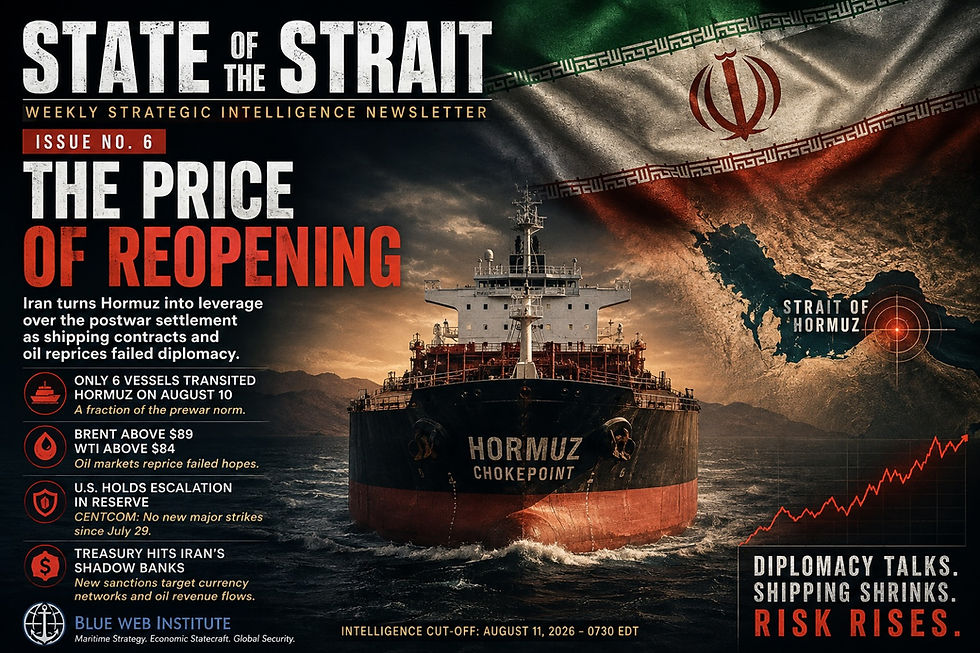
The Price of Reopening
Iran turns Hormuz into leverage over the postwar settlement as shipping contracts and oil reprices failed diplomacy.
Reporting Period: August 4–11, 2026Information Cutoff: Tuesday, August 11, 2026 — 0730 EDTPublished by the Blue Web Institute
Executive Summary
The sixth week of the Strait of Hormuz crisis produced the clearest evidence yet that Iran no longer views reopening the waterway as a narrow maritime question. Tehran is attempting to use commercial passage as leverage over the broader postwar settlement, demanding sanctions relief, release of frozen assets, compensation for war damage, an end to the U.S. counterblockade, and broader changes in American regional policy before normal navigation resumes. Negotiations with Oman over shipping lanes may be approaching technical agreement, but Iranian officials now explicitly distinguish between agreeing upon the mechanism for passage and actually reopening the Strait.
The commercial system responded accordingly. Only six vessels transited Hormuz on Monday, August 10, compared with a ten-day average of roughly eleven and a prewar norm of approximately 130–140 daily movements. Four entered and only two exited. The outgoing vessels carried liquefied petroleum gas and residual fuel rather than the large crude volumes that would indicate meaningful normalization. The continuing imbalance between inbound and outbound traffic reinforces the assessment that the Strait remains a selectively penetrable corridor rather than a functioning international energy artery.
Oil markets reversed sharply. Brent rose above $89 per barrel Tuesday morning and WTI above $84, their highest levels since July 31, after a roughly 5% rise Monday. The movement was not caused by a major new destruction of producing capacity. Traders repriced the probability that diplomatic negotiations would fail to restore dependable energy flows. Middle Eastern oil exports fell from roughly 4.4 million barrels per day the previous week to about 3 million barrels per day, strengthening the connection between physical transportation constraints and benchmark prices.
At the same time, the United States continues to hold large-scale kinetic escalation in reserve. CENTCOM has announced no renewed major Iran strike campaign since the July 29 attack on IRGC targets. Public U.S. policy instead appears to combine military readiness, continuing blockade pressure, and an increasingly aggressive financial campaign. Treasury expanded sanctions against Iran's clandestine currency networks on August 7, targeting mechanisms used to retrieve and move overseas oil revenue.
Marine insurance remains a decisive constraint. The proposed Iran–Oman passage system has encountered serious opposition from shipowners and insurers because payments or fees connected to Iranian authorities could trigger U.S. sanctions and termination clauses in war-risk policies. Lloyd's List continues to characterize Hormuz risk as extreme even if a diplomatic arrangement is announced. The difficulty is therefore no longer simply finding a navigable route through the Strait. It is constructing a route that is simultaneously secure, legal, insurable, financeable, and commercially acceptable.
The reporting period is therefore best classified as:
Strategic overreach producing renewed operational deterioration.
Iran retains considerable leverage because global commerce still depends upon Hormuz. Yet by attaching increasingly expansive political demands to reopening the waterway, Tehran risks accelerating precisely the adaptations that reduce that leverage over time: bypass infrastructure, alternative sourcing, financial isolation, multinational maritime coordination, and increasingly formalized systems for protecting non-Iranian commerce.
The central assessment of Issue No. 6 is therefore:
Iran is attempting to convert control over passage into control over the peace settlement. In doing so, it may be placing the long-term strategic value of the Strait itself at risk.
Strategic Indicators
Strategic Indicator | Current Assessment | Weekly Change |
Freedom of Navigation | Legally open; selectively controlled and politically conditioned | Unchanged |
Commercial Shipping | Critically restricted; traffic declined again to six observable transits | Deteriorated |
Marine Insurance | Extreme war-risk environment; proposed passage regime remains commercially problematic | Unchanged |
Energy Markets | Risk premium rebuilding as diplomatic expectations deteriorate | Deteriorated |
Iranian Military Capability | Conventional maritime capability remains degraded, but coercive capacity persists | Unchanged |
Regional Political Coordination | Oman remains central intermediary; broader Gulf adaptation continues | Strengthened |
Alternative Export Infrastructure | Increasingly important as Hormuz negotiations stall | Strengthened |
Economic Pressure on Iran | Financial isolation and shadow-banking pressure intensifying | Strengthened |
LNG / Gas Security | Selective traffic remains possible, but dependable passage has not returned | Unchanged |
Strategic Overview
Issue No. 5 argued that financial markets had begun pricing peace while commercial shipping continued pricing risk.
Issue No. 6 demonstrates what happens when the diplomatic expectations behind that market optimism begin to unravel.
Iran and Oman appear to have made progress on the technical mechanics of navigation. Proposed concepts have included separate routes, coordination mechanisms, traffic-management responsibilities, and varying ideas regarding maritime-service charges. Iran subsequently stated that fee details were not yet formally under discussion, illustrating how fluid the negotiating framework remains.
Yet Tehran has simultaneously expanded what it expects in exchange for reopening the Strait.
Iranian officials now link normal passage to compensation for wartime damage, sanctions relief, release of frozen assets, termination of the U.S. blockade, and an end to broader American military pressure. The negotiations have therefore evolved from a maritime deconfliction exercise into a contest over the terms of the postwar political order.
That distinction is strategically significant.
A shipping lane can be negotiated.
A postwar settlement is substantially harder.
The widening Iranian demand set therefore reduces the probability that technical progress between Oman and Iran will automatically restore commercial flows.
The result is a curious contradiction.
The engineering problem of Hormuz may be becoming easier.
The political problem is becoming harder.
This week's commercial data reflect that reality. Six observable transits on Monday represent a substantial decline from even the already depressed ten-day average of eleven. Before the war, roughly 130–140 ships normally crossed each day. Traffic is therefore operating at a small fraction of normal commercial capacity.
The implications reach beyond shipping.
Oil markets are again moving primarily on the probability of transportation rather than the destruction of production infrastructure. Gulf equity markets weakened Tuesday as investors reassessed the probability of a U.S.–Iran agreement, while energy shares benefited from higher crude prices.
This reinforces a conclusion that has become increasingly important throughout the newsletter series:
The strategic center of gravity remains confidence.
Iran can threaten shipping without physically occupying the Strait.
The United States can degrade Iranian military capability without restoring shipping.
Oman can negotiate corridors without persuading insurers to cover them.
Markets can price peace without shipowners believing it.
The future of Hormuz therefore depends upon the interaction of all four systems.
Military Situation
United States
The most notable military development this week is what did not happen.
CENTCOM's official public-release record shows no renewed large-scale strike campaign against Iran after the July 29 response to attempted Iranian attacks. The most recent CENTCOM release since then is unrelated to combat operations.
That absence should not be interpreted as military disengagement.
Washington continues to maintain the blockade and regional military posture while diplomacy and economic pressure operate in parallel. The more plausible interpretation is that military escalation is presently being held in reserve rather than abandoned.
This creates strategic flexibility.
If diplomacy succeeds, Washington avoids additional expenditure of munitions and further escalation.
If Iran attacks American forces or commercial shipping at sufficient scale, the United States retains the option to resume strikes.
The current posture can therefore be described as armed restraint.
Iran
Iran's surviving coercive capability remains substantial even after months of strikes.
The principal Iranian advantage is no longer conventional sea control. It is the ability to impose uncertainty.
Commercial operators must consider missile attacks, drones, mines, inspections, navigation directives, sanctions exposure, and the possibility that an apparent diplomatic opening could reverse rapidly.
Iran therefore continues achieving interdiction by risk rather than by physical occupation of the waterway.
The difficulty for Tehran is that the same strategy that creates short-term bargaining leverage also imposes long-term costs.
Every week of unreliable passage encourages:
greater use of Fujairah;
expansion of Saudi east-west export capacity;
Mediterranean alternatives;
replacement crude purchases;
higher investment in maritime protection;
and commercial planning that assumes Hormuz may not always be dependable.
Iran can therefore win individual bargaining rounds while weakening the structural foundation of its leverage.
Military Assessment
The current military balance remains asymmetric.
The United States retains overwhelming strike and naval superiority.
Iran retains enough distributed capability to create substantial commercial uncertainty.
Neither fact contradicts the other.
This is why counting destroyed launchers or daily transits alone cannot determine strategic success.
The decisive question is whether Iran's remaining capability is sufficient to prevent commercial normalization.
Current evidence indicates that it is.
Economic Warfare
The financial campaign expanded significantly during the reporting period.
On August 7, Treasury targeted Iranian clandestine currency networks operating across several jurisdictions and accused them of helping Iran retrieve and move hundreds of millions of dollars generated through overseas commerce, including petroleum sales. Treasury described this as its eighth action of 2026 targeting Iran's shadow-banking apparatus.
The action is particularly relevant to State of the Strait because the economic campaign is increasingly targeting every stage of Iran's commercial system:
production,
transportation,
insurance,
shipping,
payment,
currency conversion,
and repatriation of revenue.
Earlier OFAC actions targeted Iranian maritime insurance companies and shadow-fleet vessels. The August 7 action moves farther downstream into the financial networks used to recover export proceeds.
This represents an increasingly comprehensive form of economic warfare.
The objective is not simply to stop Iranian oil from leaving port.
It is to make the entire transaction progressively more difficult to complete.
The Insurance Problem
The proposed Hormuz passage arrangement illustrates how thoroughly maritime finance has become integrated into the conflict.
Industry sources have warned that an Iran–Oman scheme involving transit payments could be commercially unworkable. U.S. sanctions prohibit payments to designated Iranian maritime entities, while Lloyd's Market Association wording can terminate war-risk coverage when vessels make prohibited or specified Iranian passage payments.
This produces a potentially absurd but strategically revealing situation:
A vessel could receive permission to pass from the authority physically controlling part of the route while simultaneously losing the insurance and financial support necessary to make the voyage commercially viable.
That is not merely an insurance technicality.
It is the Blue Web contest in its purest form.
Military authority says the vessel may pass.
Sanctions law says the vessel may not pay.
The insurer says coverage may terminate.
The bank questions whether it can finance the transaction.
The shipowner declines the voyage.
The Strait remains physically navigable—and commercially restricted.
Energy Markets
The energy market reversed sharply during the reporting period as expectations for a rapid diplomatic settlement deteriorated.
Brent rose more than 2% Tuesday morning to approximately $89.81 per barrel, while WTI reached approximately $84.28. Both had already gained roughly 5% Monday as the U.S. and Iran exchanged harder demands regarding compensation and conditions for reopening the Strait.
The significance lies in what traders are pricing.
There has been no comparable destruction of Gulf production capacity sufficient to explain the move.
Instead, the market is repricing the probability that existing production can reach consumers.
Middle Eastern weekly exports reportedly fell from approximately 4.4 million barrels per day to 3 million barrels per day.
That figure reinforces one of the central conclusions of the entire State of the Strait series:
Available oil is not equivalent to deliverable oil.
Production.
Tankers.
Insurance.
Routes.
Ports.
Finance.
Security.
Each is necessary to convert underground reserves into delivered energy.
Commercial Shipping and AIS
Monday's six observable Hormuz transits represent one of the week's strongest indicators.
Four vessels entered and two exited. The outbound cargoes were LPG and residual fuel. That is far removed from the heavy flow of crude, products, LNG, bulk cargoes, and container traffic associated with a functioning prewar Strait.
Public AIS remains imperfect because some vessels operate with transponders disabled or reduce their visibility near high-risk waters.
But the scale of the decline cannot plausibly be explained by AIS suppression alone.
The more important evidence is behavioral.
Deeply discounted Iraqi crude has failed to attract normal tanker participation. Reuters previously reported Basrah grades offered at discounts approaching $30 per barrel while shipowners remained unwilling to accept the voyage risk.
That is one of the most revealing data points of the crisis.
Normally, price solves commercial problems.
Here, even extraordinary price incentives have struggled to overcome security, insurance, and legal risk.
Bab el-Mandeb and the Regional Network
Hormuz cannot be considered independently from the Red Sea.
Bab el-Mandeb traffic remains considerably healthier, with 25 vessels recorded Monday compared with a ten-day average of roughly 24. But Houthi attacks continue creating uncertainty, including recent attacks affecting Saudi energy infrastructure and shipping.
Saudi Aramco has delayed restarting its Jazan refinery following Houthi attacks. The effect is strategically important because the Gulf's principal alternative export system increasingly relies upon corridors that themselves remain exposed to coercion.
This creates a connected maritime battlespace:
Hormuz,
Fujairah,
the Red Sea,
Bab el-Mandeb,
Suez,
and Mediterranean terminals.
The system increasingly has to be assessed as a network rather than as isolated chokepoints.
Political Developments
Iran's Expanding Price for Reopening
The week's most important political development is Iran's decision to attach increasingly expansive conditions to normal passage.
Tehran is seeking war compensation, sanctions relief, release of frozen assets, termination of the counterblockade, and changes in U.S. military behavior. Iran's Foreign Ministry also continues rejecting direct negotiations with Washington while relying upon intermediaries.
From Iran's perspective, the logic is understandable.
Hormuz is one of Tehran's most valuable remaining bargaining assets.
If the United States and global markets desperately want the Strait normalized, Iran has little incentive to exchange that leverage cheaply.
The problem is the scale of the demand.
The more Iran attempts to extract from the crisis, the stronger the incentive becomes for outside powers and commercial institutions to reduce dependence upon Iranian cooperation altogether.
This is where the Iranian position begins to resemble strategic overreach.
Oman
Oman remains indispensable because it can communicate with nearly every major participant.
But its role is also becoming more complicated.
The Oman–Iran negotiations demonstrate that Muscat can help design technical mechanisms for restoring traffic. They do not demonstrate that Oman can resolve the underlying U.S.–Iran political confrontation.
This limits what mediation can accomplish.
Oman may help answer:
Which route?
Which lane?
Which authority coordinates traffic?
What emergency procedures apply?
It cannot independently answer:
Who compensates whom?
Which sanctions disappear?
Does the U.S. blockade end?
What happens to frozen Iranian assets?
Those questions belong to the broader settlement.
The distinction increasingly separates a Hormuz agreement from a Hormuz reopening.
Media Perspective
The media narrative again risks becoming trapped between two extremes.
One narrative treats every diplomatic announcement as evidence that reopening is imminent.
The other treats continued Iranian demands as evidence that a new large-scale war is inevitable.
The observable evidence supports neither conclusion.
Diplomacy remains active.
Military escalation remains restrained.
Shipping remains critically restricted.
Economic pressure is increasing.
Oil markets are repricing risk.
The current system is therefore neither peace nor unrestricted war.
It is coercive bargaining conducted through maritime commerce.
That is the more accurate description of the strategic environment.
Blue Web Strategic Assessment
Is Commerce More Secure?
No.
Observable Hormuz traffic fell again, commercial exits remain extremely limited, and insurers continue treating the region as an extreme-risk environment.
Is Iran Adapting?
Tactically, yes.
Strategically, less clearly.
Iran has shifted from attempting simply to close or tax the Strait toward using reopening as leverage over a much broader political settlement.
That is sophisticated coercion.
But it also increases the possibility of overreach.
Iran's strategy assumes the world's dependence on Hormuz remains greater than its willingness and ability to build alternatives.
That proposition becomes weaker with every additional week of disruption.
Is the United States Adapting?
Yes.
Washington increasingly combines military readiness with blockade enforcement and financial pressure instead of relying exclusively upon continuous air operations.
Treasury's August 7 action against shadow-banking networks demonstrates that economic pressure continues even while major strikes remain paused.
Are Markets Adapting?
Yes.
Markets have become extraordinarily sensitive to diplomatic probability rather than simply physical destruction.
The approximately 5% Monday oil move followed by another 2% Tuesday demonstrates how rapidly traders are repricing the expected duration of transportation disruption.
Are Insurers Adapting?
Yes—but in the opposite direction from policymakers.
Governments are trying to design mechanisms that allow traffic to resume.
Insurers are designing contract language that protects them from new political and sanctions risks.
That distinction may determine whether any diplomatic corridor succeeds.
Most Strategically Significant Development
Iran's decision to condition reopening Hormuz upon elements of the wider postwar settlement.
This transforms the Strait from a maritime-security problem into a bargaining instrument over sanctions, compensation, frozen assets, and regional military policy.
Largest Headline with Less Strategic Significance
Daily speculation over whether a peace agreement is imminent.
The negotiations matter. But until vessel counts, insurance prices, tanker fixtures, and export volumes materially change, diplomatic language should not be confused with commercial normalization.
Quiet Development with Potentially Major Significance
The growing incompatibility between proposed passage arrangements and the international insurance/sanctions system.
If the commercial world cannot legally pay for, insure, or finance the negotiated mechanism, governments may discover that they have produced a diplomatic solution without a usable maritime solution.
Iranian Strategic Overreach?
The answer is increasingly possibly yes.
Iran currently possesses genuine leverage.
The Strait remains critically important.
Shipping remains depressed.
Oil has risen sharply.
Tehran therefore has rational reasons to demand concessions.
But coercive leverage has diminishing returns.
If Iran attempts to convert temporary control over maritime risk into permanent entitlement to sanctions relief, compensation, transit authority, and regional political concessions, outside actors gain progressively stronger incentives to construct systems that circumvent Iranian leverage altogether.
The Blue Web framework predicts exactly this response.
Coercion encourages adaptation.
Adaptation reduces future coercive power.
The process may involve pipelines, ports, storage, insurance mechanisms, naval corridors, alternative suppliers, financial restrictions, and—if required—more aggressive security measures against Iranian positions directly affecting navigation.
Iran may therefore succeed in raising the immediate price of reopening Hormuz while simultaneously lowering the Strait's future value as a strategic weapon.
That would represent a classic strategic overplay.
What to Watch Next Week
The first indicator remains actual commercial traffic. A sustained return into double-digit daily tanker and LNG movements would matter far more than another political statement.
The second is insurance. Any significant reduction in war-risk premiums, cancellation of restrictive Iranian-payment clauses, or new sovereign underwriting arrangements would suggest that commercial reopening is becoming credible.
The third is OFAC. A General License or maritime guidance accommodating an Oman-mediated passage system would be a major signal that Washington intends to make a negotiated corridor commercially usable.
The fourth is Iran's demand set. Any narrowing from compensation, sanctions relief, frozen assets, and strategic concessions toward a limited maritime arrangement would materially improve the probability of reopening.
The fifth is CENTCOM. A renewed strike cycle would signal that Washington has concluded diplomacy is failing. Continued restraint combined with increasing Treasury pressure would indicate the opposite.
Finally, watch alternative infrastructure. Every additional cargo shifted through Fujairah, Saudi west-coast facilities, Mediterranean loading points, or non-Gulf suppliers represents a small but cumulative reduction in Hormuz's monopoly value.
Conclusion
The Strait of Hormuz crisis has entered a new phase.
Iran is no longer simply threatening commerce.
It is attempting to price the restoration of commerce.
That distinction transforms the strategic contest.
The question is no longer merely whether the United States possesses sufficient military power to reopen a maritime chokepoint.
It does.
The harder question is whether the United States, regional governments, insurers, shipowners, financial institutions, and energy markets can create a commercial architecture that reduces the value of Iranian permission.
That process is already underway.
Pipelines are carrying more strategic importance.
Alternative terminals are receiving greater attention.
Insurance has become an instrument of statecraft.
Sanctions increasingly attack the financial network supporting Iranian commerce.
Shipowners are rejecting cargoes whose discounts would normally be irresistible.
Markets now rise and fall on the probability that the transportation network will function.
Iran therefore faces a difficult strategic choice.
It can convert current leverage into a limited political settlement that restores commerce while preserving some influence.
Or it can continue raising the price of reopening until the international system concludes that dependence upon Iranian-controlled geography itself represents an unacceptable strategic vulnerability.
The second path may produce greater short-term concessions.
It may also accelerate the construction of the post-Hormuz world.
That is the central strategic question following Issue No. 6.
Methodology
The assessments presented in State of the Strait are based on comparative analysis of publicly available information, including energy prices, equity markets, maritime traffic, insurance conditions, official government statements, sanctions actions, and open-source reporting.
Interpretive conclusions represent the author's strategic assessment of observable trends rather than official positions of governments, financial institutions, insurers, or commercial market participants.
The newsletter distinguishes between tactical disruption, operational change, strategic evolution, and systemic transformation. Particular attention is given to differences between legal freedom of navigation and commercially viable navigation.
Endnotes
Reuters, “Gulf Shipping Traffic via Strait of Hormuz Falls to Six Vessels,” August 11, 2026.
Reuters, “Oil Climbs 2%, Extending Gains on Dimming U.S.-Iran Peace Hopes,” August 11, 2026.
Reuters, “Iran Says Oman Deal Is in ‘Final Stages’ but U.S. Must Act to Open Hormuz,” August 9, 2026.
Reuters, “Oil Climbs 5% as Iran, U.S. Both Demand Compensation and Hormuz Hopes Fade,” August 10, 2026.
Reuters, “Proposed Hormuz Passage Deal Not Feasible for Shipping Industry, Sources Say,” August 6, 2026.
Reuters, “Vessel Traffic Through Hormuz Dwindles This Week as Markets Watch Iran-Oman Talks,” August 7, 2026.
Reuters, “Proposed Hormuz Deal Would Give Iran Control of Inbound Traffic, Sources Say,” August 5–6, 2026.
U.S. Central Command, Public Releases, reviewed August 11, 2026.
U.S. Department of the Treasury, “Treasury Dismantles Iranian Regime's Global Clandestine Currency Networks,” August 7, 2026.
U.S. Department of the Treasury, “Treasury Disrupts Iranian Regime's Strait of Hormuz Extortion Network,” July 29, 2026.
U.S. Department of the Treasury, “Treasury Cracks Down on Global Networks Enabling Iran's Mahan Air and IRGC,” July 30, 2026.
Lloyd's List, “Hormuz Deal Nears, but Shipping Warned Risk Will Remain ‘Extreme,’” August 6, 2026.
Reuters/Kpler shipping data, August 3–11, 2026.
Reuters, Gulf equity-market coverage, August 11, 2026.
Reuters, reporting on Bab el-Mandeb traffic and Houthi attacks, August 2026.
U.S. Treasury/OFAC, Iran sanctions program and maritime guidance, reviewed August 11, 2026.
International Maritime Organization statements regarding free and nondiscriminatory navigation through international straits, as cited in contemporary shipping reporting.
Lloyd's Market Association insurance provisions concerning Iranian transit payments, as reported by Reuters, August 6, 2026.
Additional Research from the Blue Web Institute
Blue Web Doctrine: Maritime Strategy for the Twenty-First Century
Blue Web Doctrine examines the interaction of naval power, commercial shipping, insurance, finance, logistics, infrastructure, and economic statecraft. The current Strait of Hormuz crisis increasingly demonstrates why maritime strategy cannot be understood through military operations alone.
Available in Kindle and paperback editions through Amazon.
Recent Research
Recent and forthcoming Blue Web Institute research includes Stepping Stones to Security: Pacifying the Tunb Islands, examining options for reducing Iranian military leverage from Abu Musa, Greater Tunb, and Lesser Tunb; Who Pays When a Tanker Is Hit?, examining the financial and insurance architecture behind maritime losses; and PACIFICA, the Institute's weekly strategic intelligence newsletter covering the Indo-Pacific.
About the Author
Francis J. Bell is an independent researcher specializing in maritime strategy, international security, and economic statecraft. He is the author of Blue Web Doctrine: Maritime Strategy for the Twenty-First Century and publisher of the State of the Strait and PACIFICA newsletters through the Blue Web Institute.


Comments