
STATE OF THE STRAITWeek Ending Monday, October 12, 2026 | Cutoff: 20:40 EDT
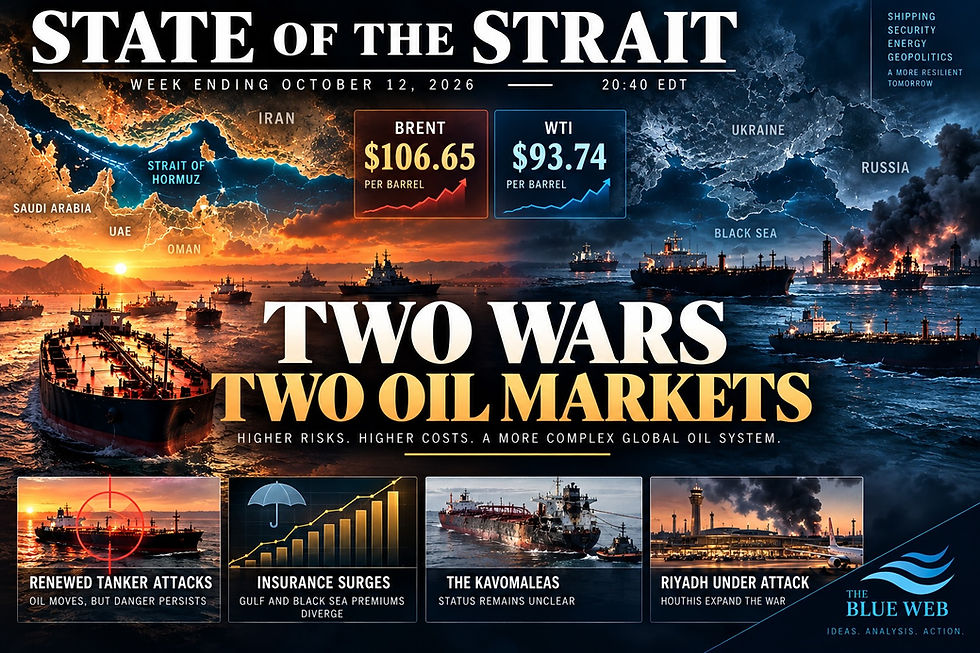
ARE WE SEEING A DIVERGENCE OF PRICING BEETWEEN THE STRAIT AND THE BLACK SEA?
THE WEEK AT A GLANCE
Two maritime wars, two insurance markets—and an increasingly expensive barrel of oil
This week's most consequential development may not be another attack on a tanker. It is emerging evidence that the global petroleum transportation system is fragmenting into distinct regional risk markets, even while crude oil continues to trade against international benchmarks.
For several weeks, State of the Strait has been tracking the possibility that the Arabian Gulf and Black Sea conflicts are beginning to produce different freight, insurance and petroleum-product pricing behavior. We now have substantially stronger evidence for that hypothesis. On October 9, S&P Global reported that Russian Black Sea tanker freight premiums were widening while comparable Baltic routes were moving in the opposite direction. On October 12, a Bulgarian petroleum executive reported that Black Sea tanker war-risk insurance had increased from approximately $200,000 to $2.5 million per voyage.
S&P Global
+1
The Gulf presents a different but equally troubling picture. At a meeting in Riyadh, OPEC and non-OPEC ministers warned that shipping and insurance expenses had climbed to more than one-third of commodity value in some energy movements. Meanwhile, crude tanker charter rates remain extraordinarily high, even after September's recovery in petroleum exports.
Reuters
+1
This is a major development for the Blue Web Doctrine. The international energy system is demonstrating that alternative routes can preserve physical supply without necessarily preserving the economic efficiency of moving that supply.
And Saudi Arabia faces another problem. The Houthi campaign has expanded from threatening the Kingdom's alternative maritime corridors to striking infrastructure central to its domestic economy. The attacks on Riyadh's airport demonstrate that Saudi Arabia's maritime and energy-security problem cannot be separated entirely from its broader national defense.
Reuters
+1
Our central assessment: The Gulf's transportation network has demonstrated resilience, but that resilience is becoming increasingly expensive. The Black Sea is developing its own separate risk premium, and the global tanker shortage is transmitting costs from one theater into the other.
1. Oil watch: the price divergence is becoming measurable
Brent crude · October 12 settlement
$106.65
Per barrel
WTI crude · October 12 settlement
$93.74
Per barrel
Reuters
+1
The benchmark spread is not itself evidence of an Arabia–Black Sea decoupling. Brent and WTI reflect different delivery locations and crude characteristics, and neither directly measures the premium for Russian Black Sea crude versus Arabian Gulf crude.
The stronger evidence comes from the physical freight market.
S&P Global's October 9 assessment found that tanker operators carrying Russian petroleum from Black Sea ports were earning increasing compensation for security, sanctions and voyage-execution risks. Comparable Baltic routes, however, were trading at discounts to their relevant freight benchmarks.
S&P Global
That is particularly revealing because it suggests that even Russian petroleum transportation is no longer being priced as one uniform risk category.
The Gulf has its own structure. Oil remains available, but extraordinary charter rates, ship-to-ship transfers, delays and insurance expenses are creating a substantial difference between the benchmark price of crude and the actual cost of delivering it.
We should therefore distinguish three separate propositions:
Confirmed: Freight pricing is diverging across routes, including Black Sea versus Baltic Russian exports.
Supported: Arabian Gulf and Black Sea shipping face distinct security and insurance risks.
Not yet demonstrated: A persistent, independently measurable decoupling of Arabian and Black Sea physical crude prices after controlling for quality, freight, sanctions and destination.
That third proposition remains the test for our original hypothesis.
2. Insurance watch: two war zones, different prices
Black Sea tanker insurance escalation
Reported per-voyage costs, cited October 12 by a Lukoil Bulgaria executive
Earlier reported cost
$200,000
Current reported cost
$2.5M
Reported Black Sea war-risk insurance cost
Per vessel/voyage; not a standardized market-wide quote.
$0$700K$1.4M$2.1M$2.8MEarlierOct 12
Increase: 12.5 times
Reported, not independently audited
Source: October 12 statements attributed to Evgeni Simeonov.
+1
For Hormuz, the most useful comparable evidence comes from the Lloyd's Market Association. In an October 1 interview with S&P Global, its marine and aviation head described additional war-risk premium rates more than 40 times their earlier headline levels, along with shortened coverage periods and fewer no-claim bonuses.
S&P Global
Measure | Strait of Hormuz | Black Sea |
Recent insurance evidence | More than 40-fold increase in headline additional war-risk rates | Reported rise from $200,000 to $2.5M per tanker voyage |
Main exposure | Missiles, drones, seizure, coercion, passage restrictions | Attacks on ships and ports, mines, sanctions, salvage difficulties |
Freight development | Gulf-to-China VLCC rates approaching $1M/day | Black Sea shadow-fleet rates widening against benchmarks |
Commercial effect | Higher delivered crude costs, slower ship turnaround | Higher export costs and a growing route-specific premium |
S&P Global
+2
These numbers cannot be compared directly as though they were identical insurance quotes. The Hormuz figure is a multiple of a premium rate, while the Black Sea figure is a reported dollar cost per voyage. Vessel values, insured periods, ownership, flags, cargoes and underwriting terms differ.
Nevertheless, they show the same phenomenon: maritime conflict is becoming an increasingly important determinant of petroleum economics.
There is also a less obvious consequence. Lloyd's has expanded its listed risk areas across both regions, and sanctions may complicate salvage and casualty response. A damaged ship that cannot quickly obtain assistance can generate a larger loss than its initial damage would suggest.
S&P Global
That issue deserves particular attention when we return to the Greek tanker Kavomaleas.
3. The Greek tanker Kavomaleas: what happened after Iran took it?
Kavomaleas
75,000 DWT product tanker, built 2025, operated by Dynacom Tankers Management and associated with George Procopiou.
The July incident remains particularly revealing because the vessel was reportedly in ballast when attacked. Iranian forces struck it near the Omani side of Hormuz, causing an engine-room fire and forcing the crew to abandon ship. The damaged vessel was subsequently towed into Iranian waters near Larak Island.
TradeWinds News
+1
Satellite imagery examined by maritime analysts subsequently identified an oil slick associated with Kavomaleas, as well as a separate slick associated with another unidentified vessel. Because Kavomaleas was not carrying a commercial oil cargo, analysts considered bunker fuel a likely source of the discharge.
Maritime Executive
+1
What has changed since July?
I could not establish a reliable, independently documented change in Kavomaleas's status through the October 12 cutoff. Specifically, I found no verified public confirmation that the vessel had been released, successfully salvaged, repaired, scrapped, or that the suspected bunker-fuel leakage had definitively stopped.
That does not establish that the ship is still leaking. It means the available public reporting does not resolve the question.
The distinction is important. We should not describe an ongoing environmental emergency solely from July satellite imagery, but neither should we assume that the problem was resolved simply because the ship disappeared from the headlines.
The strategic significance
The incident remains unusual for three reasons. First, Iran attacked a tanker reportedly carrying no commercial cargo. Second, Iranian forces subsequently took custody of the damaged vessel. Third, the resulting suspected bunker-fuel release threatened waters around Iran's own Larak and Qeshm islands.
It is reasonable to ask whether Iranian forces correctly identified the vessel, its cargo status and its intentions before the attack. But those questions remain hypotheses, not proof that Iran was firing indiscriminately at every visible ship.
The case also illustrates how a limited strike can become a prolonged salvage, environmental and insurance problem. The cost of an attack cannot be measured solely by the price of the weapon or the immediate damage.
The Kavomaleas case should remain open on our incident board until there is credible confirmation of the vessel's disposition and pollution outcome.
4. A record week for tanker attacks—and the danger of counting headlines
An October 7 Reuters report, citing maritime-security sources, placed the number of incidents in the September 28–October 5 period at at least twelve, including attacks, attempted attacks and harassment. That was the highest weekly incident count reported since the war began. The IMO had corroborated nine incidents at that stage.
Reuters
This reinforces a distinction we have made repeatedly: an incident count is not a vessel-loss count. An aggressive radio warning, drone overflight, projectile strike and catastrophic tanker fire should not be presented as equivalent military outcomes.
The new attacks nevertheless present a genuine threat to the shipping recovery. Reuters reported injuries to twelve crew members aboard the On Peace, demonstrating that the danger to seafarers is not merely theoretical.
Reuters
The commercial effect may exceed the direct physical damage, especially when attacks force vessel owners to reconsider routes, crews to accept greater risks and underwriters to raise premiums.
There is also a growing possibility that Iran's attacks and the U.S. blockade are becoming mutually reinforcing sources of shipping disruption. Washington's October 8 sanctions against seventeen additional vessels involved in Iranian petroleum trade extended the economic campaign beyond the physical blockade.
Reuters
5. Saudi Arabia: the war reaches the airport
The Houthi attacks on Saudi Arabia have expanded the strategic problem well beyond the oil-export network.
Repeated strikes on Riyadh's international airport, together with attacks reported against other Saudi infrastructure, have affected civilian aviation, investor confidence and the Kingdom's efforts to present itself as a reliable international business destination. Reuters reported fourteen deaths and hundreds of injuries in its October 12 assessment of the airport attacks.
Reuters
The immediate economic consequences are visible. Saudi equities weakened on October 12, while Brent rose as markets considered the possibility of further regional escalation.
Reuters
For Saudi Arabia, the issue is not simply defending another airport. The Kingdom has invested heavily in making Riyadh a global commercial and financial center. Repeated successful attacks threaten the perception of security on which that ambition depends.
This also complicates the Mecca Pact's developing role. A defense arrangement involving Saudi Arabia, Turkey and Pakistan must eventually be judged not merely by diplomatic solidarity but by its ability to contribute to actual defense requirements.
The most important requirements may turn out to be relatively unglamorous: persistent surveillance, early warning, layered air defense, interception capacity and the protection of civilian infrastructure.
The Houthis do not have to defeat the Saudi military to impose meaningful economic costs. They can exploit the disparity between inexpensive offensive weapons and the expensive defensive systems required to stop them.
6. Russia's diesel deal: a test of the decoupling hypothesis
The announced U.S.-Russia diesel arrangement adds another dimension to our oil-market analysis.
President Trump announced an agreement under which Russia would release more than 300,000 metric tons of diesel initially, with additional volumes expected later. He also announced an energy-infrastructure ceasefire between Russia and Ukraine. But by October 12, Kyiv was reporting new Russian attacks against Ukrainian energy facilities, and there was no verified, mutually accepted ceasefire framework.
Reuters
+1
The petroleum market's reaction is instructive. Early expectations of additional Russian diesel pushed European gasoil futures lower, while continued Gulf attacks and uncertainty about the proposed ceasefire subsequently helped lift Brent to $106.65 at Monday's settlement.
live
+1
This is not proof of complete market decoupling. In fact, the events show how the two theaters remain connected through global pricing. But they also demonstrate that a development affecting Russian diesel can move refined-product prices differently from a development affecting Arabian crude transportation.
The commercial implications could be substantial. Refiners buying crude, shipowners carrying it and customers buying finished diesel are increasingly facing different combinations of risk. That makes regional pricing, product margins and freight costs more informative than a single headline Brent quotation.
7. Qatar: the recovery remains far from complete
The Gulf's crude recovery has not been matched by a comparable restoration of LNG supply.
Reuters' October 12 assessment indicated that Qatari LNG exports in September remained at roughly one-quarter of their prewar level, with damage at Ras Laffan having eliminated approximately 17% of export capacity. The outlook for October remained difficult despite the successful movement of individual LNG carriers through Hormuz.
Reuters
This reinforces the distinction we have drawn between individual successful voyages and the restoration of a complete commercial system.
Saudi Arabia can reroute crude through pipelines, terminals and storage arrangements. Qatar's LNG infrastructure is more concentrated, its ships are specialized and its ability to improvise alternative export pathways is far more limited.
The Blue Web lesson is that resilience must be built before a crisis. It cannot always be purchased or improvised once the conflict begins.
8. Blue Web Watch: the cost of redundancy becomes the next battlefield
Last week's issue argued that the Gulf transportation network had demonstrated resilience. The East-West Pipeline was repaired, alternative routes continued operating, and the volume of petroleum moving from the region had recovered substantially.
This week's insurance and freight evidence reveals the next challenge.
A network can remain physically functional while becoming progressively less economical to operate.
The extraordinary charter rates on Gulf-to-Asia routes, the widening Black Sea tanker premiums and the reported escalation in war-risk insurance show how military disruption can spread through a transportation system without destroying its infrastructure.
Even producers far removed from Hormuz are affected. Reuters reported on October 12 that heavy crude was accumulating in the Americas because tanker shortages and extraordinary freight costs made some export movements uneconomical, despite demand elsewhere.
Reuters
That is an important development. The conflict is no longer imposing costs only on vessels passing through the threatened waters. By tying up ships and extending voyages, it is changing the economics of petroleum movements elsewhere in the world.
The mature Blue Web therefore requires more than alternative pipelines and ports. It also requires sufficient tanker capacity, commercial financing, insurance mechanisms, repair facilities and storage to absorb disruptions without allowing transportation costs to overwhelm the value of the commodity.
The relevant test is no longer simply whether oil can reach its destination. It is whether the system can deliver that oil at a price the customer and producer can continue to bear.
Blue Web Assessment: ▲ Physical resilience improving; commercial resilience under severe pressure.
Strategic indicators dashboard
October 12, 2026 · Changes relative to the October 5 assessment. Arrows indicate movement in the stated indicator, not a uniform measure of improvement.
Indicator | Assessment at cutoff | Trend |
Freedom of Navigation | Continued tanker attacks and coercive conditions | ▼ |
Commercial Shipping | Oil moving, but tanker availability and voyage costs constrain recovery | ▼ |
Iranian Maritime Coercion | Record recent incident frequency; continued threats | ▲ |
U.S. Blockade Pressure | Seventeen additional vessels sanctioned; Iranian export networks remain constrained | ▲ |
Tanker War | High incident count; damage and casualties require vessel-level verification | ▼ |
Hormuz Insurance | Additional war-risk rates more than 40 times earlier levels | ▼ |
Black Sea Insurance | Reported increase to $2.5M per tanker voyage | ▼▼ |
Energy Markets | Brent $106.65; transportation and supply risks elevated | ▼ |
Saudi Export Resilience | Multiple pathways remain available, but infrastructure and shipping costs threaten efficiency | ► |
Saudi Domestic Security | Riyadh airport attacks demonstrate broader vulnerability | ▼▼ |
Qatari LNG | Production damage and shipping constraints prevent normalization | ▼ |
Mecca Defence Pact | Institutional development continuing; operational effects not yet established | ► |
Iran-U.S. Diplomacy | Economic pressure continues without a decisive settlement | ► |
Russia-Ukraine Energy Diplomacy | Announced ceasefire disputed; diesel arrangement offers limited potential relief | ► |
Arabia–Black Sea Decoupling | Stronger evidence of differentiated freight and insurance markets | ▲▲ |
Blue Web Development | Physical adaptation visible; financial and insurance resilience increasingly urgent | ▲ |
Strategic assessment
The week ending October 12 may prove important because the financial consequences of maritime warfare are becoming easier to measure than some of the physical consequences.
Iran can continue attacking commercial vessels without sinking enough tankers to stop Gulf petroleum exports. The Houthis can threaten Saudi Arabia's economic ambitions without destroying its oil-production system. Ukrainian and Russian attacks on energy infrastructure can disrupt refining and product availability while crude production continues elsewhere.
In each case, the immediate physical event is only the beginning of the economic consequence.
The Black Sea insurance figures provide a particularly useful warning. If the reported increase from $200,000 to $2.5 million per voyage is representative of a broader market trend, it means a single tanker movement now carries millions of dollars in additional risk costs. Those costs are ultimately absorbed by some combination of shipowners, producers, refiners, traders and consumers.
The Gulf is experiencing the same underlying phenomenon, but on a larger and more complicated transportation network. A tanker that once made a conventional voyage may now require extraordinary insurance, security arrangements, additional time or a ship-to-ship transfer. The oil may still reach the customer, but its delivered cost can bear little resemblance to the conditions that existed before the war.
This also explains why our Arabia–Black Sea hypothesis deserves continued attention. The two theaters are not becoming independent markets. Rather, they are developing different regional risk structures within a globally connected petroleum system.
The most useful evidence is increasingly found beneath the benchmark price: in freight rates, insurance premiums, product margins, crude differentials and the availability of ships.
What to watch next
1. Physical crude differentials: Obtain matched Dubai/Oman, Brent and Urals assessments for the same dates and comparable delivery terms. That will help determine whether the observed freight and insurance divergence is translating into a sustained difference in physical crude pricing.
2. War-risk insurance: Track actual percentage-of-hull quotations for both Hormuz and the Black Sea, not just reported dollar premiums. The most useful comparison will control for vessel type, age, insured value and voyage duration.
3. The Kavomaleas: Seek fresh satellite imagery or verified AIS/salvage information around Larak Island, along with confirmation of any cleanup operation and the vessel's present legal custody. The July oil slick alone cannot establish its October condition.
4. Saudi domestic defense: Determine whether the airport attacks lead to new defensive deployments, changes in Saudi-Houthi operations or more concrete assistance under the Mecca Pact.
5. Russian diesel: Monitor actual loadings and deliveries rather than announced volumes, while tracking whether the proposed energy ceasefire produces a measurable reduction in refinery and infrastructure attacks.
6. Qatar LNG: Watch production recovery and sustained contract deliveries, not merely the number of vessels successfully transiting Hormuz.
Bottom line
For several months, State of the Strait has argued that the conflict surrounding Hormuz should be understood as a contest between the ability to disrupt trade and the ability of a transportation network to adapt.
The events of October 12 suggest that the contest has entered a more expensive phase.
The Gulf's physical petroleum network is proving harder to paralyze than many expected. Yet insurance and freight costs are imposing extraordinary financial penalties on the ships and cargoes keeping that network operational. Meanwhile, the Black Sea is developing its own distinctive risk premium, with reported tanker insurance costs rising more than twelvefold and freight rates separating even from comparable Russian Baltic routes.
We can now see the outlines of a petroleum market in which different wars create different regional costs, even though those costs ultimately meet in the same global energy system.
The unresolved Kavomaleas incident offers a smaller but revealing example. A tanker carrying no commercial cargo was struck, abandoned, taken into Iranian custody and subsequently associated with suspected bunker-fuel pollution near Iran's own islands. Nearly three months later, its publicly documented disposition remains unclear. The consequences of maritime attacks do not necessarily end when the fires go out or the headlines disappear.
The emerging strategic lesson is that a resilient network must be capable of surviving not only physical attacks, but the accumulating financial consequences of operating under attack.
That may become the decisive test of the Blue Web.


Comments