
RISING SUN 2.0. Japan’s Break with Postwar Restraint Is Strategic—and Historically Resonant
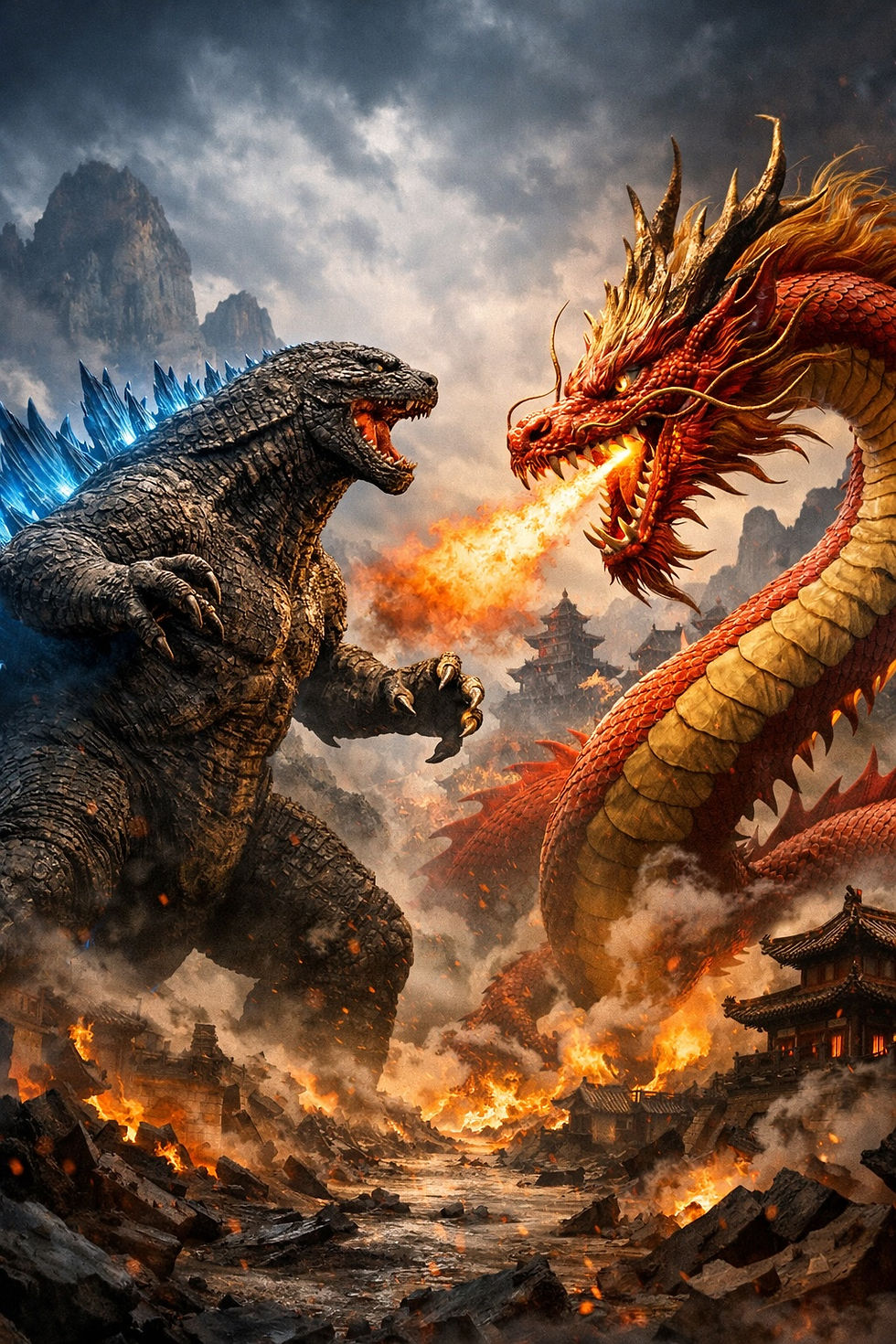
A MORE MILITANT JAPAN BRINGS BACK NIGHTMARES FOR CHINA
Japan’s Break with Postwar Restraint Is Strategic—and Historically Resonant
For most of the post-1945 era, Japan anchored its security posture in constitutional pacifism, U.S. alliance guarantees, and economic statecraft. That model rested on two assumptions: a stable U.S.-enforced order, and a China content to grow within it. Both have eroded.
Tokyo’s recent moves—expanded defense budgets, long-range strike capabilities, hardened bases in the Ryukyus, and explicit linkage between Japanese security and Taiwan—are not emotional or revanchist. They are deterrence restoration.
What is often missed is that these moves activate a deep and uncomfortable historical memory in Beijing—one that makes the easy “David vs. Goliath” analogy especially misleading.
China’s Military History with Japan: A Record of Defeat That Still Matters
China’s modern historical experience confronting Japan militarily has been disastrous, and that fact weighs heavily—if quietly—on PLA strategic culture.
During the Second Sino-Japanese War (1937–1945), a smaller, resource-poor island nation:
Shattered Chinese defensive lines
Seized major cities (Shanghai, Nanjing, Wuhan)
Exposed deep weaknesses in Chinese command, logistics, and coordination
Forced Chinese reliance on geography, attrition, and eventual Allied intervention rather than battlefield superiority
The enduring lesson for Chinese planners is not merely defeat, but how Japan won:
Superior organization and officer corps
Integrated naval, air, and ground operations
Rapid adaptation and decentralized command
Maritime and logistical competence despite numerical inferiority
That history is politically sensitive in Beijing—but institutionally remembered. Japan is not viewed inside Chinese military planning circles as just another regional actor. It is remembered as the last Asian power to decisively defeat China in a modern war.
Why China’s Conventional Record Reinforces This Anxiety
Post-1949 China has not erased that lesson through later success in conventional warfare. Its record remains mixed at best:
Korea ended in stalemate at immense cost
The 1962 war with India was limited and terrain-specific
The 1979 invasion of Vietnam exposed severe operational shortcomings
No large-scale modern peer conflict experience since
Where China has excelled is not traditional warfare, but:
Espionage and technology acquisition
Economic coercion and dependency creation
Lawfare and political influence operations
Incremental “gray-zone” pressure
Those tools work best against ambiguity and division. They work poorly against hardened maritime coalitions and explicit red lines—especially when Japan is involved.
Taiwan Changes the Equation—Japan Changes It Further
When Japan openly ties its security to Taiwan, it resurrects a scenario Beijing finds uniquely threatening:
A two-axis maritime problem (north and south)
Japanese control of critical chokepoints
World-class Japanese anti-submarine warfare and ISR
A technologically advanced adversary with historical credibility
This is not theoretical. Chinese military writings frequently describe Japan as “technologically dangerous”—often with more respect than is afforded to other regional actors.
A Taiwan contingency with Japan involved is not a repeat of gray-zone salami slicing. It is an unforgiving test of amphibious logistics, sea control, air superiority, and coalition warfare—domains where China’s confidence is least proven.
The Regional Shift: From Hedging to Conditional Balancing
Japan’s repositioning does not stand alone. Across Southeast Asia, resistance to “aggression through trade” is hardening:
Vietnam has strengthened its maritime posture and diversified security ties
Philippines has reopened U.S. basing access and pushed back against maritime harassment
Indonesia, Malaysia, and others are increasingly vocal on EEZ violations
Even within ASEAN, the center of gravity is shifting—from quiet accommodation to conditional balancing.
What these states reject is not Chinese trade, but trade as coercion: debt leverage, dual-use ports, political conditioning, and the erosion of sovereignty over time.
Bottom Line
Japan’s rearmament is not a prelude to war—it is the closing of a permissive window Beijing exploited for years.
China remains formidable in economic and informational domains. But when faced with explicit alignment, maritime coalitions, and a historically credible adversary, its conventional-warfare uncertainties resurface.
Publicly, Beijing dismisses Japan as a declining pacifist relic. Privately, Japan is remembered as something far more dangerous.
That memory absolutely plays in the back of Beijing’s mind—and it is one of the quiet reasons a more militant Japan makes Taiwan more defensible and the region more stable, not less.

The End of an Unbroken Line Forces Strategic Self-Awareness
The reign of Naruhito marks a quiet historical rupture. For the first time in over two millennia, Japan faces the plausible end—or at least interruption—of the world’s oldest continuous imperial line. This is not a tabloid issue inside Japan; it is a civilizational signal.
The Imperial House has long functioned less as a political institution and more as a symbol of temporal continuity—Japan as something that persists beyond governments, ideologies, or economic cycles. When that continuity is perceived as fragile, it forces a broader reckoning.
Inward Focus Requires an Intact Outer Shell
Japan’s postwar strategy was inward-looking by design:
Economic reconstruction
Social cohesion
Technological excellence
Cultural preservation
All of this rested on an implicit guarantee: the external environment would remain permissive—secured by U.S. power and regional stability.
That assumption no longer holds.
Your formulation captures it precisely:
If Japan wishes to continue to look inside, it must keep the outside protected.
This is not militarism; it is civilizational risk management.
Why the Imperial Question Matters Strategically
In Japanese strategic culture, the Emperor embodies:
Continuity across eras of upheaval
National identity divorced from ideology
The moral center of the state
When the imperial succession itself becomes uncertain, it sharpens awareness that no institution is self-preserving in a hostile environment—not even one as ancient as the Chrysanthemum Throne.
This creates a psychological alignment between:
Preserving tradition
Maintaining sovereignty
Deterring external coercion
Defense policy becomes not just about territory, but about time—ensuring Japan’s story continues uninterrupted.
A Regional Environment That Punishes Introspection
East Asia is currently defined by actors who exploit inwardness:
Economic entanglement as leverage
Political pressure applied below open conflict
Strategic patience designed to outlast domestic resolve
A Japan that remains purely introspective risks finding that decisions about its future—including its cultural and institutional continuity—are made elsewhere.
Rearmament, in this light, is not a rejection of postwar identity, but a guardrail around it.
The Quiet Shift in Japanese Thinking
What is happening now is not loud nationalism. It is something far more characteristically Japanese:
Long deliberation
Institutional consensus
Reluctant but decisive adaptation
The possible closing of the imperial line does not cause Japan’s strategic awakening—but it reinforces a truth Japanese elites understand intuitively:
Continuity requires protection.
In that sense, Japan’s turn outward—to defend sea lanes, deter aggression, and stabilize its periphery—is the necessary price of being able to remain inward, cohesive, and culturally whole.
It is not about becoming something new.It is about ensuring Japan remains itself.
If Miyamoto Musashi, author of The Book of Five Rings, were observing Japan’s current rearmament and its posture toward China, he would almost certainly approve—not as a nationalist, but as a strategist.
Musashi was hostile to complacency, illusion, and ritualized weakness. His lens was brutally practical.
Musashi’s Core Principle: Do Not Rely on the Enemy’s Restraint
One of Musashi’s central teachings is that defeat comes from mistaking custom for security.
In The Book of Five Rings, he warns repeatedly against:
Assuming the opponent will behave “properly”
Clinging to tradition when conditions have changed
Believing reputation or past victories substitute for readiness
Applied to modern Japan, Musashi would see postwar pacifism not as moral virtue, but as a stance that only works while the opponent permits it.
China, in Musashi’s terms, has been probing distance, testing timing, and seeking advantage without striking—classic pre-contact strategy.
Musashi would say:
When the enemy sharpens his blade while you admire the scabbard, the outcome is already decided.
Timing and Initiative: Japan Is Acting Late—but Not Too Late
Musashi places extraordinary emphasis on initiative (sen):
Go first when the moment is ripe
If late, strike decisively and change the rhythm
Japan’s rearmament is late by Musashi’s standards—but crucially, it is before contact, not after defeat.
Musashi would recognize Japan’s shift as:
Reclaiming initiative
Breaking the enemy’s expectation of passivity
Forcing China to recalculate tempo and distance
In Fire, he writes that victory comes from disrupting the opponent’s rhythm before the clash. Japan’s clearer stance on Taiwan and regional defense does exactly that.
Musashi on China’s Strengths: “Skill Without Combat Is Not Proof”
Musashi distrusted reputations built without decisive contests.
China’s modern strength—numbers, missiles, industrial scale—would not impress him on its own. He would ask:
Has this force been tested under pressure?
Has it faced an opponent who does not retreat?
Has it fought when surprise fails?
Musashi famously defeated larger, better-equipped opponents by:
Forcing them into unfamiliar ground
Attacking rhythm and morale, not mass
Exploiting overconfidence
He would see China’s reliance on coercion without collision as a sign of strategic caution, not inevitability.
On Alliances: Musashi Would Approve—If They Are Real
Contrary to romantic myth, Musashi was not opposed to cooperation. He opposed false security.
He would judge Japan’s alliances (especially with the U.S. and regional partners) by one metric only:
Will they fight when steel meets steel?
A Japan that arms itself independently, integrates allies, and prepares for worst-case outcomes would meet Musashi’s standard.
A Japan that outsourced its survival entirely would not.
Musashi’s Likely Verdict
Stripped of modern politics, Musashi would likely say something like this:
“To know the Way, you must see things as they are.A house that wishes to remain quiet must first secure its gate.Those who prepare without hatred endure.Those who trust in words are already cut.”
Japan’s rearmament, in Musashi’s framework, is not aggression.It is clarity.
It signals:
Awareness of changing ground
Acceptance that continuity requires force
Refusal to be surprised at the moment of decision
Musashi would not call this warmongering.
He would call it walking the Way with open eyes.


Comments