
Another Legal Blackeye for Philadelphia: Placards Back Up — But Columbus and Rizzo Still Out
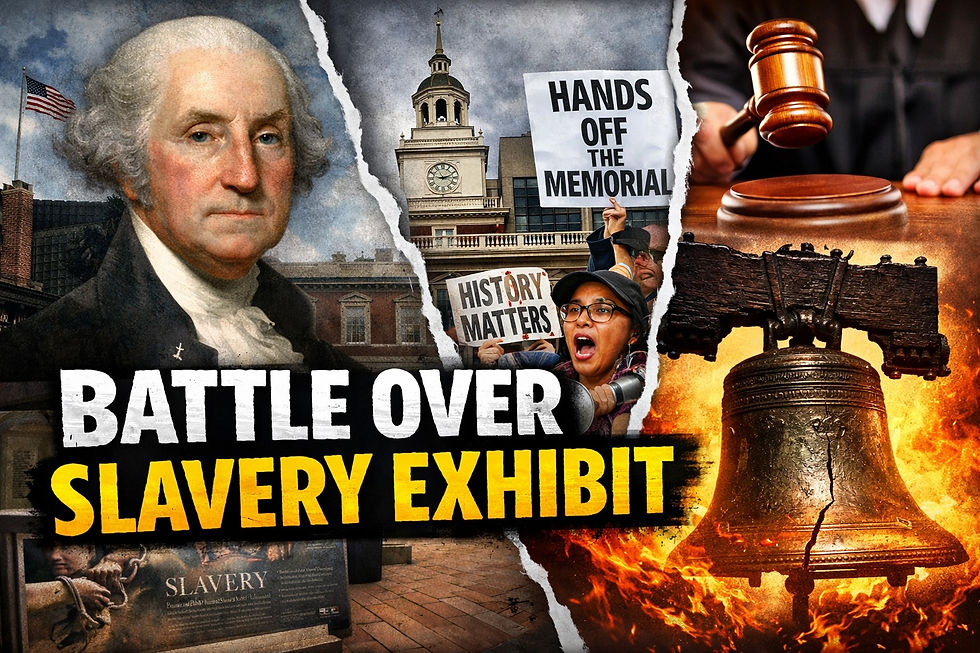
A recent federal court ruling ordering the restoration of historical materials at Independence National Historical Park has reignited a familiar debate in Philadelphia: why some historical interpretations receive strong legal protection while others — including high-profile statues like Christopher Columbus and former Mayor Frank Rizzo — proved relatively easy to remove.
For Philadelphia-area residents, the decision highlights deeper questions about historical interpretation, government authority, and the different legal rules that apply depending on who controls public property. The case also raises questions about judicial framing, potential bias, and the broader political tensions surrounding how governments present history.
Here is what happened, what the judge decided, and why the outcomes differ.
The Federal Ruling: Slavery Exhibit Must Be Restored
In February 2026, U.S. District Judge Cynthia M. Rufe ruled that the National Park Service likely acted unlawfully when it removed or altered portions of an exhibit at the President’s House site near Independence Hall. The dispute focused on interpretive materials discussing George Washington’s enslaved household and the role of slavery at the site.
The court ordered the federal government to restore the installation and temporarily blocked further changes while the case proceeds.
Judge Rufe concluded that federal agencies cannot change historical interpretation arbitrarily at congressionally designated historic sites. She found that the National Park Service likely violated administrative law by altering the installation without adequate justification and emphasized that cooperative agreements between the federal government and the City of Philadelphia limited the agency’s authority to make unilateral changes. The opinion also stressed that the site’s legal mission requires full historical context, including the presentation of slavery as part of the nation’s founding story.
The judge framed the dispute in strong terms, arguing that the government does not have the authority to dismantle or reshape established historical interpretation at national historic sites. Her ruling emphasized that preservation statutes and prior agreements bind federal agencies and restrict their discretion when managing historically designated locations.
For Philadelphia officials, the decision represents a legal victory protecting the city’s role in shaping how national history is presented at Independence National Historical Park. For critics, however, the ruling raises questions about judicial neutrality and consistency.
Questions Raised About Judicial Framing
Observers noted that the opinion used unusually forceful language for a preliminary ruling. Judge Rufe opened her decision with references to George Orwell’s 1984 and the concept of government manipulation of truth. Critics argue that this framing suggests the court assumed ideological motives behind federal actions before a full trial.
Some legal commentators also pointed to the decision’s moral tone, which emphasized the protection of historical truth rather than focusing strictly on procedural or statutory violations. Others questioned whether courts should define what constitutes proper historical interpretation, an area traditionally associated with academic scholarship and policy decisions rather than judicial oversight.
Supporters of the ruling counter that the judge was simply enforcing federal preservation law and holding the government accountable to its statutory obligations. They argue that strong language reflects the seriousness of the alleged violations rather than political preference.
The issue of judicial framing and potential bias may become more prominent if the decision is appealed.
Why Columbus and Rizzo Were Much Easier to Remove
The federal ruling stands in sharp contrast to Philadelphia’s own recent actions involving controversial monuments. The city removed the statue of Christopher Columbus in Marconi Plaza and permanently removed the statue of former Mayor Frank Rizzo from outside the Municipal Services Building in 2020. Legal challenges to those removals were largely unsuccessful.
The reason those cases produced different outcomes lies primarily in who owned the property and what legal rules applied.
The President’s House installation is located on federal land and governed by federal statutes passed by Congress. It is also subject to preservation mandates and cooperative agreements that define how the site must be interpreted and maintained. Federal agencies managing such locations must follow administrative procedures and demonstrate legal authority before making significant changes.
By contrast, the Columbus and Rizzo statues stood on municipal property controlled by the City of Philadelphia. Local governments traditionally have broad authority to manage public spaces, monuments, and civic symbols. Courts generally treat decisions about city monuments as policy choices unless state law, contractual obligations, or specific preservation rules restrict removal. Pennsylvania law provides relatively few barriers to municipal monument removal compared with some states that have strong statutory protections for historical memorials.
In practical terms, the federal government faced legal constraints in the President’s House case that the city did not face when removing its own statues.
Different Governments, Different Rules
The situation illustrates a central feature of American federalism: different levels of government operate under different legal frameworks. Federal agencies must comply with detailed statutory requirements and administrative procedures established by Congress. Cities, on the other hand, typically exercise broad discretion over local public property unless higher law limits their authority.
Courts evaluate each government actor according to the specific legal obligations that apply to it. They do not require consistency in policy choices across federal, state, and municipal governments. The central legal question is not whether two governments acted similarly, but whether each acted within its own authority.
The Political and Philosophical Tension
Despite the legal distinctions, the situation creates an obvious tension that critics frequently highlight. Philadelphia successfully argued in federal court that government should not alter established historical interpretation at a national site. Some observers contend that this principle could also apply to decisions removing monuments that represent other aspects of history.
Supporters of the city’s position respond that the President’s House case involves binding federal agreements and statutory obligations, while city monument decisions fall within ordinary municipal authority. The debate reflects broader national disagreements over who controls historical interpretation, how governments present the past, and whether historical narratives should be fixed by law or remain subject to changing public values.
What Happens Next
The federal government may appeal Judge Rufe’s ruling, which could clarify the limits of executive authority over historical interpretation at national sites. If higher courts uphold the decision, it could make future changes to federally managed historical installations more difficult and invite additional litigation over how American history is presented.
Meanwhile, the Columbus and Rizzo statues remain removed, underscoring how different legal rules can produce very different outcomes within the same city.
Bottom Line for Philadelphia Residents
Philadelphia now finds itself in a complex position. The city successfully challenged federal changes to a historic installation while its own monument removals remain intact. The difference reflects legal authority more than historical philosophy, but the contrast has intensified public debate.
The episode highlights the growing role courts play in disputes over historical interpretation and public memory. It also ensures that debates over civic identity, government authority, and the presentation of history will continue to shape Philadelphia’s public landscape for years to come.
(ED. NOTE: I know that most activists prefer to stay with "sexy" protests like the one above. It allows them to do zero research and keeps in their "keep the mindset at slavery" viewpoint of race relations so here are a few events that happened in Philadelphia that were worth a series of plaques.)
1. Founding of the Institute for Colored Youth (1837) — Early Black Higher Education
4
The Institute for Colored Youth was founded in Philadelphia to provide advanced education for African Americans at a time when most schools excluded them.
It offered:
classical education
teacher training
science and mathematics instruction
leadership development
Notable figures included Fanny Jackson Coppin (first Black woman principal of a U.S. school) and Octavius Catto.
The institution later became Cheyney University of Pennsylvania, the oldest historically Black college in the United States.
Why it matters:It reflected a belief that education and professional excellence were the path to racial advancement.
2. The Banneker Institute (1854) — Black Intellectual Development Society
4
The Banneker Institute was a literary and scientific society for young Black men focused on:
debate and public speaking
scientific study
intellectual self-improvement
moral discipline
leadership training
Members included Octavius Catto and other future civic leaders.
Why it matters:It promoted disciplined education and intellectual achievement as tools for racial progress decades before the civil rights movement.
3. Berean Institute (1888) — Industrial Training and Economic Self-Reliance
4
Founded by Rev. Matthew Anderson, the Berean Institute provided:
vocational training
business skills
industrial education
job preparation
adult education
Its mission emphasized economic independence and self-sufficiency.
Why it matters:It represented the late-19th-century “economic uplift” movement focused on skills and entrepreneurship.
4. The Christian Street YMCA (1889) — Physical, Moral, and Social Development
4
The Christian Street YMCA became a major center for:
physical fitness
moral instruction
leadership development
job training
youth mentoring
It also hosted lectures, classes, and community programs.
Why it matters:It embodied the belief that personal discipline and character building strengthened the community.
5. The Philadelphia Pythians Baseball Club (1856) — Organized Excellence and Respectability
4
The Philadelphia Pythians, organized by Octavius Catto, was one of the first Black baseball clubs in America.
The team aimed to demonstrate:
discipline
professionalism
organizational skill
racial equality through achievement
They even petitioned white baseball leagues for inclusion.
Why it matters:Sports were used as a strategy of respectability and racial advancement.
6. Free African Society Mutual Aid Model (Late 1700s–1800s Expansion)
4
Beyond its founding, the Free African Society pioneered:
savings systems
burial insurance
education funds
social discipline codes
economic cooperation
Its model influenced Black mutual aid societies nationwide.
Why it matters:It built financial stability and community self-governance.
7. Black Cooperative Business and Banking Efforts (Early 1900s)
Philadelphia saw numerous early Black business initiatives, including:
cooperative stores
Black insurance associations
savings organizations
professional networks
These efforts aimed to create independent economic infrastructure during segregation.
Why it matters:Economic independence was seen as essential to racial advancement.


Comments