
THE US's GREENLAND SECRET. OPERATION: ICEWORM & CAMP CENTURY
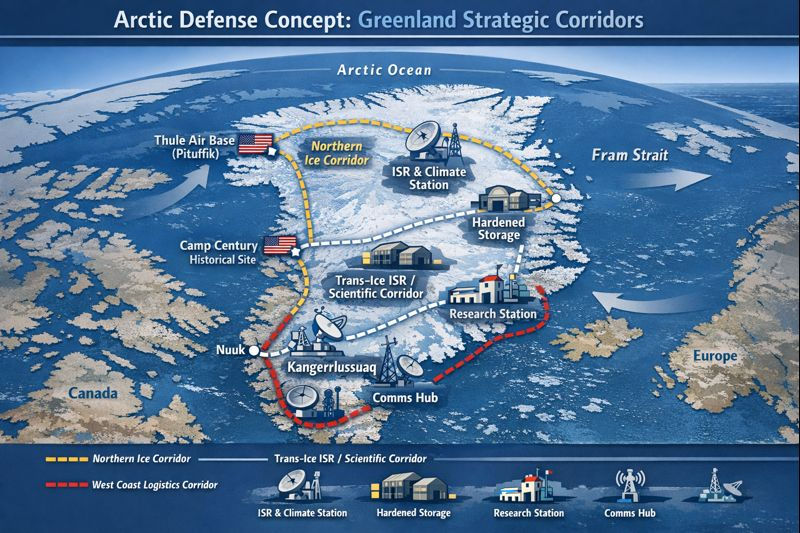
Project Iceworm and Camp Century in 1950s Greenland
Project Iceworm was a secret U.S. Cold War initiative in the late 1950s to build a network of nuclear missile launch sites under the Greenland ice cap. The plan centered on Camp Century, an underground base dug into northwestern Greenland’s ice sheet. Publicly, Camp Century was billed as a scientific research outpost, but behind the scenes it was part of an audacious military project to conceal nuclear missiles within the ice. Below we examine who originated this project, its true purpose, the scale of Camp Century’s footprint, and the legal agreements with Denmark that made it possible.
Origins and Purpose of Project Iceworm
Project Iceworm’s originators were primarily the U.S. Army leadership, driven by inter-service competition and strategic necessity during the Cold War. In the mid-1950s, President Eisenhower’s “New Look” defense policy had reallocated budgets heavily toward the Air Force’s strategic bombers and missiles, leaving the Army with the smallest share (about 22%). Determined to remain relevant, Army brass sought a role in the nuclear deterrent and proposed deploying mobile nuclear missiles on the ground. They identified the remote Greenland icecap as ideal for this purpose – sparsely monitored and within striking distance of the Soviet Union. Notably, a Norwegian-born U.S. Army Colonel, Bernt Balchen, had earlier championed Greenland’s strategic value; Balchen (a pioneer of polar aviation) suggested as early as the 1930s that the Arctic could serve as a military frontier. His ideas helped inspire the concept of a hidden “city under the ice” from which nuclear strikes could be launched.
The purpose of Project Iceworm was kept top-secret. Officially, Camp Century (established in 1959) was described as a “nuclear-powered Arctic research center” where U.S. personnel would test construction techniques in polar conditions and perform scientific studies. Indeed, the base did host genuine scientific work – for example, Army scientists drilled the first deep ice cores at Camp Century to study past climate, a contribution still cited by researchers today. However, this was a cover story. In reality, Camp Century was a pilot site to assess the feasibility of an enormous subterranean missile complex. Project Iceworm envisioned hundreds of nuclear missiles shuttling along a vast grid of tunnels beneath the ice, aimed at the USSR. Pentagon planners imagined deploying up to 600 nuclear-tipped “Iceman” missiles (a variant of the Minuteman ICBM) that would be constantly moved between 2,100 concealed launch sites – a “shell game” strategy to keep the Soviet Union guessing. This sprawling scheme would span approximately 52,000 square miles of northern Greenland (about three times the size of Denmark) in a lattice of tunnels and missile silos. In short, the Army’s true aim was to build a secretly armed nuclear city under the ice, beyond the prying eyes of adversaries and even unknown to most allies. The cover purpose of scientific exploration was used to avoid alarm – especially since Denmark (which owned Greenland) had officially declared it would not allow nuclear weapons on its territory in 1957.
Camp Century: Construction and Footprint of the Underground Base
To test and advance Project Iceworm, the U.S. Army Corps of Engineers built Camp Century deep in the Greenland ice sheet. Site scouting took place in spring 1959, led by Army engineers like Col. John Kerkering and Capt. Thomas Evans. They selected a flat, stable stretch of ice about 150 miles east of Thule Air Base in northwestern Greenland – far inland from the coast and well beyond existing military installations. Starting in 1959, hundreds of Army engineers and personnel hauled heavy equipment across the ice and excavated Camp Century between 1959 and 1961. Rather than digging an open pit, they bored tunnels into the ice, then reinforced them. By the time it was fully operational, Camp Century consisted of a network of 21 under-ice tunnels with a total length of about 9,800 feet (3 km), all buried roughly 8 meters below the surface of the ice cap.
Despite its hidden nature, Camp Century was essentially a small subterranean city. The base was remarkably powered by the world’s first mobile nuclear reactor, a portable PM-2A reactor, which supplied electricity and heat in the extreme Arctic conditions. Inside the covered snow tunnels, the Army built prefabricated wood-and-metal structures to serve as facilities. Camp Century boasted accommodations for around 200 personnel, including dormitories, a mess hall and kitchen, a communications center, plus recreational and social amenities. There were laboratories and workshops for research, a hospital infirmary, a chapel, a barber shop, and even leisure areas like a gym and a movie theatre – all connected by the snow tunnels under the ice. The only parts visible on the surface were a few access hatches and ventilation shafts poking through the snow. In essence, the U.S. Army had constructed a fully functional “city under the ice” in Greenland’s interior. This camp’s footprint was modest compared to the vast Iceworm plan – Camp Century itself covered only a small area of the ice sheet (its tunnels spanned a few kilometers). It was, however, a proof-of-concept for the far larger subterranean network envisioned. Camp Century operated successfully for several years: it was manned year-round and demonstrated that soldiers could live and work beneath the ice cap through all seasons. By 1962, the secret Project Iceworm plan had been formally presented to the U.S. Joint Chiefs of Staff, using Camp Century’s results to argue that a larger under-ice base was technically achievable.
Ultimately, Camp Century was abandoned in 1967, without any missiles ever being installed. The engineering challenges proved too great – the glacier ice was not as stable as hoped and continually shifted, causing tunnels to deform and making a large-scale missile network unworkable. Additionally, technological advances (like submarine-launched ballistic missiles) and inter-service politics reduced the Pentagon’s enthusiasm by the mid-1960s. The nuclear reactor was removed in 1964 due to technical issues, and the camp was closed a few years later. Camp Century and its frozen infrastructure (along with tons of chemical, biological, and low-level radioactive waste) were entombed in the ice – the planners assumed perpetual snowfall would keep the site buried forever. (Only decades later has climate change raised concerns that the melting ice sheet may eventually expose these old wastes.)
Legal Agreements and U.S.-Denmark Treaty Issues
Greenland in the 1950s was a Danish territory, so the United States needed legal permission to build and operate any military base there. A broad U.S.-Denmark defense agreement signed in 1951 provided the general framework for American military activities in Greenland. This treaty (often called the 1951 Greenland Defense Agreement) reaffirmed Denmark’s sovereignty over Greenland but allowed the U.S. to maintain defense installations in specified zones of the island. For example, it granted U.S. use of Thule Air Base (Pituffik) in the far north. Crucially, the agreement stipulated that any U.S. military or research activities outside the agreed base areas required prior Danish approval.
Because Camp Century’s site was outside the existing Thule Air Base area (about 150 miles away on the ice sheet), the U.S. theoretically needed to get Denmark’s consent to build it. Initially, American officials approached Denmark informally in 1959 about the plan to set up an ice-cap research camp, but Denmark was hesitant and fearful of provoking the Soviet Union, so the request was not approved at first. The U.S. Army, however, proceeded largely in secret. In August 1959, the American ambassador in Copenhagen casually informed the Danish Foreign Minister – at a cocktail party – that Camp Century’s construction was already underway on the ice. This diplomatic blindsiding caused consternation in Denmark; government ministers held emergency meetings but ultimately realized they had little practical means to stop the project. Denmark was a small country and relied on the U.S. for NATO defense; in effect, the Americans had de facto free rein in Greenland’s far reaches, which Denmark reluctantly had to accept.
In the end, no separate public treaty was ever signed specifically for Camp Century – the base was ostensibly covered under the umbrella of the 1951 agreement, now with quiet Danish acquiescence. Danish officials allowed Camp Century to continue, but they insisted on strict secrecy and a media blackout to avoid domestic political backlash. At Denmark’s urging, the project was portrayed as an entirely non-military scientific endeavor. The Danish government censored news about Camp Century, ensuring press reports emphasized polar research and omitted any suggestion of U.S. military expansion. They even restricted access: journalists who visited the camp were closely managed, and Danish authorities forbade any contact between American personnel and local Inuit residents. This information control was partly successful – to the public, Camp Century appeared to be just a remarkable engineering and scientific outpost. (Unbeknownst to Denmark, the U.S. did all this while concealing the true aim of Project Iceworm. In fact, only the Danish Prime Minister himself was secretly informed that the U.S. had some nuclear-related intentions in Greenland; the full plan for under-ice missiles was not revealed to the broader Danish Parliament until documents came to light in the 1990s.)
It’s important to note that Denmark’s official policy prohibited nuclear weapons on Danish territory, a stance adopted in 1957 and explicitly including Greenland. Thus, even though Denmark permitted the Camp Century project, it was never told about any deployment of nuclear warheads or missiles there. The U.S. never formally sought Danish consent to stockpile or launch nuclear weapons from Greenland, and indeed no missiles were ever actually installed at Camp Century before it closed. The legal understanding between the two countries was essentially that Camp Century was a research base under the defense agreement – any offensive nuclear use would have violated Denmark’s non-nuclear policy.
In summary, Project Iceworm was a bold U.S. Army plan to exploit Greenland’s ice for strategic advantage, and Camp Century was its tangible embodiment – a nuclear-powered under-ice base built to prove the concept. The project’s origin lay with Army innovators responding to Cold War pressures and budget competition, and its purpose (though cloaked in science) was to establish a secret nuclear missile platform. Camp Century’s physical footprint was relatively small – a hidden camp of about 3 km of tunnels for 200 men – but it was meant to prototype a far larger subterranean network covering tens of thousands of square miles. Legally, the camp operated under the 1951 U.S.-Denmark treaty that allowed American bases in Greenland, albeit with Denmark kept only marginally in the loop. The “city under the ice” ultimately proved unworkable due to shifting glaciers and political constraints, but it remains a fascinating chapter of Cold War history – one that underscores the extreme lengths to which the superpowers would go, even digging into the ice, in the quest for strategic superiority.
Sources
Eric Niiler, "When the Pentagon Dug Ice Tunnels in Greenland to Hide Nukes," History.com, Jan 9, 2026.
George Bass, “The U.S. Army Tried to Build a Secret Nuclear City under Greenland’s Ice,” Washington Post (via Bunk History), Nov 13, 2023.
Kristian H. Nielsen et al., ScienceNordic: “Denmark’s Cold War struggle for scientific control of Greenland,” 2016.
William Colgan et al., Greenland’s receding icecap to expose top-secret US nuclear project, The Guardian, 27 Sept 2016.
Camp Century – Wikipedia (summary of declassified documents and camp specifications).


Comments