
The Shortest Way to Iran Is Through Cuba?Getting to Know UANI—and Why Cuba Suddenly Matters
"The purpose of this article is not to assign hidden motives, but to examine publicly available facts, identify emerging patterns, and ask whether a significant shift in UANI's public messaging reflects a broader strategic objective."
Introduction
Former Florida Governor Jeb Bush recently appeared on national television holding a model of an Iranian Shahed-136 drone while warning that press reports suggested hundreds of similar drones could be present in Cuba. The image was unmistakable. An Iranian weapon was no longer being discussed as a threat confined to the Persian Gulf; it was being presented as a potential danger only ninety miles from the United States.
Whether the reported number ultimately proves accurate is not the central question.
The more important question is why United Against Nuclear Iran (UANI)—an organization created specifically to counter the Iranian regime—has now inserted itself into the debate over Cuba.
UANI has inserted itself into the Cuba debate by presenting an Iran-focused security narrative. The public deserves to understand who UANI is, who leads it, what its mission is, and why it may have strategic reasons for broadening its focus from Iran to Cuba.
Who Is UANI?
Founded in 2008, United Against Nuclear Iran describes itself as a nonprofit organization dedicated to preventing Iran from acquiring nuclear weapons while countering Tehran's regional military activities, sanctions evasion and support for terrorism.¹
Unlike a traditional think tank, UANI combines policy advocacy with open-source intelligence collection. It monitors Iranian oil exports, tracks suspected sanctions-evasion shipping networks, identifies vessels believed to be involved in Iranian petroleum exports, and publicly pressures corporations to cease doing business with Iran.
Its tanker-tracking program has become one of its most visible activities. Through publicly available maritime data, vessel histories and commercial intelligence sources, UANI attempts to identify ships participating in what it describes as Iran's "ghost fleet."
While UANI possesses no governmental authority, organizations of this type can significantly influence commercial behavior. Banks, insurers, shipping companies, regulators and governments frequently review publicly available sanctions analyses when assessing risk.
That makes UANI an important participant in the broader sanctions ecosystem.
The Bush Connection
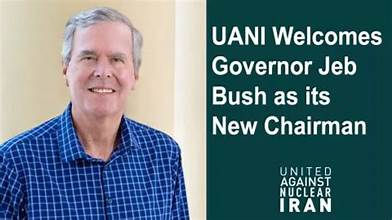
Jeb Bush currently serves as Chairman of UANI.
That distinction matters.
When Bush discusses Iranian activities, he is not speaking solely as a former governor. He is speaking on behalf of an organization whose stated mission is to increase pressure on the Iranian regime.
Bush also occupies a unique political position.
As a former governor of Florida, he possesses longstanding relationships within Florida's Cuban-American community, Republican foreign-policy circles and national-security networks.
When he recently shifted from discussing Iran to warning about alleged Iranian drones in Cuba, he effectively connected two separate foreign-policy debates into one national-security narrative.
That transition deserves closer examination.
Why Cuba?
Until recently, UANI's public mission was overwhelmingly centered upon Iran.
Now Cuba has entered the discussion.
The obvious explanation is concern over potential Iranian military activity in the Western Hemisphere.
But another question naturally follows:
Why has an organization focused on Iran concluded that developments in Cuba now fall within its public mission?
That question is entirely legitimate.
Organizations generally expand their public focus because they believe doing so advances their institutional objectives.
Iran—or Cuba?
The alleged drone deployment creates a powerful image.
Iranian drones.
Cuba.
Ninety miles from Florida.
Whether the reported inventory ultimately proves accurate, incomplete or exaggerated, the political effect is immediate.
Iran is no longer portrayed as simply a Middle Eastern problem.
Cuba is no longer portrayed simply as an isolated communist state.
Instead, the two become part of a single strategic narrative.
That framing may significantly influence public opinion regardless of how many drones are actually present.
A Seat at the Table
Political transitions create opportunities—not only for the people seeking freedom—but also for governments, financial institutions, investors and policy organizations hoping to shape what comes next.
If Cuba eventually experiences significant political change, enormous questions immediately arise.
Who governs during the transition?
How are Communist Party institutions dismantled—or preserved?
How are military and intelligence services restructured?
Who finances reconstruction?
Who determines sanctions relief?
Who gains access to Cuban ports, telecommunications, tourism, banking and infrastructure?
These questions involve far more than ideology.
They involve political influence, commercial opportunity and long-term strategic positioning.
By broadening its public mission to include Cuba through an Iranian security narrative, UANI potentially establishes itself as an organization with relevant expertise during any future debate over Cuba's transition.
Whether that ultimately occurs remains to be seen.
But the possibility deserves public attention.
The China Dimension
Iran may be the most visible component of the current discussion.
China may be the more significant long-term issue.
Recent reporting and satellite analysis have renewed attention on suspected Chinese intelligence-related facilities operating in Cuba.²
Unlike drones—which, if present, could theoretically be located and destroyed—signals-intelligence facilities represent an enduring strategic capability.
Any future Cuban political transition would inevitably raise questions concerning Chinese, Russian and Iranian military and intelligence access to the island.
Those issues extend well beyond Iran.
Following Incentives
This article does not argue that UANI secretly directs American foreign policy.
Nor does it suggest that Jeb Bush's warning is necessarily incorrect.
Instead, it asks several questions that deserve public consideration.
Why has UANI expanded its public messaging to include Cuba?
Who first originated the reported drone numbers?
Has that reporting been independently verified?
Does UANI simply seek removal of alleged Iranian military assets?
Or does it envision broader political conditions for Cuba's eventual reintegration into the international system?
These are not conspiracy theories.
They are ordinary questions about institutional interests, political influence and strategic communication.
Freedom—and Independence
Most Americans support the idea of a free Cuba.
So do many Cubans.
But political freedom alone does not determine the future of a nation.
Every major political transition produces new alliances, new financial relationships and new centers of influence.
The challenge is ensuring that genuine Cuban sovereignty accompanies political liberty.
Replacing one dependency with another would not fully realize the aspirations of the Cuban people.
That principle deserves careful consideration regardless of one's views toward the current government.
Conclusion
Perhaps UANI is simply responding to a legitimate security concern.
If so, its warning deserves serious attention.
But influential organizations rarely devote significant political capital to issues outside their original mission without believing those issues have broader strategic importance.
That reality makes UANI's sudden interest in Cuba worthy of examination.
Understanding who is shaping public narratives is not an exercise in cynicism.
It is an essential part of democratic oversight.
If Cuba stands on the threshold of historic political change, Americans—and Cubans—deserve to understand not only who seeks that change, but also who hopes to shape what follows.
Endnotes
United Against Nuclear Iran, "About UANI" and organizational mission statements.
Center for Strategic and International Studies (CSIS), analyses of suspected Chinese intelligence-related facilities in Cuba; Reuters reporting on related satellite imagery and U.S. assessments.
Fox News interview with Jeb Bush discussing alleged Iranian Shahed drones in Cuba and his remarks as Chairman of UANI.
United Against Nuclear Iran, "Iran's Oil Exports and Shipping Activities," describing its tanker-tracking initiative and sanctions-monitoring activities.
Publicly available IRS Form 990 filings and organizational financial disclosures regarding UANI's nonprofit status and operations.
Source Appendix
Primary Sources
United Against Nuclear Iran (UANI)
Organizational mission
Leadership
Tanker Tracker
Iran sanctions initiatives
Fox News interview with Jeb Bush regarding alleged Iranian drones in Cuba.
Government & Research
Center for Strategic and International Studies (CSIS)
Analysis of suspected Chinese intelligence-related facilities in Cuba.
Supporting Reporting
Reuters reporting concerning Chinese-related facilities in Cuba and U.S. intelligence assessments.
Public nonprofit filings concerning UANI's organizational structure and finances.
Editorial Note
This article distinguishes between documented facts and analytical observations. Factual statements are drawn from publicly available sources. Analytical sections are offered to encourage public discussion regarding institutional incentives, strategic messaging and policy development. They should not be interpreted as evidence of undisclosed agreements or coordinated activity absent additional corroborating evidence.


Comments